Business Process Management (BPM): What IT Leaders Actually Need to Know
Business process management (BPM) is a disciplined approach to designing, automating, monitoring, and optimizing repeatable business workflows. From invoice approvals to employee onboarding, BPM helps organizations eliminate bottlenecks, reduce manual errors, and drive operational efficiency at scale. This guide covers BPM types, the BPM lifecycle, real-world examples, common implementation pitfalls, and how low-code platforms are reshaping process management for enterprise teams.
What BPM actually is
Business process management is the practice of designing, executing, monitoring, and continuously improving the structured activities that turn inputs into outcomes across an organization. Think of it as the operating system for how work actually gets done, not in theory, but in the messy reality of approvals that stall, handoffs that drop, and workarounds that everyone knows about but nobody documents.
At its core, business process management sits at the intersection of strategy and execution. It gives leaders the visibility to see where value is created and where it leaks. It gives teams the structure to move faster without cutting corners. And increasingly, it gives organizations the foundation they need to deploy intelligent automation and make it stick. According to a 2025 McKinsey survey, the redesign of workflows is the single biggest factor in whether organizations see real EBIT impact from their technology investments.
What separates BPM from casual process improvement is discipline. BPM does not just map a workflow once and walk away. It creates a living, measurable system where processes are analyzed, redesigned, automated, and optimized in repeating cycles. The goal is not perfection on day one. The goal is a process management capability that compounds over time, making the organization smarter with every iteration.
A common misconception is that BPM is just software. It is not. Business process management is a management discipline first and a technology category second. The software is important, but without clear process ownership, executive sponsorship, and a culture that values continuous improvement, even the best business process management platform will collect dust. That said, the right business process management solutions can dramatically accelerate what would otherwise take years of manual effort.
 Kissflow Round Table series
See Kissflow in Action
Take a guided tour of Kissflow to build apps and automate workflows.
How BPM works
Understanding what business process management is matters less than understanding how it works in practice. At a functional level, BPM operates as a continuous loop that turns chaotic, ad-hoc work into structured, measurable, and improvable operations.
The mechanics are straightforward. First, you identify a process that matters: one that is repeated frequently, involves multiple people or systems, and has a measurable impact on business outcomes. Then you document how it actually works today, not how the policy manual says it should work. This distinction is critical because the gap between documented processes and actual behavior is where most organizations hemorrhage time and money.
Next, you redesign the process to eliminate waste, reduce handoffs, and automate wherever possible. A business process management platform provides the tools to model this redesign visually, configure the automation rules, and connect the process to your existing systems. Once live, the platform executes the process automatically, routing tasks, enforcing business rules, triggering notifications, and capturing data at every step. According to McKinsey, organizations that successfully implement process automation can boost productivity by up to 30% within a few years.
What makes BPM different from a one-time improvement project is the feedback loop. The data captured during execution feeds back into analysis, which drives the next round of optimization. Every cycle makes the process a little faster, a little cheaper, or a little more reliable. Over months and years, this compound effect is what separates organizations that merely automate tasks from those that build a genuine operational advantage.
In practical terms, BPM works across three layers simultaneously. The strategic layer aligns processes with business objectives and prioritizes which processes to improve first. The operational layer handles the day-to-day execution, monitoring, and exception management. And the technology layer, the business process management development platform, provides the infrastructure that connects the other two layers and makes the whole system scalable.
The BPM market reality check
The business process management market is no longer a niche category tucked into IT budgets. It has become a strategic investment category that C-suite leaders are paying close attention to, and the numbers reflect that shift.
The global BPM market was valued at $17.78 billion in 2024. By 2032, it is projected to reach $70.93 billion, growing at a CAGR of 18.6%. That is not incremental growth. That is a market that is roughly quadrupling in under a decade.
Several forces are driving this expansion:
Cloud BPM is becoming the default deployment model. Cloud-based business process management solutions are expected to capture 51.2% of market share in 2025, with the segment growing at a projected CAGR of 23.2%. The advantages are straightforward: lower upfront investment, faster deployment, and the flexibility to scale without rearchitecting infrastructure.
The SME segment is surging. Small and medium enterprises are expected to account for 51.4% of total market share in 2025. Cost-effective cloud BPM, combined with low-code platforms that compress implementation timelines, is making enterprise-grade process management accessible to organizations that were priced out just five years ago.
The U.S. market alone is projected to reach $5.93 billion in 2025. North America continues to dominate with over 41% of global revenue share, driven by demand across BFSI, healthcare, and IT verticals where operational efficiency is not optional.
The takeaway for enterprise leaders is clear: business process management is no longer a back-office function. It is a strategic capability that directly impacts competitive positioning.
BPM vs BPMN: Understanding the difference
These two acronyms get mixed up constantly, and the confusion creates real problems during implementation.
BPM (business process management) is the discipline. It encompasses the entire practice of analyzing, designing, executing, monitoring, and improving business processes. It includes the people, the governance, the technology, and the strategic intent behind process improvement.
BPMN (Business Process Model and Notation) is the language. Specifically, it is a standardized graphical notation developed by the Object Management Group (OMG) that provides a common visual vocabulary for representing business processes in diagrams. Think of BPMN as the blueprint language that architects and engineers both understand.
Here is a practical way to think about the difference: BPM is the strategy for running a restaurant well. BPMN is the recipe card format that everyone in the kitchen can read.
You can practice BPM without using BPMN, though it is harder to scale. And you can draw BPMN diagrams without practicing BPM, though those diagrams will likely sit in a drawer. The most mature organizations use BPMN as part of their broader business process management practice, creating executable process models that connect directly to their automation platforms.
For C-suite leaders, the key insight is this: do not let BPMN complexity become a barrier to getting started with BPM. Modern business process management solutions increasingly abstract away the notation layer, allowing business users to design processes visually without needing to learn the full BPMN specification.
BPA vs BPM vs workflow: What you actually need
If you have spent any time evaluating business process management solutions, you have encountered three terms used almost interchangeably: BPA, BPM, and workflow automation. They are related, but they solve different problems at different levels of maturity. Understanding the distinctions will save your organization from buying the wrong tool for the wrong job.
Workflow automation
Workflow automation is the most granular of the three. It handles the execution of a defined sequence of tasks: route this form to that approver, send this notification when a condition is met, move this record from one status to another. Workflow automation is tactical, focused, and relatively easy to implement. If your problem is a single broken process, like expense approvals or leave requests, workflow automation may be all you need.
If workflow automation is the specific piece you\'re evaluating, the complete workflow automation guide covers the full scope definition, benefits, use cases, and the five-step build process in one place.
BPA (Business process automation)
Business process automation takes workflow automation a step further by applying automation across multiple processes and often connecting them to each other. BPA focuses on reducing manual effort at scale, typically involving integration between systems (connecting your CRM to your ERP, for example) and automating end-to-end processes that span multiple departments. BPA is about doing things faster. It asks: what manual work can technology take over?
Turn Process Complexity Into Your Competitive Edge
Eliminate bottlenecks, cut manual effort, and transform operations into streamlined, scalable workflows.

Thank you downloading
BPM (Business process management)
BPM is the broadest of the three. It includes automation, but it also encompasses process discovery, design, governance, monitoring, and continuous improvement. BPM asks not just how to automate what exists, but whether the existing process is even the right one. It is a management discipline, not just a technology category.
Here is the critical distinction: workflow automation and BPA are components within BPM, not alternatives to it. An organization that only automates without managing, measuring, and improving is building on sand. They will automate broken processes, lock in inefficiencies, and eventually wonder why technology did not deliver the results they expected.
The right approach for most organizations is a business process management platform that includes workflow automation and BPA capabilities as part of a broader management framework. According to Gartner, 80% of business process automation customers will eventually use workflow process tools as a composition layer on top of other business services and APIs, reinforcing that automation is moving toward orchestration, not just task-level efficiency.
The three types of BPM
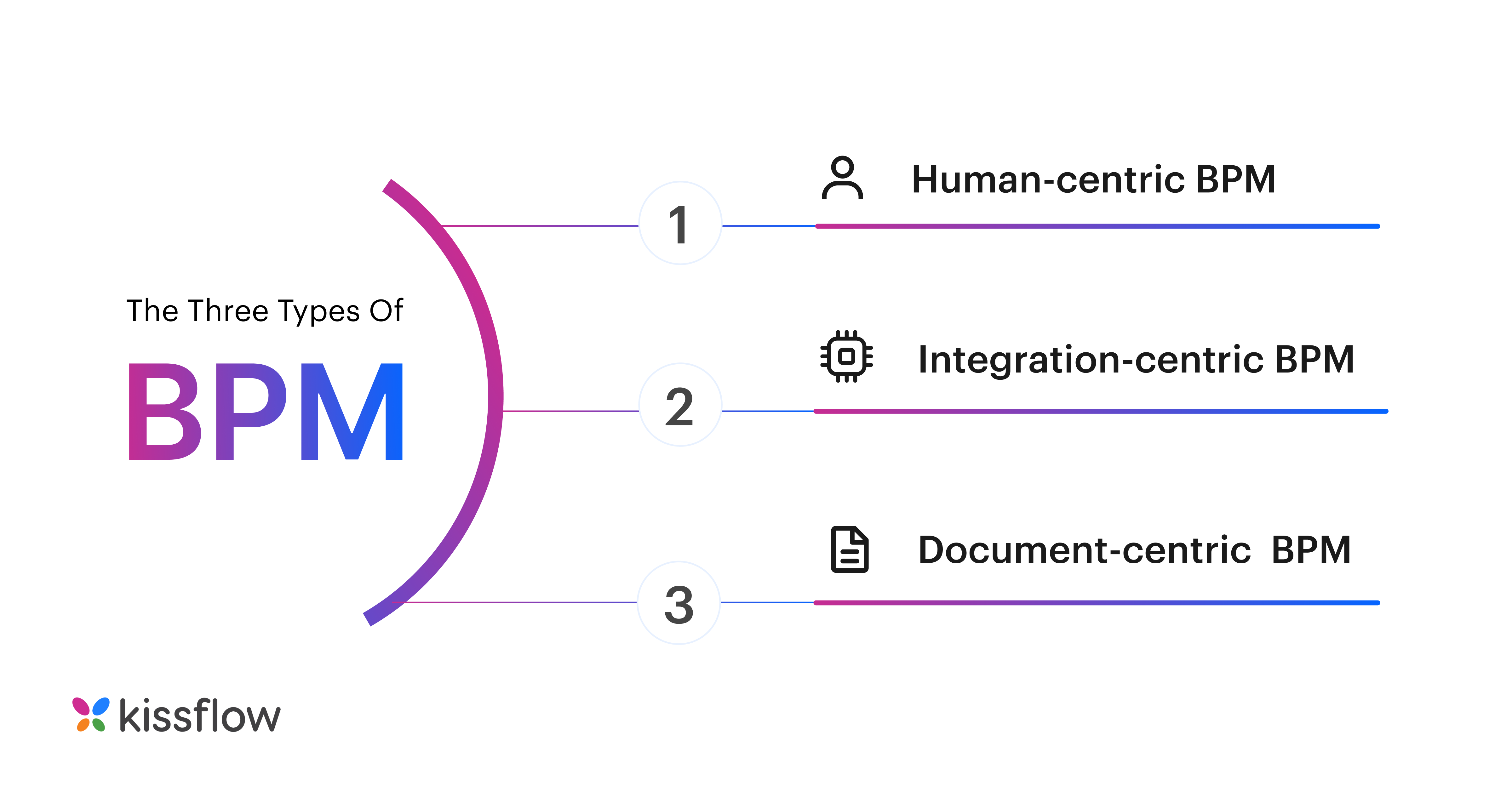
Not all business processes are the same, and trying to manage them all with the same approach is a recipe for failure. The industry has converged on three distinct categories that help organizations match the right management approach to the right kind of work.
Type 1: Human-centric BPM
These are processes where people are the primary actors and decisions require human judgment. Think employee onboarding, expense approvals, leave requests, and performance reviews. Human-centric BPM focuses on routing tasks to the right people at the right time, managing escalations, and ensuring accountability. The technology layer here is about making people more effective, not replacing them.
Type 2: Integration-centric BPM
These are processes that primarily involve data moving between systems with minimal human interaction. API-driven order processing, CRM-to-ERP synchronization, and automated data validation fall into this category. Integration-centric BPM focuses on connecting disparate systems, managing data transformations, and ensuring reliable execution across technology boundaries.
Type 3: Document-centric BPM
These processes revolve around documents as the primary unit of work. Contract lifecycle management, regulatory compliance submissions, invoice processing, and audit preparation are classic examples. Document-centric BPM focuses on version control, approval routing, compliance tracking, and ensuring that the right documents reach the right reviewers at the right stage.
The important nuance that most practitioners miss is that real-world processes almost always combine all three types. An employee onboarding process, for example, is human-centric (manager approvals), integration-centric (provisioning accounts across systems), and document-centric (offer letters, tax forms, NDAs) all at once. The best business process management solutions handle this complexity without forcing organizations to pick just one model.
Core components of the BPM platform
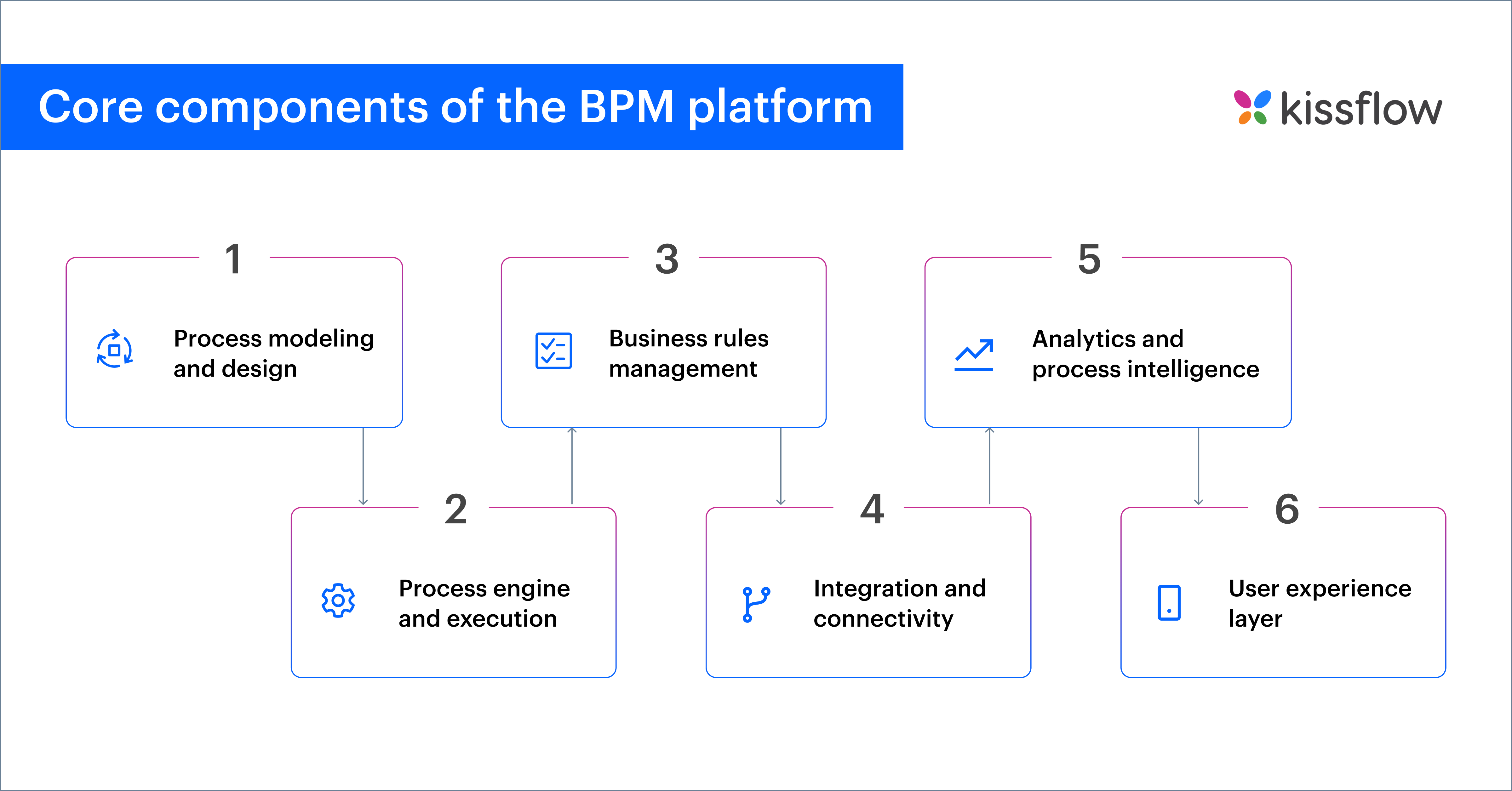
A mature business process management practice rests on several interconnected components. Understanding each one helps leaders make better decisions about where to invest and what to prioritize.
1. Process modeling and design
This is where processes are visually mapped, documented, and designed. It includes identifying process boundaries, defining roles and responsibilities, establishing business rules, and creating the blueprints that guide execution.
2. Process engine and execution
The engine is the runtime environment that actually drives process instances from start to finish. It manages task assignments, enforces business rules, handles exceptions, and maintains the state of every running process.
3. Business rules management
Business rules define the decision logic that governs process behavior. Separating rules from process flow is critical because rules change frequently, often driven by regulatory updates, pricing changes, or policy shifts.
4. Integration and connectivity
Modern business process management solutions must connect with the broader technology ecosystem: ERP, CRM, HRIS, document management, communication platforms, and custom applications.
5. Analytics and process intelligence
You cannot improve what you cannot measure. Process analytics provide real-time visibility into cycle times, bottleneck locations, exception rates, SLA compliance, and resource utilization.
6. User experience layer
The interface through which people interact with processes matters more than most organizations realize. Complex, clunky interfaces drive workarounds and shadow processes. Clean, intuitive interfaces drive adoption and compliance.
Must have features of a BPM platform
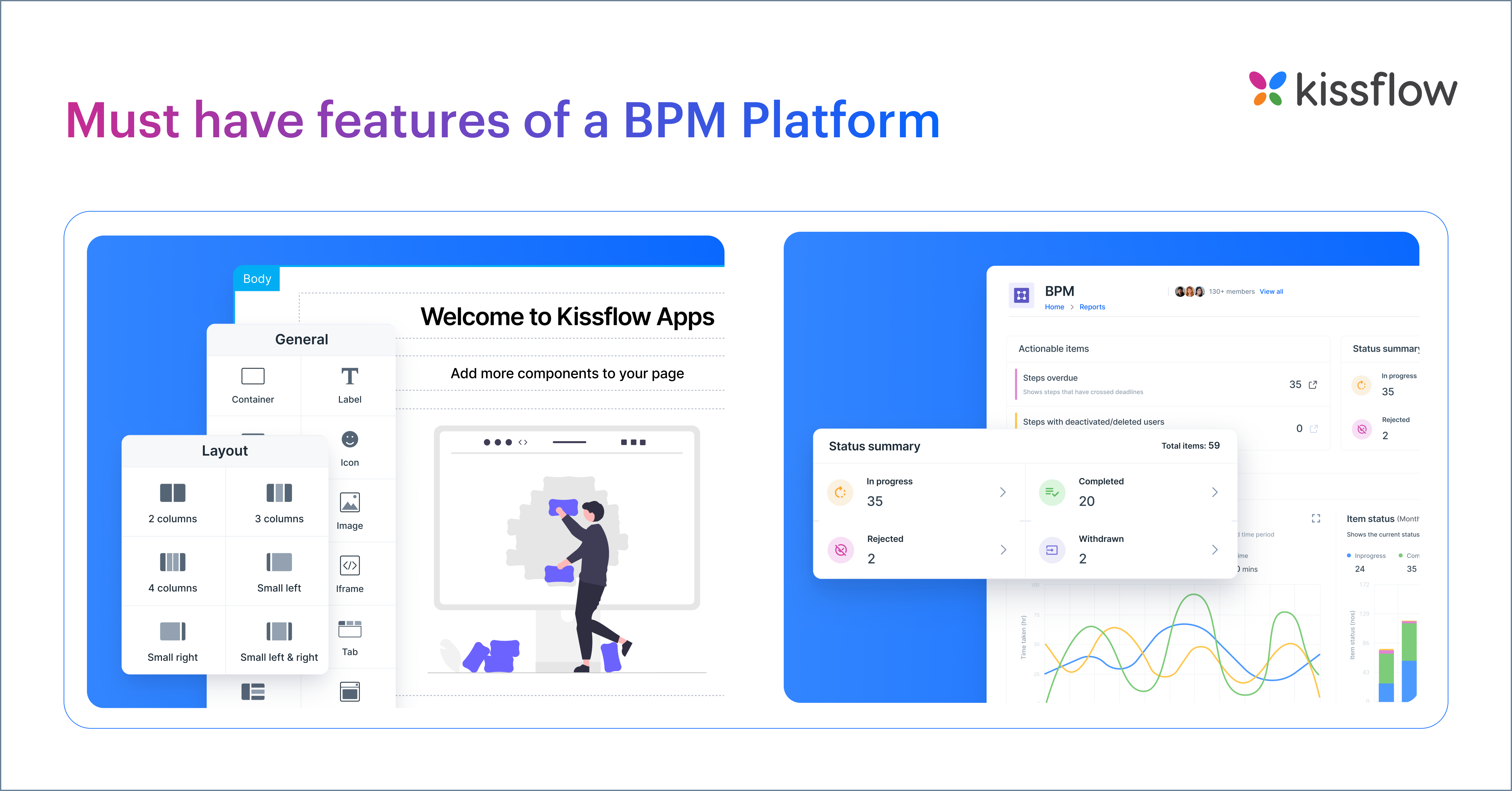
Not all business process management platforms are created equal. When evaluating solutions for your organization, these are the capabilities that separate platforms that deliver lasting value from those that become expensive shelf-ware.
-
Visual process designer with drag-and-drop capability: The ability to design processes visually without writing code is non-negotiable in 2026. Your business process management platform should allow process owners and analysts to build, modify, and iterate on workflows using an intuitive drag-and-drop interface. If designing a process requires a developer ticket, you will never achieve the speed and agility that modern business demands.
-
No-code and low-code development environment: A business process management development platform needs to support both no-code users (business analysts, process owners) and low-code users (IT teams, citizen developers) within the same environment. With Gartner projecting that 75% of new enterprise applications will be built using low-code by 2026, any BPM platform without robust low-code capabilities is already falling behind.
-
Flexible business rules engine: Processes change because business rules change. Your platform must allow business users to modify decision logic, approval thresholds, routing conditions, and escalation rules without rebuilding the entire process. Look for platforms that support decision tables, conditional branching, and dynamic rule sets that can be updated independently of process flows.
-
Pre-built integrations and API connectivity: A business process management platform that cannot talk to your existing systems is useless. Evaluate the breadth of pre-built connectors (for systems like Salesforce, SAP, Microsoft 365, Slack, and major ERPs) as well as the depth of API capabilities for custom integrations.
-
Real-time analytics and dashboards: Your platform should provide out-of-the-box dashboards that track process performance: cycle times, bottleneck locations, SLA compliance, workload distribution, and exception rates. Advanced platforms also offer predictive analytics that flag potential issues before they impact outcomes.
-
Mobile accessibility: Processes do not stop when people leave their desks. Mobile-responsive task management, approval capabilities, and status visibility are essential for organizations with distributed teams, field workers, or leaders who need to keep things moving while traveling.
-
Role-based access control and governance: Enterprise-grade security is not optional. Your business process management platform must support granular role-based permissions, audit trails, data encryption, and compliance with standards like SOC 2, GDPR, and HIPAA where applicable.
-
Scalability and performance: A platform that works beautifully for ten users and five processes but buckles under a hundred users and fifty processes is a liability. Evaluate platforms based on their ability to scale with your organization's growth, both in terms of user volume and process complexity.
The BPM lifecycle framework
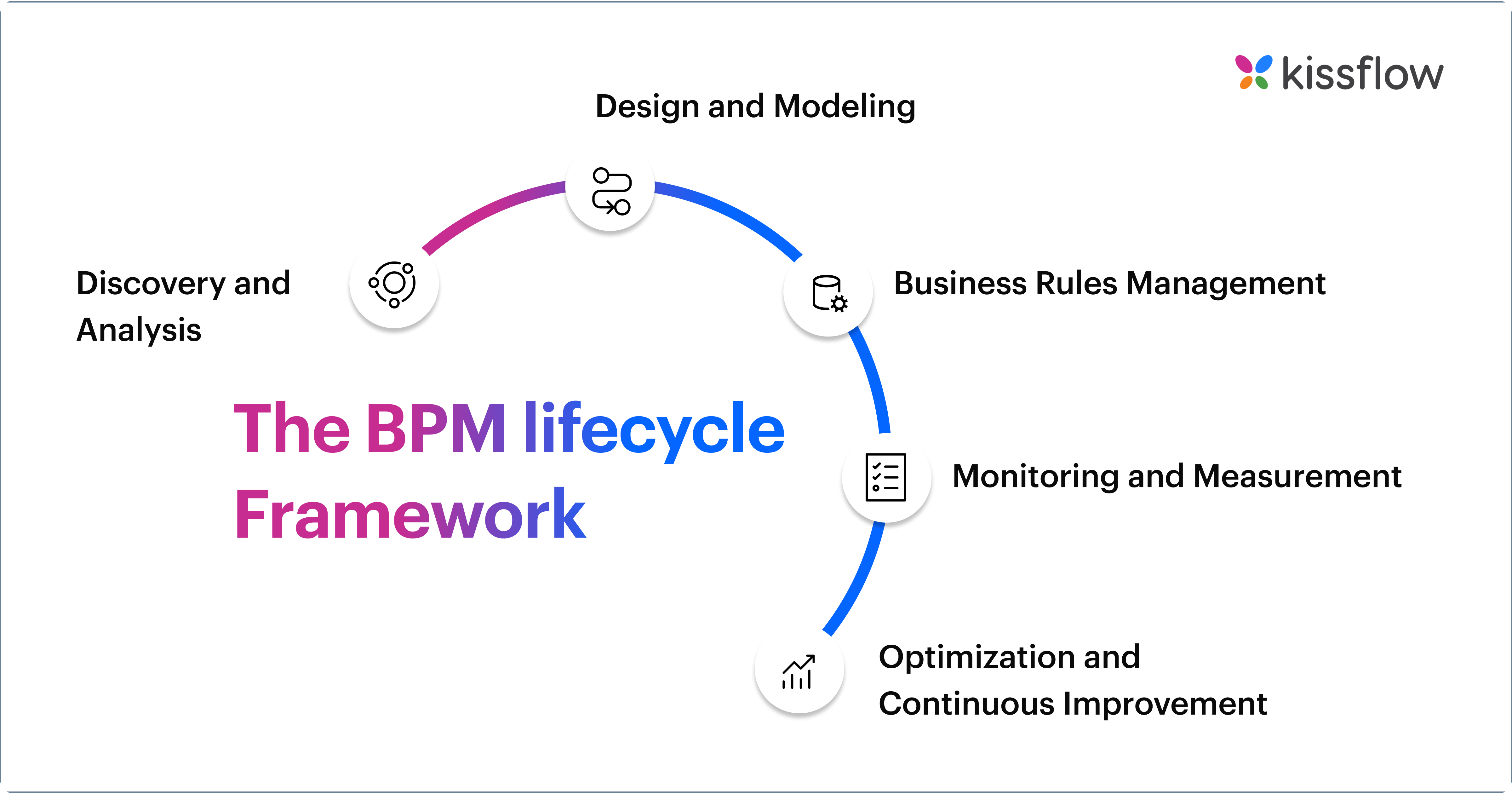
Business process management is not a project with a start and end date. It is a continuous cycle of improvement that compounds over time.
Stage 1: Discovery and analysis
Before improving anything, you need to understand what actually exists. Discovery involves mapping current-state processes, identifying pain points, quantifying inefficiencies, and establishing baselines for improvement. Process mining tools can accelerate discovery by analyzing system event logs to reconstruct real process flows automatically.
Stage 2: Design and modeling
With a clear picture of the current state, teams design the future-state processes. This involves eliminating unnecessary steps, automating repetitive tasks, redesigning handoffs, establishing clear ownership, and embedding business rules. The modeling phase creates the blueprints that will guide implementation.
Stage 3: Implementation and execution
This is where designs become reality. Implementation involves configuring the business process management platform, building integrations, creating user interfaces, testing thoroughly, and deploying to production. The critical success factor here is phased rollout.
Stage 4: Monitoring and measurement
Once processes are live, continuous monitoring tracks performance against the baselines established during discovery. Dashboards surface real-time metrics on throughput, cycle times, exception rates, and compliance.
Stage 5: Optimization and continuous improvement
The final phase loops back to the beginning. Monitoring data reveals new optimization opportunities. This is what makes BPM a discipline rather than a project. The organizations that treat it as an ongoing capability consistently outperform those that treat it as a one-time initiative.
Benefits of Business process management Platform
The case for business process management is not theoretical. Organizations that invest in structured process management consistently report measurable improvements across multiple dimensions. Here is what the data actually shows.
1. Operational efficiency and cost reduction
Organizations can lose up to $1.3 million annually due to inefficient processes. BPM directly addresses this by eliminating redundant steps, automating manual handoffs, and reducing the rework that results from process errors. According to Deloitte, companies integrating automation into operations have reduced operational costs by around 25%.
2. Improved compliance and reduced risk
Every regulated industry, from financial services to healthcare to manufacturing, struggles with compliance. BPM embeds compliance requirements directly into process flows, ensuring that required steps cannot be skipped, approvals cannot be bypassed, and audit trails are generated automatically. Instead of hoping people follow the rules, BPM makes following the rules the path of least resistance.
3. Greater agility and faster response to change
Markets shift. Regulations change. Customer expectations evolve. Organizations with mature BPM capabilities can adapt faster because their processes are documented, measurable, and modifiable. Changing a process in a well-designed business process management platform takes days, not months of custom development work.
4. Enhanced visibility for leadership
One of the most underrated benefits of business process management is the visibility it gives to C-suite leaders. Instead of relying on anecdotal reports about how work is progressing, executives get real-time dashboards showing exactly where processes are bottlenecked, which teams are overloaded, and which SLAs are at risk. This visibility enables faster, more informed decision-making.
5. Employee satisfaction and retention
Nobody enjoys spending their day on repetitive, low-value tasks. Research shows that more than half of employees spend at least two hours daily on repetitive work. BPM frees people from this drudgery by automating the mundane and letting them focus on the strategic, creative, and relationship-driven work that actually requires human judgment. According to a Salesforce study, 89% of employees using automation tools report higher job satisfaction.
6. Scalability without proportional cost increases
Growing organizations face a persistent challenge: every new customer, market, or product line adds process complexity. Without BPM, growth means hiring proportionally more people to manage that complexity manually. With BPM, processes scale through automation and standardization, allowing organizations to grow revenue faster than they grow headcount.
The real ROI question
Every C-suite leader wants to know the return on investing in business process management. The honest answer is that ROI varies depending on process complexity, organizational readiness, and implementation quality. But the data is compelling. Camunda's 2026 State of Agentic Orchestration report found that 95% of organizations that invested in process automation reported increased business growth over the past year. On average, organizations have automated 48% of their processes and believe they can push that to 64%.
Realistic timelines look like this:
-
Quick wins (1 to 3 months): Simple approval workflows, form digitization, and basic routing automation. These are the processes where you prove value and build organizational buy-in.
-
Operational impact (3 to 12 months): Cross-functional process redesign, system integrations, and measurable improvements in cycle times and error rates.
- Strategic transformation (12+ months): Enterprise-wide process standardization, predictive process analytics, and the organizational capability to continuously improve.
Leaders who promise overnight transformation will be disappointed. Leaders who invest in building a genuine process management capability will see returns that compound year over year.
When NOT to use BPM
Business process management is powerful, but it is not the right tool for every situation. Misapplying BPM wastes resources and creates unnecessary complexity.
-
One-off tasks that will never repeat. BPM is designed for structured, repeatable processes.
-
Highly creative or unstructured work. Strategy brainstorming and open-ended research do not benefit from rigid process structures.
-
Processes with no clear owner or stakeholder. If nobody will be accountable for maintaining a process, automating it creates automated dysfunction.
-
When the underlying problem is people, not process. Sometimes what looks like a broken process is actually a management issue, a skills gap, or a cultural problem.
-
Simple tasks that a spreadsheet handles well. Not every workflow needs a business process management platform.
The discipline to say "no" to BPM in the wrong context is just as important as the discipline to implement it in the right context.
The 2026 BPM landscape: What's actually changing
The BPM market in 2026 is fundamentally different from where it was even two years ago. Several converging forces are reshaping what business process management looks like in practice.
Agentic AI is reshaping BPM
The most significant shift in business process management is the emergence of autonomous AI agents that can execute process steps, make decisions within defined parameters, and learn from outcomes. According to Camunda's 2026 report, 71% of organizations say they are using AI agents in some capacity. However, only 11% of those use cases have actually reached production in the last year.
This gap between experimentation and production is the defining challenge of 2026. Organizations need process orchestration frameworks that provide guardrails for AI agent behavior while still allowing the flexibility that makes agents valuable.
Process intelligence becomes mission-critical
Process mining and process intelligence have graduated from nice-to-have analytics tools to essential infrastructure. Organizations are using event log analysis, task mining, and predictive analytics to understand not just how processes performed in the past, but how they are likely to perform in the future.
Low-code is eating traditional BPM
Gartner projects that by 2026, approximately 75% of all new enterprise applications will be built using low-code technologies. Developers outside formal IT departments are expected to account for at least 80% of the user base for low-code tools. Traditional business process management development platforms that require specialized developers and months-long implementation cycles are losing ground.
AI governance is non-negotiable
While 70% of Fortune 500 executives say their companies have AI risk committees, only 14% say they are fully ready for AI deployment. This readiness gap is driving demand for BPM platforms that embed governance capabilities directly into process orchestration.
Platform consolidation is accelerating
Camunda's report found that 85% of organizations have not yet reached the right level of process maturity to implement agentic orchestration, partly because their automation capabilities are fragmented across too many tools.
Composable BPM architecture
Composable BPM breaks processes into modular, reusable components: microservices, APIs, reusable decision models, and pluggable AI capabilities. This architectural shift enables organizations to respond to change faster without rebuilding entire process applications from scratch.
Introduction to BPM orchestration
If business process management is the discipline, orchestration is the mechanism that makes it work at scale. BPM orchestration refers to the coordinated execution of complex, multi-step processes that span people, systems, AI agents, and organizational boundaries. It is the conductor that keeps every instrument playing in time.
Traditional BPM handled straightforward sequential workflows well: step A triggers step B, which triggers step C. But modern business processes are rarely that simple. A single customer onboarding process might involve parallel tasks running simultaneously across compliance, IT provisioning, and account management teams, with conditional branches that depend on the customer's risk profile, geography, and product selection. Orchestration manages this complexity.
In 2026, BPM orchestration has become even more critical because of the introduction of AI agents into process flows. When an AI agent handles a task within a larger process, something needs to manage the handoff between the agent and the human reviewer, monitor the agent's confidence level, trigger fallback paths when the agent encounters edge cases, and maintain the audit trail. That something is the orchestration layer. According to Camunda, 73% of organizations acknowledge a significant gap between their automation vision and current reality, and much of that gap comes down to orchestration maturity.
There are two primary orchestration patterns that modern BPM platforms support. Deterministic orchestration follows predefined paths with clear rules for every decision point. It is predictable, auditable, and well-suited for compliance-heavy processes. Dynamic orchestration, on the other hand, allows AI agents and real-time data to influence process paths, enabling more adaptive and intelligent workflows. The most effective business process management platforms blend both patterns, using deterministic guardrails to contain the flexibility of dynamic, AI-driven orchestration.
For C-suite leaders evaluating business process management development platforms, orchestration capability should be near the top of the evaluation criteria. A platform that can only handle simple, linear workflows will become a bottleneck as your organization's process maturity grows. You need a platform that can orchestrate across systems, teams, and increasingly, AI agents, all while maintaining the governance and visibility that enterprise operations demand.
Building your BPM team
Technology alone does not deliver BPM success. People do. Building the right team structure is often the difference between a BPM program that delivers lasting value and one that produces a shelf full of process maps that nobody follows.
Executive sponsor
Every successful BPM initiative needs a C-level champion who can secure budget, remove organizational barriers, and signal that process management is a strategic priority.
BPM center of excellence (CoE)
A dedicated team that owns the methodology, tools, standards, and best practices for process management across the organization. The CoE enables process owners by providing frameworks, training, and the technology platform they need to succeed.
Process owners
Each critical business process needs a designated owner accountable for its performance, improvement, and alignment with business objectives.
Process analysts
The people who do the hands-on work of discovering, documenting, analyzing, and redesigning processes. They combine analytical skills with domain knowledge and communication ability.
Citizen developers
With low-code BPM platforms, business users can increasingly build and modify their own process applications. The key is providing them with proper guardrails, governance, and training.
BPM challenges and solutions
1. Implementation complexity
BPM implementations often become more complex than initially scoped. The solution is to start small and iterate. Camunda's research revealed that 73% of organizations acknowledge a significant gap between their automation vision and current reality.
2. Change management resistance
People resist process changes for rational reasons. The solution is not to dismiss resistance but to address it. Involve affected stakeholders from the design phase. Communicate the "why" before the "what." Celebrate early wins publicly.
3. Technology integration challenges
Most organizations have accumulated a complex web of legacy systems. The solution is to prioritize integration capabilities when evaluating business process management solutions.
4. Lack of executive buy-in
Without sustained executive commitment, BPM initiatives lose momentum. The solution is to tie BPM outcomes directly to metrics executives already care about: cost reduction, cycle time improvement, compliance risk, and revenue impact.
The governance conversation
Process governance ensures BPM delivers sustained value rather than short-term gains followed by long-term chaos. It answers: Who can create and modify processes? What standards must they follow? How are changes approved? How is compliance monitored?
AI governance within BPM
Only 26% of organizations currently report having comprehensive AI governance policies in place. Another 64% say they have some guidelines or are developing them. For BPM-embedded AI, governance needs to address human-in-the-loop requirements, audit trails, bias monitoring, data privacy compliance (GDPR, CCPA), and clear escalation paths when AI confidence falls below acceptable thresholds.
The hard truth about vendors
The BPM vendor landscape is crowded and confusing. Here is a no-nonsense look at the major players:
-
Pega: Enterprise-grade with deep decisioning and case management. Trade-off: steep learning curve, high implementation costs, and licensing complexity.
-
Appian: Strong low-code BPM with good integration and process mining. Trade-off: can be overkill for simpler needs, and pricing scales quickly.
-
Microsoft Power Automate: Accessible automation that integrates deeply with Microsoft 365. Trade-off: limited process orchestration compared to purpose-built BPM platforms.
-
OutSystems: Primarily low-code app development with added BPM capabilities. Trade-off: BPM features feel secondary and require more technical skill.
-
Nintex: Solid workflow automation with strong SharePoint integration. Trade-off: less suited for complex, multi-system orchestration.
-
Kissflow: Purpose-built for mid-market with a unified business process management platform combining BPM, workflow automation, and low-code development. Designed for business users who need enterprise-grade capabilities without enterprise-grade complexity.
Where Kissflow fits in
Kissflow takes a fundamentally different approach to business process management. Instead of building a platform that requires months of implementation, dedicated BPM consultants, and specialized developer teams, Kissflow delivers enterprise-grade process management that business users can actually own.
BPM without the baggage
Most business process management platforms are designed top-down for IT teams and then grudgingly extended to business users. Kissflow flips that model. Its no-code and low-code interface means process owners, operations managers, and department heads can design, deploy, and iterate on processes without writing a single line of code. IT stays in control of governance, security, and platform standards while the people closest to the work build the solutions they actually need.
Low-code that actually delivers
Kissflow's business process management development platform enables rapid process application development with visual builders, pre-built templates, and drag-and-drop configuration. It supports custom workflows, complex business logic, integrations with existing enterprise systems, and the kind of flexibility that real-world processes demand.
Unified platform, not a Frankenstein stack
Instead of buying separate tools for process management, workflow automation, case management, and collaboration, Kissflow provides a single unified platform. Process design, task management, analytics, and team collaboration live in one environment with one data model, one security framework, and one user experience.
For organizations ready to move beyond spreadsheets and email chains without taking on the complexity and cost of traditional enterprise BPM, Kissflow offers a path that is both practical and powerful.
BPM in action: Industry examples
1. Financial services
Banks and financial institutions use business process management to automate loan origination, streamline KYC compliance, accelerate account opening workflows, and manage regulatory reporting. A typical loan approval process that takes weeks with manual handling can be compressed to days with well-designed BPM.
2. Healthcare
Healthcare organizations apply BPM to patient intake, insurance verification, clinical trial management, claims processing, and regulatory compliance. The shift toward value-based care is accelerating BPM adoption as providers need systematic ways to track and improve care delivery processes.
3. Manufacturing
Manufacturers deploy BPM for production planning, quality management, supplier onboarding, change order processing, and safety compliance. BPM connects the shop floor to the back office, ensuring that engineering changes propagate correctly through production, procurement, and quality control.
4. HR and employee services
HR departments are among the heaviest users of business process management for onboarding, offboarding, leave management, performance reviews, and benefits administration. BPM orchestrates cross-functional handoffs and ensures nothing falls through the cracks.
Future of BPM in 2027
Business process management is at an inflection point. The convergence of several technology and market forces is set to reshape what BPM looks like by 2027 and beyond. Here is where the trajectory is heading.
AI-native BPM becomes the standard
By 2027, the distinction between BPM and AI will largely disappear. Business process management platforms will embed AI capabilities natively, from process discovery (using AI to automatically map how work gets done) to process optimization (using AI to recommend and implement improvements). The 73% vision-reality gap that exists today for agentic AI will narrow significantly as orchestration platforms mature and governance frameworks catch up.
Process-as-code will emerge
Just as infrastructure-as-code transformed IT operations, process-as-code will transform business process management development. Process definitions will become version-controlled, testable, and deployable through CI/CD pipelines, bringing the rigor of software engineering to process management without sacrificing business user accessibility.
Autonomous process optimization
Today, optimization is largely human-driven: analysts review dashboards, identify bottlenecks, and propose changes. By 2027, expect to see business process management platforms that can autonomously detect optimization opportunities, simulate proposed changes, and implement improvements within governance guardrails, all without human intervention for routine adjustments.
The BPM-ERP convergence
The boundary between BPM platforms and ERP systems will continue to blur. Organizations will increasingly use their business process management platform as the orchestration layer that sits above and across ERP modules, coordinating cross-functional processes that no single ERP module can handle on its own.
Sustainability-driven process management
Environmental sustainability is becoming an operational requirement, not just a reporting exercise. By 2027, leading BPM platforms will include carbon footprint tracking, waste reduction analytics, and sustainability metrics as standard process KPIs, enabling organizations to optimize for environmental impact alongside cost and speed.
The BPM market's projected growth to $70.93 billion by 2032 signals that this is not a technology wave that will crest and recede. It is a fundamental shift in how organizations operate. The leaders who invest in building genuine process management capabilities now, through the right business process management platform, the right team, and the right governance framework, will compound that advantage for years to come.
Related Topics:
- What is Process Management? Definition, Types & Real-World Examples
- Business Process: Definition, Steps & Examples in 2026
- 11 Key Advantages of Business Process Management (BPM)
- Process vs Procedure: The Key Differences
- Understanding Business Process Technology
Frequently asked questions
1. What is business process management (BPM)?
Business process management is the practice of analyzing, designing, executing, monitoring, and continuously improving an organization's business processes. It combines management discipline, technology, and governance to turn unstructured work into repeatable, measurable, and improvable operations.
2. What is the difference between BPM and workflow automation?
Workflow automation handles the execution of specific task sequences. BPM is the broader discipline that encompasses process discovery, design, automation, monitoring, optimization, and governance. Workflow automation is one component within a comprehensive business process management practice.
3. How is AI changing BPM in 2026?
AI is transforming BPM through intelligent process discovery (using process mining to map how work actually gets done), smart automation (AI agents handling complex, judgment-based process steps), and predictive optimization (using historical data to anticipate bottlenecks before they emerge).
4. What is agentic process automation?
Agentic process automation uses autonomous AI agents within business processes. These agents can make decisions, take actions, and interact with systems within defined parameters, going beyond rule-based automation to handle nuanced, context-dependent tasks.
5. How big is the BPM market in 2026?
The global BPM market is projected at approximately $21.51 billion in 2025, with forecasts projecting growth to $70.93 billion by 2032 at an 18.6% CAGR.
6. What is process mining and why does it matter?
Process mining uses event log data from enterprise systems to automatically reconstruct and analyze how business processes actually execute. It eliminates guesswork from process improvement by revealing real process flows, including deviations and workarounds.
7. What are the 5 stages of the BPM lifecycle?
The five stages are: Discovery and Analysis, Design and Modeling, Implementation and Execution, Monitoring and Measurement, and Optimization and Continuous Improvement.
8. What is the difference between BPM and BPMN?
BPM is the management discipline for improving business processes. BPMN (Business Process Model and Notation) is a specific standardized visual notation for creating process diagrams. BPM is the strategy; BPMN is one of the tools used to document it.
9. What are the three types of BPM?
Human-centric BPM (processes driven by people and decisions), Integration-centric BPM (data flows between systems), and Document-centric BPM (documents as the primary unit of work). Most real-world processes combine all three.
10. How do AI agents work in business process management?
AI agents operate within orchestrated process flows, handling specific steps that require reasoning or natural language understanding. They receive context from the process engine, make decisions within guardrails, and return results that determine next steps.
11. What is the difference between BPA, BPM, and workflow automation?
Workflow automation handles individual task sequences. BPA (business process automation) applies automation across multiple processes and systems at scale. BPM is the broadest discipline, encompassing automation plus process discovery, design, governance, monitoring, and continuous improvement. BPA and workflow automation are components within BPM.
12. What is composable BPM?
Composable BPM is an architectural approach that breaks process applications into modular, reusable components (microservices, APIs, decision models, UI fragments) that can be assembled and reconfigured as business needs change.
13. How do I know if my organization needs BPM?
Your organization likely needs BPM if you experience recurring process bottlenecks, high error rates, compliance gaps, difficulty scaling, excessive manual handoffs, or lack of visibility into how work gets done. If multiple departments are creating ad-hoc workarounds, that is a strong signal.
14. What is BPM orchestration?
BPM orchestration is the coordinated execution of complex, multi-step processes that span people, systems, AI agents, and organizational boundaries. It manages parallel workflows, conditional branching, AI agent handoffs, and cross-system integrations within a unified process framework.
15. What should I look for in a business process management platform?
Key capabilities include visual process design, no-code/low-code development, a flexible business rules engine, pre-built integrations, real-time analytics, mobile accessibility, role-based access control, and scalability. Prioritize platforms that enable both business users and IT teams to collaborate within a governed environment
16. What are the 5 pillars of business process management?
The five pillars of Business Process Management are process design and modelling, process execution, performance measurement, process optimization, and governance and compliance. Together, design, execution, measurement, optimization, and governance support successful BPM. Comprehensive BPM tools address all five pillars within a unified platform, ensuring they work together cohesively rather than in isolation.
17. What is business process management (BPM)?
Business Process Management (BPM) is a systematic approach to improving an organization's processes, making them more efficient, effective, and adaptable to change. It involves analyzing, designing, implementing, monitoring, and optimizing processes to achieve organizational goals, with a focus on continuous improvement and aligning processes with business objectives. BPM platforms help automate and manage processes, unify fragmented workflows, eliminate redundancies, and support scalable operations.
%20(1)%20(1).png)

Related Articles

22 MINUTES READ
Process vs Procedure: The Key Differences
22 MINUTES READ
Business Process Management Solutions: Complete Guide (2026)