What Are the Different Types of AI Models? A Guide for Enterprise Leaders
AI models are systems that learn patterns from data to make predictions, decisions, or generate content. They include supervised, unsupervised, reinforcement, deep learning, and generative models, each designed for different enterprise use cases such as forecasting, automation, and intelligent decision-making.
Artificial intelligence is no longer an emerging technology. According to McKinsey's State of AI 2025, 88 percent of organizations now use AI in at least one business function. Yet fewer than a third have managed to scale it across the enterprise.
That gap between adoption and impact comes down to a basic question: which AI model fits which problem? Understanding the different types of AI models is not a technical exercise reserved for data scientists. For CIOs, CTOs, and digital transformation leaders, it is a strategic decision that shapes how fast your organization can move, how much value you extract from your data, and whether your AI investments pay off or stall.
This guide breaks down the major types of AI models, explains how enterprises use them, and shows how low-code platforms are making it easier to operationalize AI without writing thousands of lines of code.
What is an AI model?
An AI model is a mathematical framework trained on data to recognize patterns, make predictions, or generate outputs. Think of it as a decision-making engine. You feed it historical data, it learns the relationships within that data, and then it applies those patterns to new, unseen information.
AI models power everything from fraud detection in banking to demand forecasting in supply chains. They sit behind chatbots, recommendation engines, image recognition systems, and increasingly, enterprise workflow automation. The model you choose depends entirely on the problem you are solving and the data you have available.
How do AI models work?
Every AI model follows a similar lifecycle. It starts with data collection, where relevant datasets are gathered and cleaned. The data is then used to train the model, allowing it to identify patterns and relationships. After training, the model is validated against a separate dataset to check accuracy. Once validated, it is deployed into production where it processes new data and delivers results.
The critical differentiator between AI model types is how they learn from data. Some models require labeled examples (where the correct answer is provided upfront). Others discover patterns on their own from unlabeled data. Some learn through trial and error, improving through feedback loops. Understanding these distinctions helps enterprise leaders match the right model to the right business problem.
To operationalize AI models effectively, organizations often rely on a low code integration platform to connect data sources and downstream applications.
Types of AI models every enterprise leader should know
1. Supervised learning models
Supervised learning is the most widely used approach in enterprise AI. These models train on labeled datasets, meaning every input comes paired with the correct output. The model learns to map inputs to outputs and then predicts outcomes for new data.
Common supervised learning techniques include linear regression (for predicting numerical values such as revenue or demand), logistic regression (for classification tasks such as fraud detection), decision trees, and support vector machines. In enterprise settings, supervised models drive credit scoring, customer churn prediction, email spam filtering, and sales forecasting.
2. Unsupervised learning models
Unlike supervised learning, unsupervised models work with unlabeled data. They analyze input data to find hidden structures, groupings, or anomalies without being told what to look for.
Techniques such as K-means clustering, principal component analysis (PCA), and autoencoders fall under this category. Enterprises use unsupervised learning for market segmentation, cybersecurity anomaly detection, customer behavior analysis, and identifying patterns in operational data that humans would miss.
3. Semi-supervised learning models
Semi-supervised learning combines elements of both supervised and unsupervised approaches. It uses a small amount of labeled data alongside a much larger pool of unlabeled data. This is especially useful when labeling data is expensive or time-consuming, which is common in enterprise scenarios.
Applications include medical image classification (where labeled scans are limited), document categorization, and speech recognition systems. Semi-supervised models help organizations get started with AI even when their labeled datasets are incomplete.
4. Reinforcement learning models
Reinforcement learning (RL) models learn through trial and error. Instead of training on static datasets, they interact with an environment, take actions, and receive rewards or penalties based on outcomes. Over time, the model optimizes its strategy to maximize rewards.
RL powers autonomous vehicles, robotics, dynamic pricing engines, and resource allocation systems. In enterprises, reinforcement learning is used for inventory optimization, personalized content recommendation, and supply chain logistics where conditions change constantly.
5. Deep learning models
Deep learning is a subset of machine learning that uses artificial neural networks with multiple layers to process complex, high-dimensional data. These models excel at tasks like image recognition, natural language processing, speech-to-text conversion, and video analysis.
Key architectures include convolutional neural networks (CNNs) for image tasks, recurrent neural networks (RNNs) for sequential data, and transformers, which underpin modern language models. Deep learning requires significant computational resources but delivers unmatched accuracy on complex tasks.
6. Generative AI models
Generative AI models create new content, whether text, images, code, or audio, based on patterns learned from training data. Large language models (LLMs) like GPT, generative adversarial networks (GANs), and variational autoencoders (VAEs) all fall under this category.
Gartner projects that by 2026, more than 80 percent of enterprises will have used generative AI APIs or deployed GenAI-enabled applications in production. For enterprise leaders, generative AI is already transforming content creation, customer service, code generation, and document processing.
How enterprises are deploying AI models today
AI model deployment has accelerated across industries. Gartner predicts that 40 percent of enterprise applications will feature task-specific AI agents by the end of 2026, up from less than 5 percent in 2025. The shift is clear: AI is moving from isolated experiments to embedded capabilities within everyday business applications.
However, McKinsey's research also shows that only 39 percent of organizations report an enterprise-level impact on EBIT from AI. The gap is not in the models themselves. It is in how organizations operationalize them, integrate them into workflows, and connect them to actual business processes.
This is where the conversation shifts from choosing the right AI model to building the right operational layer around it.
Why low-code platforms are essential for enterprise AI adoption
The biggest bottleneck in enterprise AI is not model selection. It is a deployment. Building custom applications that integrate AI models, connect to existing systems, and fit into governed workflows typically requires months of development and scarce engineering talent.
Low-code platforms solve this problem by providing visual development environments where both IT teams and business users can build AI-powered applications without writing extensive code. Gartner forecasts that 75 percent of all new enterprise applications will be built using low-code technologies by 2026.
Here is how low-code accelerates AI model deployment across the enterprise:
-
Faster prototyping: Teams can build and test AI-infused applications in weeks instead of months, reducing time-to-value significantly.
-
Democratized development: Business analysts and process owners can create applications that leverage AI without depending on data scientists for every deployment.
-
Built-in integrations: Pre-built connectors link AI services (like OpenAI, TensorFlow, or custom ML models) to enterprise systems such as ERP, CRM, and HRMS.
-
Governed citizen development: IT maintains oversight and security controls while business teams build the applications they need.
-
Scalability: Applications built on low-code platforms can scale across departments without requiring custom code for each new use case.
 Free ebook
The Next Normal in Application Development: Where Low-Code and AI Intersect
How Will Low Code and AI Co-exist?

Thank you for downloading!
How to choose the right AI model for your enterprise
Selecting an AI model is not a one-size-fits-all decision. The right choice depends on several factors:
-
Your data: Is it labeled or unlabeled? Structured or unstructured? The quality and type of your data immediately narrow your model options.
-
Your problem: Classification, prediction, content generation, and anomaly detection each point to different model families.
-
Your infrastructure: Deep learning models demand significant compute resources. Simpler models, such as decision trees, can run on standard infrastructure.
-
Your team: If you have limited data science talent, platforms that offer no-code AI capabilities can bridge the gap between ambition and execution.
-
Your governance requirements: Regulated industries need models with explainability and audit trails baked in, not bolted on.
The enterprises seeing the most value from AI are not chasing the most complex models. They are matching the right model to the right use case and deploying it within workflows that people actually use every day.
How Kissflow helps enterprises operationalize AI models
Knowing the types of AI models is just the starting point. The real challenge is getting those models into the hands of the people who need them, embedded within the processes that drive your business forward.
Kissflow's low-code platform is purpose-built for exactly this challenge. It gives enterprises a unified environment where IT and business teams can build, deploy, and manage applications that leverage AI without the overhead of traditional development.
With Kissflow, enterprise teams can:
-
Build AI-powered workflows using a visual drag-and-drop builder that requires minimal coding, from approval chains enhanced by intelligent routing to procurement processes driven by predictive analytics.
-
Integrate with AI services like OpenAI directly into workflows using pre-built connectors, enabling capabilities like automated content generation, sentiment analysis, and data summarization within existing processes.
-
Empower citizen developers to build departmental applications that incorporate AI, while IT retains full governance, role-based access control, and audit trails.
-
Scale AI-infused applications across departments, whether it is finance automating invoice processing, HR streamlining onboarding, or operations optimizing resource allocation.
-
Leverage AI-suggested form fields, natural language commands, and intelligent workflow recommendations that reduce build time and improve application quality from day one.
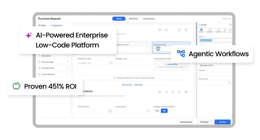
Kissflow does not require you to rip and replace your existing systems. It works as an operational layer that connects your SIS, ERP, CRM, and other systems of record, bringing AI-driven intelligence into the workflows your teams already run. Explore the full capabilities of Kissflow's low-code platform and see how organizations like Perelman School of Medicine (University of Pennsylvania), McDermott, and SN Aboitiz Power are already building smarter operations.
Frequently asked questions
1. What are the main types of AI models?
The main types include supervised learning, unsupervised learning, semi-supervised learning, reinforcement learning, deep learning, and generative AI models. Each type serves different business use cases depending on the data available and the problem being solved.
2. What is the difference between machine learning and deep learning?
Machine learning uses algorithms to learn from data and make predictions. Deep learning is a specialized subset of machine learning that uses multi-layered neural networks to process complex data like images, text, and audio. Deep learning models generally require more computational power but deliver higher accuracy on complex tasks.
3. Which AI model is best for enterprise use?
There is no single best model. The right choice depends on your use case, data quality, infrastructure, and team capabilities. Supervised learning works well for prediction and classification. Generative AI excels at content creation and document processing. Reinforcement learning suits dynamic optimization problems.
4. How do generative AI models differ from traditional AI models?
Traditional AI models analyze data and produce predictions or classifications. Generative AI models go a step further by creating new content, such as text, code, images, or reports, based on patterns learned during training. This makes them especially useful for automating content-heavy business processes.
5. Can enterprises deploy AI models without a data science team?
Yes. Low-code and no-code platforms now offer built-in AI capabilities and pre-built connectors to external AI services. This allows business users and citizen developers to build AI-powered applications without deep technical expertise, while IT maintains governance and security oversight.
6. What role do low-code platforms play in AI adoption?
Low-code platforms bridge the gap between AI models and business applications. They provide visual development environments, pre-built integrations, and workflow automation capabilities that make it practical to embed AI into everyday enterprise processes.
7. What is supervised learning used for in business?
Supervised learning is used for tasks where historical data with known outcomes is available. Common business applications include sales forecasting, customer churn prediction, credit scoring, fraud detection, and email classification.
8. How are AI agents different from traditional AI models?
Traditional AI models respond to specific inputs with outputs. AI agents are autonomous systems that can plan, execute multi-step tasks, use tools, and make decisions independently. Gartner predicts 40 percent of enterprise apps will have task-specific AI agents by the end of 2026.
9. What is the biggest challenge in enterprise AI deployment?
The biggest challenge is not selecting the right model but operationalizing it. Most enterprises struggle to integrate AI into existing workflows, connect it to legacy systems, and scale it beyond isolated pilots. This is why platforms that combine workflow automation with AI capabilities are gaining traction.
10. How does Kissflow support AI model integration?
Kissflow's low-code platform supports AI integration through pre-built connectors to services like OpenAI, natural language workflow creation, AI-suggested form fields, and intelligent process automation. It allows enterprises to embed AI capabilities into workflows without replacing existing systems, giving both IT and business teams the tools to build and manage AI-powered applications in a governed environment.
Related Articles

8 MINUTES READ
Build Smarter Apps with Low-Code and Generative AI
8 MINUTES READ
Generative AI + Low-Code: Build Smart Apps Faster