BPM Solutions: How to Choose the Right Platform in 2026
BPM solutions provide enterprises with the tools to design, automate, and monitor business processes across departments. Modern platforms offer no-code workflow builders, real-time dashboards, integration APIs, and governance controls for collaborative process management between IT and business users.
A business process management solution is software that connects people, systems, and data into managed, repeatable workflows giving organisations visibility and control over how work gets done, continuously improving over time.
What is a Business Process Management (BPM) Solution?
Business Process Management Soultion (BPM) is designed to carry out the essential operations of business process management: namely modeling, executing, evaluating, and improving business processes to ensure optimal efficiency and productivity.
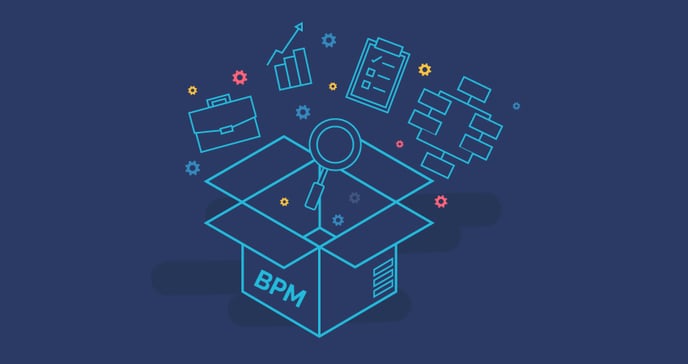
Business Process Management solutions may be on-premise or cloud-based in terms of installation and come in a variety of shapes, sizes, and prices.
Types of BPM Solutions
|
BPM Type |
What it manages |
Common examples |
|
Human-Centric BPM |
Processes where people make most decisions — approvals, reviews, escalations |
Employee onboarding, purchase approvals, performance reviews |
|
Document-Centric BPM |
Processes where creating, routing, and approving documents is the core unit of work |
Contract management, compliance routing, invoice approvals |
|
Integration-Centric BPM (iBPMS) |
System-to-system automation with minimal human involvement; AI agents handle exceptions |
ERP-CRM sync, automated reporting, data pipeline orchestration |
Key Features that BPM Solutions Need
When looking for the right business process management solution for your company, look for the following crucial features.
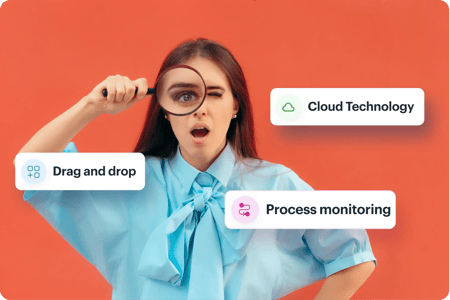
1. Drag-and-drop Form Builders
A visual-based approach to BPM is the best way to go. With this feature, you can drag and drop common elements to define forms in your workflow or logically structured processes.
2. Rule-based Workflows
BPM is done by arranging workflows as a sequential series of tasks, accompanied by data-collecting forms, and defining the team members involved in various stages. A rule-based workflow dictates the flow of data through a process, routing it by making logical decisions, which in turn are defined by ‘rules’ set by the user.
3. Automation Capabilities
Automation in the context of BPM simply refers to the routing of data and sequential execution of tasks, without any manual intervention.
4. Process Monitoring
Simply modeling and executing a process won’t help you carry out true BPM. For this, you’ll need a good Business Process Management (BPM) solution to offer the ability to monitor, analyze, and provide insights into business processes.
5. Cloud Technology
Most newer Business Process Management Systems(BPMS) are cloud-based, meaning they don’t have to be installed on site. This makes for instant use–you can start using them the moment you complete payment. Fees are also significantly lower with a cloud-based BPM Application like Kissflow.
How BPM Solutions Are Evolving in 2026
BPM is no longer just about digitizing forms and routing approvals. In 2026, the BPM market projected to reach $26.18 billion by 2028 at a 12% CAGR (Fortune Business Insights) — is undergoing a fundamental shift from static workflow management to AI-first process orchestration. Here are the defining trends reshaping BPM solutions this year:
AI-Powered Process Intelligence
The most significant shift in BPM for 2026 is the integration of artificial intelligence across the entire process lifecycle. An estimated 40% of BPM tools adopted today are integrated with AI capabilities. Modern BPM solutions now use AI to automatically discover and map processes from system logs (process mining), predict bottlenecks before they occur, generate workflow documentation from natural-language descriptions, and recommend optimization paths based on historical performance data. This eliminates the weeks-long manual mapping cycles that have traditionally slowed down BPM implementations.
Agentic Automation and iBPMS
2026 marks the rise of intelligent business process management suites (iBPMS), where AI agents autonomously execute parts of a workflow, escalate exceptions, and self-correct. Unlike traditional RPA, which follows rigid scripts, agentic automation enables BPM solutions to handle unstructured tasks — such as interpreting emails, categorizing documents, or making routing decisions — without human intervention. According to SS&C Blue Prism, BPM is shifting from static workflows to dynamic, AI-orchestrated processes that support a more autonomous enterprise.
Process Mining Integration
Process mining is no longer a standalone discipline. In 2026, it is embedded directly into BPM platforms. The process mining market, valued at $3.63 billion in 2025, is projected to reach $97.88 billion by 2034, growing at a CAGR of 44.2%. Object-centric process mining (OCPM) is gaining traction, enabling organizations to analyze processes that involve multiple interrelated objects, not just single-case flows. This gives BPM solutions a level of process visibility that was previously impossible.
Hyperautomation and Composable BPM
Hyperautomation — the combination of AI, ML, RPA, and BPM into a unified automation layer is going mainstream. Gartner estimates this approach can redesign up to 30% of processes and reduce operational costs by nearly one-third. Alongside this, composable BPM architectures enable organizations to assemble processes from reusable, modular components rather than building each workflow from scratch. This dramatically reduces time-to-deploy and allows businesses to adapt rapidly to regulatory or market changes.
Platform Consolidation
Tool sprawl remains the silent killer of process visibility. In 2026, BPM solutions are moving toward unified platforms that link processes, decisions, documents, SOPs, compliance controls, and automation in a single operating layer. Platforms like Kissflow address this by combining workflow automation, app building, process management, and governance into one low-code environment — eliminating the need for 5-7 disconnected tools.
The Benefits of Implementing BPM Solutions
Implementing a BPM solution can bring numerous benefits to organizations. Let's explore some of the most significant:
1. Improved Efficiency
By modeling, executing, evaluating, and improving business processes, organizations can streamline their operations and increase efficiency.
2. Increased Productivity
Optimizing business processes leads to increased productivity, allowing organizations to accomplish more in less time.
3. Better Decision-Making
BPM solutions provide organizations with valuable data and insights that can inform their decision-making processes.
4. Enhanced Collaboration
A good BPM platform often comes equipped with built-in collaboration features, making it easier for teams to work together, communicate effectively, and stay aligned throughout the process lifecycle
5. Increased Competitiveness
By improving efficiency and productivity, organizations are better equipped to compete in their respective industries.
How to Choose the Right BPM Solution in 2026
The BPM market has matured significantly, and the criteria for evaluating solutions have shifted. In 2026, choosing the right BPM platform means looking beyond basic workflow automation. Here is a framework for enterprise decision-makers:
1. AI and Process Intelligence Capabilities
Does the platform offer AI-powered process discovery, predictive analytics, or intelligent routing? In 2026, solutions without AI are already a generation behind. Look for platforms that use AI to surface process bottlenecks, recommend improvements, and generate workflows from natural language.
2. Low-Code/No-Code Accessibility
75% of organizations are now investing in low-code or no-code platforms. The BPM solution you choose must empower process owners and business users to build and modify workflows without developer dependency. This is the foundation of citizen development and IT-business alignment.
3. End-to-End Process Lifecycle Coverage
A true BPM solution covers the full lifecycle: design, automate, monitor, optimize, and govern. Avoid tools that only handle one phase. Look for platforms with visual process builders, automation engines, real-time dashboards, and built-in analytics.
4. Integration Depth
Your BPM solution must connect seamlessly with existing enterprise systems — ERP, CRM, HRMS, ITSM, and cloud infrastructure. Pre-built connectors and API-first architectures are essential. Isolated BPM tools create data silos.
5. Governance and Compliance
With AI regulations expanding globally (EU AI Act, sector-specific mandates) and ESG reporting requirements increasing, BPM solutions need built-in governance: role-based access controls, audit trails, data residency options, and compliance tracking.
6. Total Cost of Ownership
Enterprise BPM solutions often carry hidden costs — implementation consulting, per-user licensing that scales unpredictably, custom development fees, and ongoing maintenance. Evaluate the full TCO over 3 years, not just the sticker price. Platforms like Kissflow minimize this with transparent pricing, built-in templates, and no-code flexibility that reduces reliance on external consultants.
7. Scalability Without Complexity
A platform that works for 10 workflows must work for 1,000. Scalability in 2026 means handling multi-department, multi-geography deployments while maintaining performance, security, and governance consistency.
⋙ Check out why these 6 BPM Software are at the top of the competition!
Summary
You now know the basics of Business Process Management solutions (BPM), and essential features any BPM software should have. This list is by no means a comprehensive one, but three of the more popular choices in the BPM platform .
Most business process management solutions, including Kissflow Process, offer a free trial. Try one today to see if it fits your organization’s business processes.
Related Topics:
- 16 Best BPM Tools for Enterprise Business Process Management in 2026
- BPM Applications: What They Do and How to Use Business Process App?
- BPM Online Tools - How To Get Even More From Them
- BPM Company | Choose The Right BPM Software Vendor with These 5 Tips
- Comparison of Features Between Free BPM Software and Kissflow BPM Tool
FAQ - Business Process Management Solutions
1. Which is the best BPM software?
The best BPM (Business Process Management) software depends on your organizational needs. However, Kissflow stands out for its no-code approach, making it ideal for process owners and non-IT teams to build and manage workflows. It simplifies business process automation, especially for departmental and workgroup applications, and supports both IT-led and citizen development initiatives.
2. What are business process solutions?
Business process solutions refer to systems that help organizations map, automate, monitor, and optimize workflows. These solutions enhance transparency, reduce manual errors, and support better decision-making. Platforms like Kissflow offer integrated solutions for managing structured and ad hoc processes, enabling both IT teams and business users to collaborate effectively on process improvement.
3. What are the 5 levels of BPM?
The five levels of BPM maturity typically include: 1) Initial (ad hoc processes), 2) Managed (defined and repeatable processes), 3) Standardized (processes are standardized and integrated), 4) Predictable (performance metrics are applied), and 5) Innovative (continuous improvement driven by data and innovation). platforms like Kissflow support growth across these levels by offering scalable automation and real-time analytics.
4. What factors should I consider when choosing a BPM solution?
When choosing a BPM solution, consider scalability, ease of use, integration capabilities, governance features, and the ability to support both IT and business-led initiatives. Kissflow is purpose-built to support process orchestration with minimal configuration, making it suitable for both IT-backed automation and citizen-led app development.
5. How can BPM solutions improve operational efficiency?
BPM solutions improve operational efficiency by digitizing manual workflows, enabling quick decision-making, reducing redundancies, and ensuring process compliance. Kissflow’s unified platform helps teams move faster by offering visual modeling software for workflow design, advanced reporting, and automation that reduces dependency on IT.
6. How are AI and machine learning changing BPM solutions in 2026?
AI is transforming BPM solutions from manual workflow tools into intelligent process platforms. In 2026, AI capabilities in BPM include automatic process discovery from system logs, predictive analytics for bottleneck prevention, natural-language workflow generation, and intelligent document routing. An estimated 40% of BPM platforms now integrate AI capabilities. Platforms like Kissflow embed AI into the workflow design and optimization process, reducing setup time and improving process performance continuously.
7. What is the difference between BPM and RPA?
BPM (Business Process Management) manages the end-to-end lifecycle of business processes — including design, automation, monitoring, and optimization. RPA (Robotic Process Automation) automates specific, repetitive tasks within a process. BPM solutions provide the orchestration layer that coordinates how work flows between people, systems, and bots. In 2026, the two are increasingly converging through hyperautomation, where BPM platforms incorporate RPA, AI agents, and process mining into a unified automation framework.
8. How much do BPM solutions cost?
A: BPM solution pricing varies widely. Enterprise platforms like Pega or Appian can cost $50,000-$300,000+ annually depending on users and customization. Mid-market and low-code BPM solutions like Kissflow offer more predictable pricing, typically ranging from $1,500-$10,000/month depending on users and features. When evaluating cost, consider total cost of ownership over 3 years — including implementation, training, integrations, and ongoing maintenance — not just the license fee.
9. What is an intelligent BPM suite (iBPMS)?
A: An intelligent BPM suite (iBPMS) extends traditional BPM with AI, machine learning, real-time analytics, and advanced decision management. Gartner defines iBPMS as a platform that supports the full BPM lifecycle while also providing intelligent automation, predictive insights, and adaptive process behavior. In 2026, iBPMS solutions are becoming the standard for enterprises that need more than basic workflow automation.
10. Can BPM solutions work with existing ERP and CRM systems?
Yes. Modern BPM solutions are designed to integrate with existing enterprise systems like SAP, Oracle, Salesforce, Microsoft Dynamics, ServiceNow, and HRMS platforms. Look for solutions with pre-built connectors, REST API support, and webhook capabilities. Kissflow offers integration with 100+ enterprise applications out of the box, plus custom API connectivity for proprietary systems.
11. How long does it take to implement a BPM solution?
Implementation timelines vary by platform complexity. Traditional enterprise BPM suites (Pega, Appian) can take 3-12 months for full deployment. Low-code BPM platforms like Kissflow typically see first workflows live within 1-2 weeks, with enterprise-wide rollouts completed in 4-8 weeks. The key factors are integration complexity, number of processes being digitized, and internal change management readiness.