Agile project management is an iterative, incremental approach to delivering work in environments where requirements are likely to change, customer feedback is essential, and the cost of late discovery is high. At team level, it runs on frameworks like Scrum and Kanban. At enterprise scale, it has to handle multiple teams coordinating against the same outcome, portfolio governance that still needs to function, and non-Agile work that has to coexist with Agile work. This guide covers what Agile project management is, the frameworks that scale it across the enterprise, and what enterprise teams actually need to make it work.
What Agile project management is
Agile project management is defined by four values laid out in the Agile Manifesto, originally written for software development in 2001 but now applied across digital products, internal platforms, customer experience programs, marketing operations, and any enterprise work that benefits from continuous learning over upfront specification.
The four values are: individuals and interactions over processes and tools, working product over comprehensive documentation, customer collaboration over contract negotiation, and responding to change over following a plan. Each one is a preference, not an absolute, and how enterprise teams interpret the trade-offs determines whether Agile delivers value or becomes a label applied to traditional work.
Why Agile looks different at enterprise scale
Team-level Agile works because a single team can self-organize, own a product, and ship within a sprint. Enterprise Agile faces three realities that change the operating model.
Multiple teams have to coordinate against the same outcome
A digital product at enterprise scale rarely lives inside one team. It crosses platform teams, infrastructure teams, security, data, and the business unit owners who consume the output. Coordination between teams becomes the dominant cost, and the team-level Agile playbook does not include the rituals that handle it.
Portfolio governance still has to function
Enterprise finance organizations cannot fund work indefinitely without visibility. Risk, audit, and compliance functions still need controls. The CFO still needs to see how a $40 million product investment is performing against the business case. Agile teams ship in sprints, but the portfolio runs on quarters and years.
Non-Agile work has to coexist with Agile work
Every enterprise has work that does not benefit from Agile. Capital projects, regulatory submissions, infrastructure migrations, and M&A integrations run on predictable methodologies for reasons that are structural rather than cultural. The operating model has to accept both methodologies and govern them coherently.
The frameworks for scaling Agile across the enterprise
Several frameworks now describe how Agile operates at enterprise scale. The differences between them matter more than the labels suggest, and choosing the wrong one for the organizational reality is the most common failure pattern in enterprise Agile transformation.
Scrum and Kanban remain the team-level foundation
Scrum organizes work in fixed-length sprints with defined ceremonies including planning, daily standups, review, and retrospective. Kanban runs work as a continuous flow with visual boards, work-in-progress limits, and pull-based assignment. Both remain the standard team-level operating model, and most enterprise scaling frameworks build on one or both.
SAFe is the most widely adopted scaling framework
The Scaled Agile Framework, or SAFe, organizes multiple Agile teams into Agile Release Trains that plan together on a quarterly cadence called Program Increment planning. SAFe adds program-level roles, portfolio-level investment governance, and the cadence rituals that align teams against shared outcomes. It is the most widely adopted enterprise Agile framework, particularly in regulated industries where audit trail and predictability matter.
LeSS keeps Scrum as the core unit
Large-Scale Scrum, or LeSS, scales by adding teams to a single product without adding layers of new roles. The framework preserves Scrum events and artifacts and resists the proliferation of scaling-specific roles that SAFe introduces. It suits product organizations with strong engineering culture and resists adoption in heavily matrixed enterprises.
Disciplined Agile offers methodology fit by context
Disciplined Agile, now part of PMI, treats methodology selection as a choice that depends on the team context, the work type, and the organizational maturity. It explicitly accommodates Scrum, Kanban, Lean, XP, and hybrid approaches within a single decision framework. Disciplined Agile suits organizations that need flexibility across very different types of work.
The Spotify model is a cultural reference, not a framework
The Spotify model gets cited frequently in enterprise Agile conversations, but it was a description of how one organization operated at a specific moment, not a transferable framework. Squads, tribes, chapters, and guilds work in the cultural conditions Spotify had at the time. Applying the labels without the conditions tends to produce structural confusion rather than Agile outcomes.
Hybrid is now the dominant enterprise reality
Wellingtone State of Project Management research found that hybrid project management adoption surged by 57 percent in a single year, overtaking single-methodology approaches in enterprise settings. The reason is structural. Enterprise portfolios always contain both predictable work and emergent work, and forcing a single methodology across both breaks at least one of them.
Standish CHAOS Report data supports the same conclusion from a different angle, showing that Agile projects succeed roughly three times more often than Waterfall projects in software contexts, while predictable capital and infrastructure work continues to perform best under phased approaches. The mature enterprise position is no longer Agile versus Waterfall. The position is governing the methodology choice at the portfolio level based on the type of work.
When Agile fits, and when it does not
Agile delivers value when requirements are uncertain, customer feedback is essential, the cost of late discovery is high, and the work can be sliced into shippable increments. Software products, digital experiences, internal platforms, customer journey programs, and marketing operations typically fit this profile.
Agile struggles when requirements are well understood and stable, when the work is inherently sequential, when regulatory environments demand exhaustive upfront specification, or when the cost of mid-flight change is higher than the cost of upfront analysis. Capital infrastructure projects, drug approval submissions, manufacturing line builds, and large-scale physical construction usually fit this profile.
The enterprise question is not whether to adopt Agile. The question is which programs should run on Agile, which should run on phased methodology, which should run on hybrid models, and how the PMO governs the choice without becoming a methodology committee.
What enterprise Agile requires from the operations layer
Enterprise Agile depends on an operational layer that team-level Agile rarely needs. Several capabilities separate the organizations that scale Agile from those that stall at the team level.
- A portfolio view that holds Agile work and non-Agile work in the same operating picture, with consistent visibility across both
- Capacity planning across teams, products, and programs that surfaces conflicts before they break delivery commitments
- Approval workflows for funding decisions, governance reviews, and compliance checkpoints that adapt to the program type
- Integration with the systems that surround product work, including finance for investment tracking, HR for capacity, and risk for compliance signal
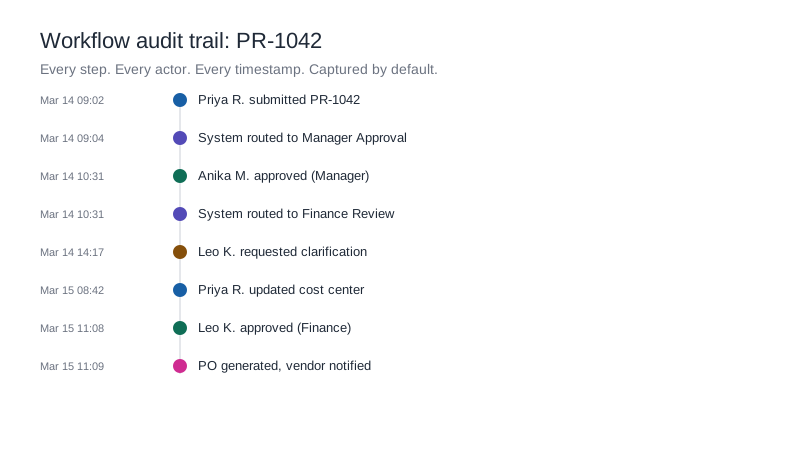
- An audit trail that satisfies regulators without forcing Agile teams into Waterfall documentation overhead
- Value realization tracking that connects sprint output to business outcomes 12 to 24 months out, not just feature delivery at the team level
How Kissflow helps enterprise Agile transformation
Kissflow gives enterprise leaders the operational layer Agile at scale depends on. The platform holds Agile work and non-Agile work in one portfolio view, runs the governance cadence across business units, manages capacity across teams, automates the approval workflows funding decisions go through, and preserves the audit trail that regulated industries require.
Enterprise teams use Kissflow to run SAFe-style Agile Release Trains alongside capital programs and transformation portfolios, to coordinate cross-team dependencies before they break delivery, to track realized business value past go-live, and to integrate Agile work with the finance, HR, and risk systems the rest of the business runs on. The platform replaces the fragmented tooling that holds back most enterprise Agile transformations.
.webp)