TL;DR
-
Social media is not optional for enterprise brands. With 5.17 billion social media users globally as of 2024, the question is not whether to publish. It is whether your team has the operational structure to do it consistently and well.
-
A social media calendar is not a posting schedule. It is the operational system that connects content strategy to execution: capturing ideas, aligning cross-functional stakeholders, managing assets, and tracking performance in one place.
-
Teams that plan content in advance outperform teams that plan in real time. The research is consistent: consistency beats quality when only one is sustainable at scale.
-
The biggest failure mode in social media operations is not bad content. It is the absence of a system: teams doing last-minute content, approvals held up in email, and no record of what worked and why.
-
Kissflow is an enterprise application platform where marketing operations teams build the workflow and project management processes that make consistent content production possible: without the coordination overhead that slows most content teams down.
The problem with "winging it" on social media
Most marketing teams know what a good social media presence looks like. They have seen the brands that publish consistently, respond quickly, and build engaged audiences over time. They also know that their own team is not operating that way.
The gap is almost never about creative talent. It is almost always about operational structure.
When content is planned week-to-week, the team spends its time on coordination rather than creation. Writers wait for topic approvals that are stuck in a Slack thread. Designers produce assets for posts that have already been pushed back. Approvals happen the night before publish dates. And when the quarter ends, there is no reliable record of what was published, what performed, and why: so the next quarter starts from the same place.
A social media calendar solves this by creating the operational structure the team needs to work ahead, not behind.
What a social media calendar actually is
A social media calendar is the central planning document, or platform, where every piece of social content is planned, produced, approved, scheduled, and tracked.
At its most basic, it captures what will be published, on which platform, on which date, and by whom. At its most valuable, it also captures the campaign context, the assets attached, the approval status, and the performance data after the fact.
The distinction between a basic calendar and a high-value one is the degree to which it serves as a system of record rather than just a schedule. A schedule tells you when things will happen. A system of record tells you what was decided, why it was decided, who approved it, and what happened after.
Who should use a social media calendar: and when
A social media calendar is useful as soon as a team is managing content on more than one platform or publishing more than a handful of posts per week. The threshold at which a calendar becomes essential rather than just useful is the point where coordination overhead starts displacing creative work.
Specifically, a social media calendar is the right tool when the team needs to:
Plan campaigns in advance. Campaign content involves multiple posts across multiple platforms, often coordinated with other marketing activities. Without a calendar, campaign coordination happens through a combination of meetings and ad-hoc messages: none of which creates a reliable record.
Manage cross-functional approvals. Legal review, brand compliance, leadership sign-off: content that requires external approval needs a workflow, not a DM. A calendar with an integrated approval process keeps content moving without creating email chains.
Maintain consistency during busy periods. High-output periods, product launches, events, demand generation campaigns, are exactly when teams are most likely to drop the ball on organic social. A calendar with content prepared in advance is the buffer that keeps publishing consistent.
What a good social media calendar includes
Content planning fields
At minimum, each entry in the calendar should capture the platform, the publish date and time, the content (copy and visual), the campaign or initiative it belongs to, the status (draft, review, approved, scheduled, published), and the team member responsible.
Richer calendars also capture the campaign objective, the target audience segment, and the content pillar or theme: so the calendar is useful not just for scheduling but for strategic analysis.
Asset management
Images, videos, graphics, and brand files belong in the calendar alongside the content they accompany. Teams that store assets separately from the calendar entries they relate to create a retrieval problem: when content needs to be repurposed or performance needs to be analyzed, the assets are hard to find.
Approval workflows
Content that requires review before publishing needs a clear approval process: who reviews it, in what order, by when, and what happens if the reviewer misses the deadline. Without a workflow, approval becomes a bottleneck that delays publishing and creates last-minute scrambles.
Performance tracking
A calendar that does not capture what happened after publishing is half a system. Even basic engagement data, reach, clicks, shares, and conversions where trackable, closes the feedback loop and makes future planning better informed.
The platforms worth evaluating
The right tool for a social media calendar depends on team size, approval complexity, and the degree of integration needed with other marketing systems.
Spreadsheets work for teams of one or two that are not managing complex approval processes. They break down quickly when multiple team members need to update the same document simultaneously or when approval tracking is required.
Dedicated social media management platforms, including Hootsuite, Sprout Social, and Buffer, combine scheduling with analytics and provide direct publishing integrations for major platforms. They are strong choices for teams whose primary need is publishing workflow.
Work management platforms are the right choice when the social media calendar needs to connect to broader campaign planning, content production workflows, and cross-functional approval processes. Teams that manage blog content, email campaigns, event materials, and social content in the same system have a more complete view of their content pipeline and fewer coordination handoffs.
How AI fits into a governed content calendar
AI content tools are now part of most marketing teams' workflows, generating copy drafts, caption variations, image briefs, and scheduling recommendations. The productivity gains are real. The governance gaps are also real.
Content generated by AI assistants and fed directly into social queues without a structured review and approval process creates two risks: content that does not meet brand standards gets published because the approval step was skipped in the interest of speed, and the organization has no record of who reviewed what before it went live. For regulated industries, that record is not optional.
The answer is not to slow down AI-assisted content creation. It is to route AI-generated content through the same approval workflow as everything else. A social media calendar with an integrated approval workflow captures every content item, regardless of how it was produced, and creates a complete audit trail from draft through publication.
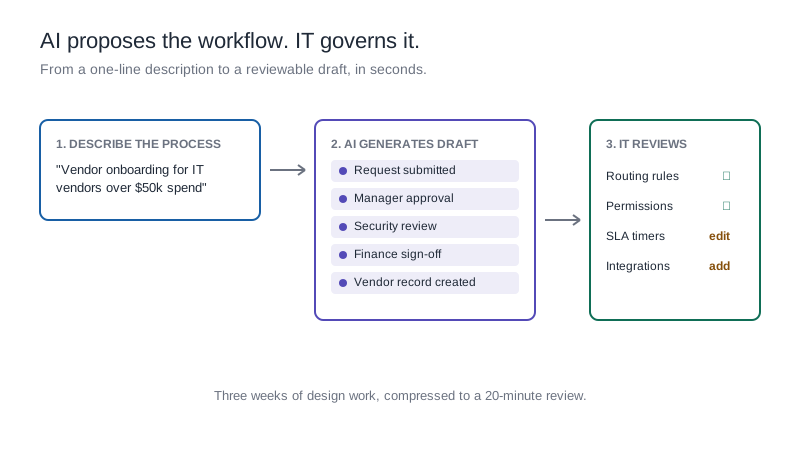
Kissflow's AI extends this to the workflow level. Teams describe their content approval process in plain language, and Kissflow generates the workflow as a blueprint: a structured, human-readable description of each stage, each stakeholder, and each condition that routes content to legal review versus standard brand review. The blueprint is transparent, modifiable, and governed by IT at the platform level. When the process changes because the team adds a new approval stage or a new platform, the team lead updates the blueprint in Kissflow without filing a development request.
How Kissflow supports content operations teams
Kissflow is an enterprise application platform where marketing operations teams build the workflow and project infrastructure that makes consistent content production possible.
On Kissflow, a social media calendar is not a template. It is a live project board where content items move through defined stages (ideation, draft, review, approved, scheduled, published), approvals route to the right stakeholders automatically, and performance data can be captured post-publication.
Teams that need to connect their social media calendar to broader marketing workflows, campaign briefs, content production requests, asset approvals, budget sign-offs, can build those connections on the same platform, without switching tools.
Because Kissflow's project and workflow capabilities are governed at the platform level, IT administrators have visibility into who is accessing what, approvals are tracked with complete audit trails, and the platform meets the compliance requirements that enterprise marketing teams operating in regulated industries need.
Frequently asked questions
What is a social media calendar?
A social media calendar is the operational system where a content team plans, tracks, and manages social media content from idea through publication. It captures what will be published, on which platform, on which date, and by whom: along with campaign context, asset links, approval status, and post-publication performance data. The most valuable social media calendars function as a system of record rather than just a publishing schedule.
How far in advance should a social media calendar be planned?
Most high-performing content teams plan at least two to four weeks ahead for evergreen and campaign content, with space reserved for real-time and reactive posts. Planning further in advance reduces coordination overhead and improves content quality by giving the team time for creative development and proper review. Last-minute content is almost always lower quality than content planned with adequate lead time.
What should a social media calendar include?
The core fields are platform, publish date and time, content copy, visual assets, campaign or initiative, status, and owner. More sophisticated calendars also include campaign objective, audience segment, content theme, approval history, and post-publication performance metrics. The right level of detail depends on team size and the complexity of the approval process.
How is a social media calendar different from a content calendar?
A content calendar covers all content across all channels: blog posts, email, video, white papers, and social. A social media calendar is the channel-specific view for social content. Most content teams maintain both, with the social calendar providing the operational detail needed for platform-specific planning and the broader content calendar providing the campaign-level view.
What is the biggest operational risk in social media management?
The biggest operational risk is the absence of a documented approval process. Content that requires legal review, brand compliance, or leadership sign-off but moves through an informal approval channel creates two risks: content that should not have been published gets published, and content that was supposed to be published gets delayed with no clear resolution path. A social media calendar with built-in approval workflows eliminates both risks.
Stop planning social media the week it needs to go out
The teams with the best social media presence are not the most creative ones. They are the most organized ones: operating four weeks ahead, approving content without chasing people down, and building on what worked last quarter because they have the data to know what that was.
.webp)