An editorial calendar holds the strategic content plan, including themes, campaigns, launches, and the major narrative arcs the business wants to land in a given quarter or year. A content calendar holds the production plan, including the individual assets being produced, the owners, the deadlines, and the publish dates. At small scale the two are often the same view. At enterprise scale they describe two distinct layers that have to be coordinated together.
This guide explains the difference, why enterprise content calendars consistently break in spreadsheets, and what mature enterprise content operations actually look like when the work is treated as the cross-functional discipline it has always been.
Editorial calendar vs content calendar: the enterprise distinction
At small scale, an editorial calendar and a content calendar are almost the same thing. A blogger or a small marketing team uses one shared view to track topics, deadlines, and publish dates. At enterprise scale, the two terms describe two different layers that sit on top of each other.
The editorial calendar is the strategic layer. It captures content themes, campaign tentpoles, product launches, executive briefings, regulatory communications, and the major narrative arcs the business wants to land in a given quarter or year. The editorial calendar is what the CMO, VP of Brand, and Head of Communications use to set direction and sequence the big bets.
The content calendar is the production layer. It captures the individual pieces of content being produced against that strategic plan, including blog posts, social posts, video scripts, white papers, landing pages, email campaigns, paid creative, and the localized variants of all of the above. The content calendar is what content producers, designers, video editors, localization leads, and approval reviewers operate against day to day.
At enterprise scale, the editorial layer and the production layer need to talk to each other, but they also need to remain distinct. Confusing the two leads to the most common failure pattern in enterprise content operations, where every piece of content gets reviewed at every level, and nothing ships on time.
Why enterprise content calendars break in spreadsheets
The Content Marketing Institute 2024 Enterprise Content Marketing research found that 40 percent of enterprise marketers say content requests go through a centralized content team, 30 percent say each department or brand produces its own content, and 23 percent say responsibility is shared across departments. The variation across operating models is one reason a single shared spreadsheet cannot hold enterprise content operations together for long.
Within twelve months of a marketing team starting with a shared spreadsheet, that spreadsheet has become unworkable. The failure pattern is consistent across organizations of any size or vertical.
Content commitments are made across multiple teams that the spreadsheet cannot keep in sync. The demand generation team commits to a launch piece, the brand team commits to a thought leadership campaign, the product marketing team commits to a competitive battle card, and the localization team has not been told about any of it until the week before launch.
Approval chains live outside the calendar. Legal review happens in email. Brand review happens in a separate document tool. Compliance review happens through a ticketing system. Executive review happens in a slide deck the night before the meeting. The calendar shows a publish date, but the calendar has no visibility into whether any of the gates have actually been cleared.
Localization adds a parallel workstream that the calendar treats as an afterthought. A piece of content scheduled for global publication needs ten or more localized variants, each with its own translation review, cultural adaptation, and regional approval. The calendar shows one row. The actual work is ten rows.
Channel-specific variants multiply the production load. A single campaign idea becomes a long-form blog post, a series of short-form social posts, a YouTube script, a podcast briefing, a landing page, an email sequence, a sales enablement asset, and a paid creative variant. The calendar that tracks the idea does not track the variants, and the variants are where most of the production time actually goes.
None of these failures comes from a lack of discipline. They come from the calendar trying to do work that requires an operational system. A spreadsheet cannot route an approval, cannot trigger a localization workflow, cannot enforce a brand check, and cannot give the CMO real-time visibility into where the work actually is.
What an enterprise editorial calendar actually has to coordinate
A working enterprise editorial calendar coordinates seven distinct workstreams, and the failure of most spreadsheet-based calendars is that they only show one or two of them.
- Strategic content commitments tied to campaigns, launches, and business narratives owned at the leadership level
- Production workflows for every content asset, including ownership, dependencies, and status across writing, design, video, and editing
- Approval chains across legal, brand, compliance, product, and executive review, with audit trails for regulated content
- Localization workflows for every market the content is published in, with translation, cultural adaptation, and regional sign-off built in
- Channel-specific production for the variants of each core asset across owned, earned, paid, and sales-enablement channels
- Performance signals from published content flowing back to the calendar so editorial decisions get informed by what actually worked
- Capacity planning across content producers, designers, video teams, and external agencies so the calendar reflects what can realistically be shipped
How mature enterprise content teams operate the calendar
The Content Marketing Institute also found that 76 percent of the most successful enterprise content marketers cite knowing their audience as the top success factor, followed by 73 percent who set goals aligned with organizational objectives and 62 percent who collaborate well with other teams. These habits show up in how mature content teams operate the calendar.
Separate the editorial layer from the production layer
Leadership operates against the editorial layer, which shows strategic themes, campaign tentpoles, and major narrative arcs. Producers operate against the production layer, which shows individual assets, statuses, owners, and approval gates. The two layers are linked, but they are not the same view, and they are not used in the same meetings.
Run approvals as workflows, not emails
Every content asset that needs review routes through a defined approval workflow with clear owners, deadlines, and escalation paths. Legal review happens in the system, not in someone's inbox. The audit trail is preserved automatically for regulated content.
Treat localization as a parallel pipeline
Localized content runs on its own production track that gets triggered when the source content reaches a defined stage. The localization team has its own queue, its own SLAs, and its own approval chain that does not block the source asset from publishing in the home market.
Make capacity visible alongside commitments
The calendar shows what the team has committed to and what the team can realistically deliver in the same view. When commitments exceed capacity, the conflict is visible to leadership before the deadline arrives, not after the deadline is missed.
Close the loop on performance
Every published content asset gets its performance data fed back into the calendar so editorial decisions for the next quarter are informed by which themes, formats, and channels actually worked. The calendar becomes a learning system, not just a scheduling system.
The shift from calendar to content operations platform
The deeper shift in enterprise content operations over the last several years has been the move from calendars to content operations platforms. A calendar shows the work. An operations platform runs the work.
The operations platform holds the strategic editorial layer and the production layer in one place, with explicit links between them. It runs approval workflows for every content type, with audit trails preserved automatically. It triggers localization pipelines, manages variant production, captures performance data, and surfaces capacity conflicts before they break the schedule. It connects to the enterprise systems that surround content production, including CRM, marketing automation, analytics, asset management, and the workflow systems the rest of the business runs on.
How Kissflow helps enterprise content operations
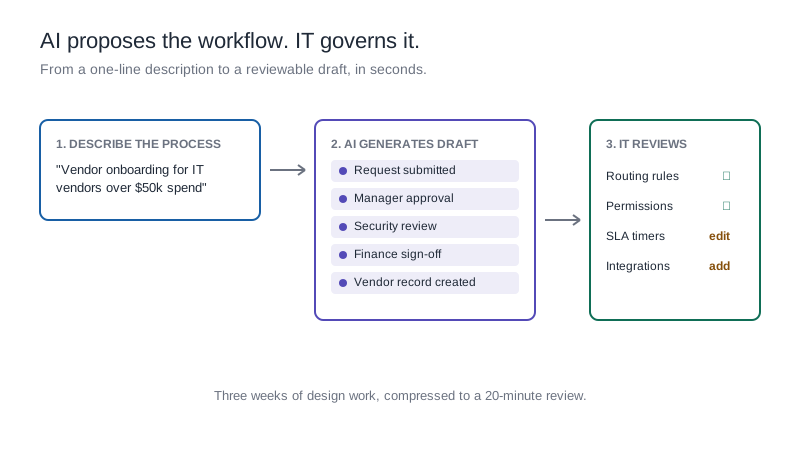
Kissflow gives enterprise marketing and content teams the operational layer the work now requires. The platform holds editorial planning and production workflows together, runs approval chains across legal, brand, and compliance, manages localization as a parallel pipeline, captures performance feedback, and integrates with the marketing, sales, and operations systems the rest of the business depends on.
Content teams use Kissflow to run multi-region content operations with audit-grade approval trails, to coordinate channel-specific variant production across owned, paid, earned, and sales-enablement assets, and to give leadership real-time visibility into where every commitment sits without rebuilding the picture each week. The platform replaces the spreadsheet and email coordination work that holds most enterprise content teams back.
Request a Kissflow demo and see enterprise editorial operations in action.

.webp)