
Business Processes Hierarchy - The Ultimate Guide
Business process hierarchy organizes workflows into levels from high-level value chains down to individual tasks. Understanding this structure helps organizations prioritize automation efforts, assign process ownership, and align operational activities with strategic objectives. Read the blog to understand how to build and use a business process hierarchy in your organization.
You're managing dozens of business processes, but do you know which ones actually drive your bottom line? Most organizations operate with scattered, unconnected processes that consume resources without delivering measurable value. Gartner research reveals that only 30 percent of business processes in typical organizations directly contribute to strategic objectives – the rest are just expensive overhead. If you can't clearly trace how your daily operations connect to your business goals, you're flying blind. Business process hierarchy provides the strategic framework that transforms operational chaos into a coordinated system where every process has a purpose and measurable impact.
Introduction to business process hierarchy
Business process hierarchy is a structured framework that organizes and categorizes business processes into multiple levels (strategic, operational, and tactical) to provide clear visibility into how individual tasks connect to broader organizational goals and value chains.
Levels of the business process hierarchy
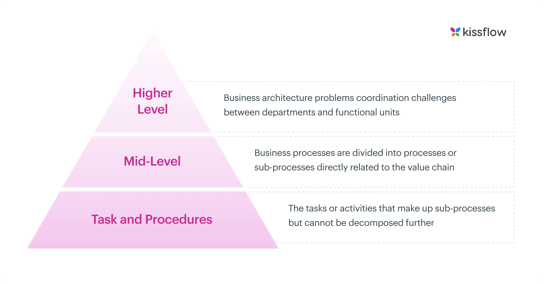
Process hierarchy is typically divided into three specific levels, with each providing more granularity and detail than the level preceding it.
1. Higher level
It's the topmost level, commonly associated with business architecture problems or coordination challenges between departments and functional units. At this level is the value chain which represents a major business line. Here, the business focuses on aligning inputs with outputs.
2. Mid-level
Depending on the nature of the organization and the complexity of business processes, here business processes are divided into processes or sub-processes directly related to the value chain. Mid-level hierarchy addresses departmental difficulties requiring simplification, task automation, or sequence rearrangement.
3. Task and procedures
It contains detailed information on the tasks or activities that make up sub-processes but cannot be decomposed further. They often require a detailed task analysis and are captured as day-to-day activities or work instructions. They include job descriptions, specific business rules, and user, or system responsibilities.

Benefits of having a process hierarchy
-
Provides knowledge on how tasks flow in the company, increasing understanding of an organization’s business processes, employee accountability, and pinpointing the people responsible for key decisions.
-
Since it follows an abstract-to-concrete principle, it acts as the documentation structure for process management and helps define each business process hierarchy level clearly.
-
Deciding and agreeing on levels of hierarchy prevents a mismatch of stakeholder expectations.
-
Helps organizations deploy resources more effectively to reduce waste, deliver value, and meet corporate goals.
-
Increases the speed and efficiency at which employees perform their tasks, ensuring the business runs smoothly.
-
It's a systematic improvement approach that identifies current and potential processes and how they link together within the organization
How to create a Business Process Hierarchy
Creating a professional, well-defined process hierarchy is a complex and time-consuming undertaking. So, depending on your business complexity, level of enthusiasm, or the amount of time, you can hire a consultant, use predefined process hierarchies, or take ownership of the project by aligning it with suitable business process mapping levels.
How process hierarchy drives business process management for businesses
When a BPM solution is implemented correctly, it boosts productivity by up to 50%[3]. It also:
- Helps organizations view and manage processes better, providing insights to optimize their business. Your company can continuously measure and improve processes incrementally across the organization by establishing the right business process hierarchy level.
- Creates a shared and systematic understanding of critical organizational processes and identifies a clear basis for improvement. From this, you can design processes to achieve a specific goal and increase process efficiency.
- Breaks down processes that offer comprehensive performance results useful for efficient decision-making. It eliminates the silo approach and pinpoints joint areas and common process touchpoints for improvement.
How process improvement and process optimization influence process hierarchy
Process improvement is performed at the business process level to identify and assess inefficiencies within the organization. Robust process management and improvement begin with process hierarchy and can be adjusted to suit organizational needs.
Process hierarchy makes process improvement and optimization easier because it helps an organization view all its processes as connected. The primary goal for business process improvement activities is to strategically align processes with organizational goals and ensure all processes and tasks add value.
Process improvement requires an accurate process understanding and proper management to implement the right changes. It also requires allocating resources to the most critical processes. You can use the process hierarchy to prioritize, improve and optimize key-level processes.
Add value to your business process hierarchy with Kissflow
Creating your process hierarchy is only the first step towards improving and optimizing your business processes. It also lays the foundation for standard operating procedures and typical workflow routines. But even with that, to succeed at process management, your ultimate process hierarchy levels must be customer-specific. By adopting the right business automation software, organizations can connect people, processes, and data to work seamlessly together. This not only reduces bottlenecks but also creates a more agile environment that can quickly adapt to changing business needs.
Kissflow is a powerful yet simple low-code platform that allows you to identify inefficiencies in existing processes and redesign them to improve overall operational efficiency. With its visual drag-and-drop form builder, you can make process changes quickly with a few clicks. Since it's low-code, business users with little to no technical knowledge can create streamlined processes from scratch.
Solve your workflow challenges with Kissflow platform and optimize your team's productivity.
Related Topics:
- Business Process Management System (BPMS) - An Ultimate Guide for 2026
- Business Process Management (BPM) Suite: Everything You Need To Know
- 5 Stages of Business Process Management Lifecycle
- BPMN - An Ultimate Guide to Business Process Model and Notion for 2026
- What Are Document-Centric, Integration-Centric and Human-Centric BPM?
FAQ's Business Process Hierarchy
1. What are the 5 levels of process mapping?
The five levels of process mapping correspond to increasing levels of detail: context diagrams (L1), high-level end-to-end process maps (L2), detailed sub-process flows (L3), activity-level task mapping (L4), and work instructions (L5). These levels ensure process clarity from strategic planning down to operational execution.
2. What is a business process hierarchy?
A business process hierarchy is a structured visualization that organizes all business processes within an organization from the top down. It helps stakeholders understand how individual tasks contribute to larger goals and supports better process governance, standardization, and improvement.
3. How can organizations effectively implement these hierarchical levels?
To implement a process hierarchy effectively, organizations should start with mapping their core value streams, involve process owners and IT in defining detailed workflows, use tools like Kissflow for modeling and automation, and establish governance frameworks to maintain consistency and adaptability.
4. What is L1, L2, L3 in business process?
L1 refers to top-level process groups or value chains; L2 outlines the core processes within those groups; and L3 breaks them into detailed sub-processes. This tiered view supports alignment between business strategy and execution, especially in large organizations.
5. What are the different levels of business processes?
Business processes exist at three levels: operational processes (day-to-day activities like order processing), management processes (resource allocation and performance monitoring), and strategic processes (long-term planning and market positioning). These form a hierarchy where strategic processes set direction, management processes allocate resources, and operational processes deliver value to customers.
6. How does hierarchy improve process management?
Process hierarchy improves management by aligning operational activities with strategic objectives, ensuring resources focus on value-creating activities, clarifying accountability at each level, enabling appropriate governance and control mechanisms, facilitating effective delegation, providing context for process improvement initiatives, and creating a framework for measuring performance from operational to strategic levels.
7. What industries use business process hierarchies?
Industries using business process hierarchies extensively include manufacturing with its production planning hierarchy, healthcare organizing clinical and administrative processes, financial services structuring risk management and customer service processes, government agencies managing policy implementation, and retail coordinating merchandising, supply chain, and customer experience processes. Complex organizations with multiple business units benefit most.
8. How do businesses optimize their process structures?
Businesses optimize process structures by aligning processes with strategic objectives, establishing clear process ownership and governance, implementing standardization where appropriate while allowing necessary variations, creating mechanisms for continuous improvement, deploying appropriate automation and decision support, developing relevant performance metrics, and fostering a process-oriented culture that values end-to-end thinking.
9. What role does automation play in business process hierarchy?
Automation plays several roles in business process hierarchy: at the operational level, it executes standardized tasks with consistency and efficiency; at the management level, it provides monitoring and analytics for performance oversight; at the strategic level, it delivers insights for decision-making and innovation. Properly implemented automation creates a virtuous cycle where operational improvements generate data that informs strategic direction.
Related Articles

![Business Process 101 : Definition, Steps and Example [Guide for 2026]](https://kissflow.com/hs-fs/hubfs/the_extensive_guide_to_business_processes_for_2025-1.webp?width=352&name=the_extensive_guide_to_business_processes_for_2025-1.webp)












%20(1)%20(1).png?width=1997&height=1800&name=The%20ultimate%20buyers%20guide%20to%20BPM%20(1)%20(1)%20(1).png)

