Finance teams rarely lose control of spending in one large, obvious decision. They lose it in a hundred small commitments made across departments that nobody sees together until the quarter closes soft. By then the money is spent, the budget conversation is a post-mortem, and the only question left is how it happened. The answer is almost always the same: the commitments were invisible while they were still reversible.
Spend management software is the system finance uses to see, control, and analyse company-wide spending as commitments are made, so budgets are managed in real time rather than reconciled after the fact. It turns spend from a number you total at month-end into a signal you can act on while there is still room to act.
Why spend gets out of control quietly
Spend escapes through the spaces between approvals. A subscription renewed automatically. A small purchase under the approval threshold, repeated by ten teams. A commitment made verbally and confirmed by email. None of these is large enough to trigger attention on its own, and together they move a budget more than the one big purchase everyone scrutinised. Visibility is the fix, because a commitment you can see is a commitment you can question.
Spend management versus expense management
These two are often confused, and the line matters. Expense management handles money employees have already spent on the company's behalf: reimbursements, travel, and claims. Spend management looks forward, at commitments the company is about to make across budgets, suppliers, and categories. Expense management asks to pay people back. Spend management asks whether the spend should happen at all, which is why it sits closer to finance automation and budget control than to reimbursement.
What spend management software gives finance
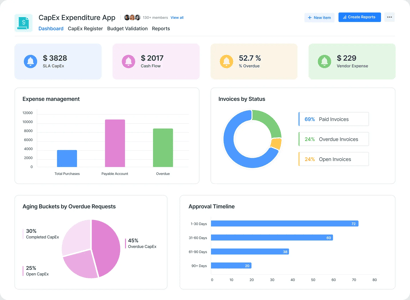
A capable system gives finance three things it usually lacks. A live view of committed spend against each budget, not just spent-and-recorded. Control at the point of commitment, so a request that breaks a budget is caught before it becomes an order. And analysis across categories and suppliers, surfaced on spend dashboards that show where the money is actually going. The shift is from reconciling the past to steering the present.
Building budget visibility and control without code
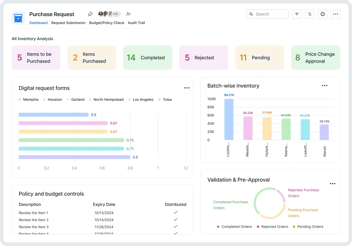
Budgets, thresholds, and categories are specific to each finance team, and they change. A no-code platform lets finance build the spend model around its own structure and adjust it as budgets shift. In Kissflow, you define the budgets, connect each commitment to its budget, set the controls that catch a breach, and surface the result on a live view. The logic is a readable blueprint that finance owns and audits, with the platform carrying the build, automate, and govern jobs so controls hold without manual policing.
Where AI helps: categorisation and early signals
AI in spend management is most valuable at the input and the warning. It can categorise spend consistently so the analysis is trustworthy, and it can surface an early signal that a budget is trending toward a breach. Kissflow AI maps these into the platform's structure for a person to confirm, with finance in the lead on every control. The categorisation is assistance; the budget decisions stay with the people who own them.
The spend control loop in practice
- Each budget is defined with its owner and its threshold.
- Every commitment is connected to its budget at the point it is requested.
- A request that would breach a budget is caught and escalated before it becomes an order.
- Committed and actual spend are shown live against each budget.
- Category and supplier analysis informs the next budget cycle.
Frequently asked questions
What is the difference between spend management and expense management?
Expense management handles money employees have already spent and need reimbursed. Spend management looks forward at commitments the company is about to make, controlling spend before it happens.
How does spend management software improve budget control?
It connects each commitment to its budget at the point of request, catches breaches before they become orders, and shows committed spend live, so budgets are steered in real time rather than reconciled later.
What is spend visibility?
Spend visibility is seeing committed and actual spend across budgets, categories, and suppliers as it happens, rather than totalling it after the period closes.
Can spend management work alongside our existing ERP?
Yes. It controls and analyses spend at the point of commitment and passes clean records to the ERP, which remains the system of record.
Related Blog's:
Procure-to-Pay Software: Connecting the Whole Buying Cycle
Purchase Requisition Software: Where Spending Decisions Should Start
Supplier and Vendor Onboarding Software: From Request to Active
Employee Offboarding Software: Closing the Gaps the Day Someone Leaves