A marketing manager needs a new analytics tool, so he emails procurement to ask for it. Procurement asks for a budget code. Finance asks who approved it. The thread gains four people and loses its original question. Three weeks later the tool is bought, the invoice arrives, and finance discovers a commitment it never saw coming. Nobody did anything wrong. The request just travelled by email, and email is where spending decisions go to get lost.
Purchase requisition software is the system employees use to request a purchase, route it for approval, and hand a clean, approved request to procurement before any order is placed. It puts structure at the front door of spending, so the decision to buy is captured, checked, and visible from the first ask rather than discovered at the invoice.
The difference between a requisition and a purchase order
These two get confused, and the confusion is expensive. A purchase requisition is an internal request: an employee asking the company for permission to spend, before anything is committed to a supplier. A purchase order is what comes next: the approved, external commitment the company sends to the supplier. The requisition is where control belongs, because it is the last point at which the answer can still be no. Once a purchase order goes out, the money is already promised.
This is why requisition software is not the same as purchase order automation. Requisition software governs the request and the approval. Purchase order automation handles the order itself. A complete procurement flow needs both, in that order, which is the logic behind a connected procure-to-pay process.
What a requisition system controls
Requisition software answers three questions before a single dollar is committed. What is being requested and why. Whether the budget exists to cover it. And who has approved it. A capable system captures the request on a structured form, checks it against the right budget, routes it to the correct approvers in sequence, and produces an approved record that procurement can act on with confidence.
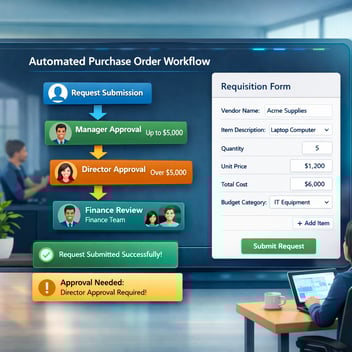
The structured form is what makes the difference. An email request omits whatever the requester forgot. A requisition form built on a no-code form builder asks for the cost centre, the category, the justification, and the amount every time, so procurement receives a complete request instead of the start of a conversation.
Why email approvals leak money
Email approvals fail in quiet, costly ways. Approvals stall in an inbox while the requester waits and the work slips. The approval chain is invisible, so no one can say where a request is stuck. And because email leaves no enforced record, the same purchase can be approved twice or approved by someone without the authority to approve it. Finance feels the result as commitments it cannot see until they land as invoices, which makes budgeting a guess.
Building a requisition workflow without code
Approval rules are specific to a business: by amount, by category, by cost centre, by who sits where in the hierarchy. A no-code platform lets finance and procurement build those rules themselves and change them as thresholds move. In Kissflow, you define the requisition form, the budget check, and the approval path, and you set who can approve what. The logic is a readable blueprint, so finance can audit exactly how a request is routed and adjust a threshold without a development cycle. The platform builds the requisition workflow, automates the routing and the budget check, and governs the record so every approved request is traceable. Pairing it with finance automation keeps the approved spend connected to the books.
Where AI helps the requester and the approver
AI in requisitions is most useful at the edges of the process. It can help a requester fill a request correctly the first time by reading a quote and drafting the line items for review, and it can help an approver by surfacing whether a request fits the budget. Kissflow AI works by mapping these into the platform's structure for a person to confirm, with a human in the lead on every approval. The decision to spend stays with the people accountable for the budget.
A requisition-to-PO flow that finance trusts
- The requester submits a structured requisition with cost centre, category, justification, and amount.
- The system checks the request against the available budget for that cost centre.
- The request routes to approvers in sequence based on amount and category.
- Once approved, the clean record is handed to procurement to raise the purchase order.
- Finance sees the committed spend at approval, not at the invoice.
Frequently asked questions
What is the difference between a purchase requisition and a purchase order?
A purchase requisition is the internal request and approval to spend. A purchase order is the approved commitment sent to the supplier afterwards. Requisition software controls the first; purchase order automation handles the second.
Does purchase requisition software replace our finance system?
No. It sits in front of it. The requisition system governs the request and approval, then passes an approved record to procurement and finance, so spend is controlled before it reaches the books.
Can approval rules differ by amount and department?
Yes. On a no-code platform you set approval paths by amount, category, and cost centre, and maintain them yourself as thresholds change.
Related Blog's:
Procure-to-Pay Software: Connecting the Whole Buying Cycle
Spend Management Software: Seeing the Money Before It Is Gone
Supplier and Vendor Onboarding Software: From Request to Active
Employee Offboarding Software: Closing the Gaps the Day Someone Leaves