Most companies have automated pieces of their buying. A requisition tool here, a purchase order step there, invoice processing somewhere else. The pieces work, but the gaps between them are where the money and the time disappear. A request approved in one system never reaches the next. An invoice arrives with no order to match it against. Each piece is fine on its own, and the process as a whole still leaks.
Procure-to-pay software is the system that connects every step from a purchase request to the final supplier payment into one continuous, tracked process. It treats buying as a single chain rather than four disconnected tools, so a request that starts at one end arrives, intact, at the other.
Why the gaps cost more than the steps
Automating one step in isolation speeds that step up and then hands the work to a gap. The approved requisition that has to be retyped into the ordering tool. The invoice that sits in a finance inbox because nobody can find the matching order. Each handoff between disconnected tools is a place for a request to stall, get duplicated, or get lost, and those handoffs are exactly what a connected procure-to-pay process removes.
What the procure-to-pay cycle includes
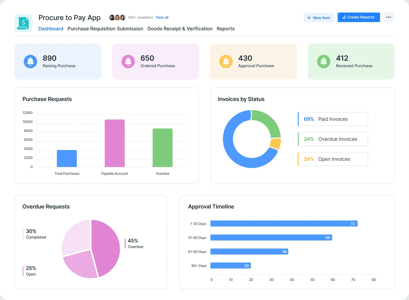
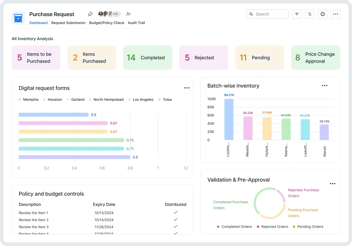
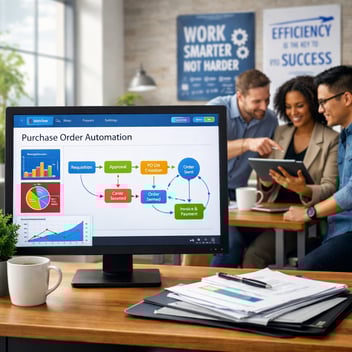
A full cycle runs from the first request to the final payment. It begins with a purchase requisition, moves through approval, becomes a purchase order sent to the supplier, receives the goods or service, matches the supplier invoice against the order, and ends in payment. When all of that lives in one system, every step can see the one before it, which is what makes a three-way match possible without anyone chasing paper.
Where most procure-to-pay processes break
The common break point is the join between approval and payment. Spend is approved in one place and paid in another, with no shared record connecting them, so finance cannot confirm that what was paid is what was approved. The second break is the supplier side: an invoice from a supplier who was never properly set up arrives and stalls, which is why onboarding belongs inside the same chain.
Building a connected P2P flow on a no-code platform
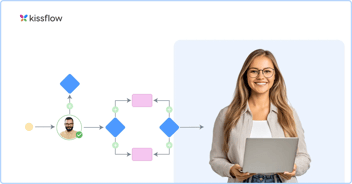
Procure-to-pay rules differ by company, and a rigid product rarely fits all of them. A no-code platform lets procurement and finance build the chain around their own steps and change it as the process matures. In Kissflow, you connect the requisition form, the approval path, the order, the match, and the payment handoff into one workflow described as a readable blueprint. Procurement and finance can audit the whole chain and adjust any step without a development request. This is the connected version of no-code procurement automation, with the build, automate, and govern jobs carried by one platform. Bringing a new supplier in through supplier onboarding at the front keeps the chain clean from the start.
Where AI helps: matching and exceptions only
The most useful AI in procure-to-pay handles the volume work and escalates the judgment work. It can read an invoice and propose the match to its order and receipt for a person to confirm, and it can flag the exceptions that need a human eye. Kissflow AI maps these into the platform's structure with a person in the lead on every exception, so automation clears the routine and people decide the unusual.
The procure-to-pay cycle in six steps
- An employee raises a requisition, which is approved against budget.
- The approved request becomes a purchase order sent to the supplier.
- The supplier delivers the goods or service, and receipt is recorded.
- The invoice arrives and is matched to the order and the receipt.
- Matched invoices are approved for payment; exceptions are escalated.
- Payment is released, and the full history stays on one record.
Frequently asked questions
What are the stages of the procure-to-pay cycle?
The cycle runs from requisition and approval, to purchase order, goods receipt, invoice matching, and payment. Procure-to-pay software connects these stages so each can see the one before it.
What is the difference between procure-to-pay and source-to-pay?
Source-to-pay starts earlier, with sourcing and supplier selection, then includes the procure-to-pay steps. Procure-to-pay begins at the request to buy and ends at payment.
Does procure-to-pay software replace an ERP?
No. It coordinates the buying process and passes clean records to the ERP or finance system, which remains the book of record for payments and accounting.
How does three-way matching work?
Three-way matching compares the purchase order, the goods receipt, and the invoice. When all three agree, the invoice is cleared for payment; a mismatch is escalated as an exception.
Related Blog's:
Purchase Requisition Software: Where Spending Decisions Should Start
Spend Management Software: Seeing the Money Before It Is Gone
Supplier and Vendor Onboarding Software: From Request to Active
Employee Offboarding Software: Closing the Gaps the Day Someone Leaves