The Future of No-Code Development: Trends Shaping 2026 and Beyond
The future of no-code programming points toward AI-assisted development, deeper enterprise adoption, and platforms that handle increasingly complex applications. Emerging trends include generative AI for app creation, no-code AI agents, advanced integration capabilities, and platforms that blur the line between no-code and traditional development.
No-Code Is the Future for Every Business
In the past, low-code platforms got a lot of attention for what they brought to the table. They provided a fast and easy way to code software. They opened the door to making skilled developers even faster, and also letting business leaders try their hand at creating applications.
But low-code development are fundamentally limited–as their name suggests, they’re not entirely code-free. At some point, maybe for some extraordinary functionality, low-code platforms will need the hand of a trained programmer.
No-code AI takes this promise further by simplifying development with intelligent automation, enabling even faster app creation and smarter workflows without deep technical expertise.
The no-code platform landscape is evolving rapidly as AI capabilities and enterprise-grade features reshape what's possible without writing code.
What is No-Code Programming?
As the name suggests, no-code programming software is a step further from low-code, providing a completely code-free experience to users so they can create and launch applications without needing to write a single line of code.
No-code programming is done through no-code app development platforms, development software specifically designed to cater to citizen developers. These business users understand the logic for the application they want to create, but don’t have the traditionally required knowledge or training in coding and programming languages.
Using no-code platform, citizen developers can create their own business applications without needing to consult with the IT department or programming staff for the implementation and execution.
But no-code programming software seems like a too-good-to-be-true situation. There has to be a catch, right? How can no-code replace traditional methods of software building altogether?
Can Traditional Programming Be Replaced by No-Code?
The short answer? No.
As miraculous as no-code programming and no-code platforms are, they can’t replace traditional hand-coding. No-code databases for modules and components need to be built by traditional programming. No-code platforms will need to be built by hand coding.
As a result, there’s never going to be a scenario where hand coding will be completely replaced. Because no-code programming software was never meant to replace hand coding.
While no-code platforms make development faster and easier, many organizations are also exploring the flexibility of open-source no-code platforms. These solutions provide greater control, customization, and transparency, empowering IT teams and enterprises to innovate without being locked into a single vendor.
No-code platforms were meant to help citizen developers have a platform to create applications on, while freeing up trained programmers to focus their attention on tasks which actually require their insight.
The emergence of no-code AI agents is enabling enterprises to deploy autonomous workflow automation that handles complex decision-making without developer intervention.
The rise of the no-code movement is reshaping how businesses build and scale applications. By putting powerful tools in the hands of business users and IT leaders alike, it accelerates digital transformation while reducing dependency on traditional coding resources. This transformation is particularly evident in workflow automation, where a sophisticated no code workflow automation platform enables organizations to orchestrate complex business processes across departments without requiring traditional programming expertise.
The rapid rise of the no-code movement is reshaping how no-code companies innovate, making it easier than ever to build apps without coding while redefining no-code vs low-code vs pro-code development approaches. As no-code trends continue to evolve, organizations are accelerating no-code digital transformation by enabling teams to build apps without developers, reducing reliance on traditional engineering resources. This shift is powered by a growing no-code ecosystem, which now includes enterprise-grade platforms alongside open-source no-code platforms that offer flexibility, extensibility, and greater control.
But if no-code programming doesn’t require knowledge in coding languages, what does a citizen developer need to start coding?

 Free eBook
The Ultimate Buyer's Guide to No-Code

Thank you for downloading!
What You Need to Start Coding on a No-Code Platform
Essentially, all a citizen developer needs is an idea for the application he wants to build, and the logic behind how the application will work. If he has both, then the citizen developer can create an application using a no-code platform.
No-code solutions might sound overly ambitious, but they really do deliver. Ideally, anyone can code their own applications using the modules and components available in no-code databases.
How Complex Can App development Get?
The degree of complexity of an app built on a no-code platform varies by product. Each platform has different resources and modules, depending on the vendor providing and servicing the platform.
But if your app is incredibly complex, then you’ll find no-code won’t be able to help you create the app, at least not entirely without code. If you cannot find components in the no-code database for the functionalities you want, then you’ll need to contact your vendor so they can code it for you, or look into building it yourself.
AI-powered no-code workflows represent the next frontier, enabling enterprises to build intelligent processes that adapt, learn, and optimize autonomously.
For a deep dive into specific future trends in no-code for 2026 and beyond, including market projections and adoption patterns, explore our detailed analysis.
See the full story → SN Aboitiz Power Future-Proofed Operations with Citizen Development — 451% ROI
Conclusion
The future of no-code programming is bright. Discover the future no-code platform leaders transforming industries with next-gen technologies.
Kissflow No-code platforms promise to thin the boundary between programmers and non-programmer. These platforms are designed to maximize productivity in the workplace, while reducing the time taken for any app to go from idea to reality. If you’re looking for a no-code platform to get started, check out Kissflow, a business process management and workflow automation platform designed for all your productivity and efficiency needs. Get a free trial and see if Kissflow is right for your organization.
FAQs:
1: Will no-code replace traditional developers in enterprises?
No-code will augment, not replace developers. The future shows: (1) Developers shifting to higher-value work - building complex integrations, custom components, AI models, and platform extensions instead of routine CRUD applications, (2) Hybrid development models - developers creating reusable components that business users assemble into applications, (3) Specialized roles - professional developers becoming "no-code architects" who design platforms and governance frameworks, (4) Reduced junior developer bottlenecks - citizen developers handle departmental apps while developers focus on enterprise architecture, and (5) Faster innovation - developers prototype with no-code before committing to custom code. The developer role evolves toward platform engineering, integration architecture, and complex problem-solving.
2: How are AI and automation shaping the next evolution of no-code?
AI is transforming no-code through: (1) Natural language app generation - describing apps in plain English that AI converts to working applications, (2) Intelligent automation - AI analyzing processes and suggesting optimization opportunities, (3) Predictive analytics built-in - no-code apps gaining forecasting and anomaly detection without data science expertise, (4) Auto-generated workflows - AI learning from historical data to create approval chains and business rules, (5) Smart testing - AI generating test scenarios and identifying bugs automatically, (6) Intelligent form design - AI suggesting optimal field types and validation based on data patterns, and (7) Automated documentation - AI generating user guides and technical documentation from application structure.
3: Can no-code platforms handle complex enterprise logic in the future?
Future no-code platforms will handle increasing complexity through: (1) Visual programming for algorithms - representing complex logic through flowcharts and decision trees that compile to efficient code, (2) AI-assisted logic building - suggesting optimal rule structures based on requirements, (3) Integration with custom code - allowing developers to write complex modules that citizen developers can utilize, (4) Advanced data modeling - supporting graph databases, time-series data, and complex relational structures, (5) Real-time processing - handling high-volume transactions and event streaming, and (6) Machine learning integration - embedding ML models into workflows without data science expertise. The gap between no-code and traditional development will narrow significantly.
4: What skills do enterprise teams need to stay future-ready?
Critical skills include: (1) Process thinking - understanding how to map business processes into automated workflows, (2) Data literacy - knowing how to structure, query, and visualize data effectively, (3) Integration concepts - understanding APIs, webhooks, and system connectivity, (4) User experience design - creating intuitive interfaces that users actually adopt, (5) Governance awareness - balancing agility with security and compliance, (6) Change management - driving adoption and managing stakeholder expectations, and (7) Analytical thinking - using data to optimize processes and measure outcomes. Technical depth matters less than business acumen combined with systematic problem-solving. Organizations should invest in certification programs and communities of practice.
5: How will governance evolve as no-code grows?
Future governance will feature: (1) AI-powered compliance - automated policy enforcement that flags risks before deployment, (2) Dynamic permissions - context-aware access control that adapts based on user behavior and risk signals, (3) Automated auditing - AI continuously monitoring applications for security issues and compliance gaps, (4) Predictive governance - identifying potential problems before they occur based on patterns, (5) Collaborative oversight - shared responsibility between IT and business with clear accountability frameworks, (6) Self-service guardrails - business users receiving real-time guidance on security best practices, and (7) Continuous certification - regular automated assessments replacing annual compliance reviews. Governance becomes proactive and embedded rather than reactive and centralized.
6. What is the future of no-code development?
The future of no-code development is set for significant growth as more organizations adopt these platforms to accelerate digital transformation and meet demand for rapid application development. Platforms will offer more advanced features, including enhanced AI and machine learning, greater integration options, and improved user experiences, enabling more sophisticated applications and reshaping the software development landscape.
7. What is no-code programming?
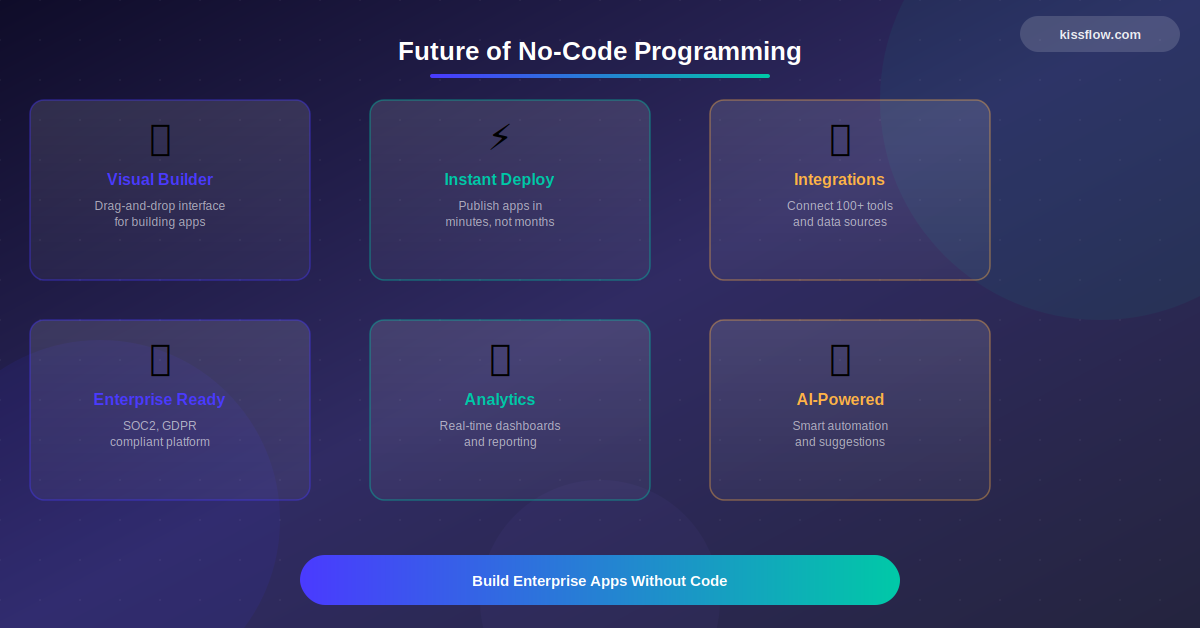
No-code programming is the process of building software applications without writing traditional code. Instead, users work in visual development environments, using drag-and-drop components, logic builders, and pre-built templates to turn logic and conditions into functional applications. This democratizes software development, allowing people without programming skills to create digital solutions and automate processes.
8. How does no-code technology work?
No-code technology provides a visual development environment where users build applications, automate workflows, and manage data using drag-and-drop tools and pre-configured components. Instead of writing code, users interact with a graphical interface to design an application's structure and behavior, and drag-and-drop builders turn their actions into automated workflows. The platform handles the underlying code generation, letting non-technical users create functional software without knowing programming languages.
.webp)

Related Articles

7 MINUTES READ
How Businesses Build Apps Without Developers in 2026