- >
- BPM>
- Business Orchestration and Automation Technologies (BOAT): The Enterprise Guide for 2026
Business Orchestration and Automation Technologies (BOAT): What Gartner's Category Means Now
Selecting a BOAT-aligned platform requires evaluating how well it unifies automation technologies like BPA, RPA, LCAP, and iPaaS into a single orchestration layer. Enterprises must assess integration capabilities, governance, and scalability to avoid fragmented automation stacks. This guide explains the key criteria CIOs should use when selecting a BOAT-aligned platform.
TL;DR
- Business orchestration and automation technologies (BOAT) is Gartner's term for a single orchestration layer that converges RPA, BPA, LCAP, and iPaaS, so automation stops living in four disconnected tools.
- Gartner's 2026 Critical Capabilities for BOAT, published 15 September 2026, evaluated 20 vendors and locked in a new requirement: native AI agent orchestration, governance, and multiagent coordination, not an optional add-on.
- By 2030, 70 percent of enterprises are expected to consolidate onto one orchestration platform for processes, agents, bots, and human tasks, up from roughly 10 percent today.
- BOAT describes the enterprise-wide category. It does not replace the buyer-intent question of automating one specific process end to end, which is what digital process automation answers.
- Ramco Group used Kissflow to unify 40-plus companies' workflows onto one platform, the same consolidation BOAT describes at category scale.
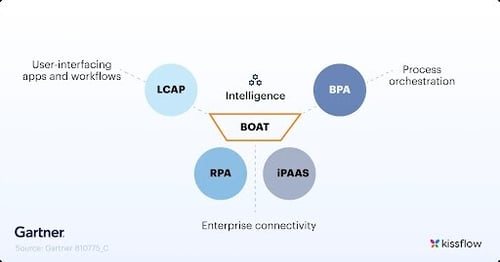
Definition: Business orchestration and automation technologies (BOAT) is Gartner's name for a unified platform category that orchestrates and governs business processes, systems, bots, APIs, AI agents, and human tasks under one control plane, rather than leaving each automation type as its own disconnected tool.
Best for: CIOs and IT leaders who have already bought RPA, BPA, LCAP, and iPaaS tools separately and now need one governed layer to coordinate them, especially as AI agents start running inside those same processes.
A claims team has an RPA bot that extracts data from a form, a BPA workflow that routes the approval, an iPaaS connector that pushes the result into the policy system, and a low-code app the business team built to track exceptions. Four tools, four vendors, four places something can quietly fail, and no single view of whether the claim actually moved. Business orchestration and automation technologies is Gartner's name for the layer that is supposed to sit above all four and make them behave like one system instead of four systems that happen to be adjacent.
What is business orchestration and automation technologies (BOAT)?
BOAT is not a single product or a software category in the traditional sense. It is Gartner's framework for how enterprise automation should be architected: not as a collection of point solutions for specific tasks, but as a unified orchestration layer that coordinates people, systems, data, and automated actions toward one process outcome. Gartner introduced the framework in 2024 as the answer to a decade of enterprises layering RPA on top of BPM, bolting iPaaS middleware onto both, and wiring the result together with custom integrations that nobody fully documented.
The core idea is that automation technologies are worth more together than apart. An RPA bot that extracts data from an invoice is useful on its own. The same bot, embedded in a governed workflow that routes the extracted data to the right approver, triggers the next process step, and logs the full sequence for an auditor, is worth an order of magnitude more. Gartner research cited by category vendors (Pega, citing a Gartner research note dated 11 July 2024) frames BOAT explicitly as this convergence, not a new technology layer bolted on top of the old four.
RPA vs. BPA vs. LCAP vs. iPaaS vs. BOAT: how do they differ?
Each term gets used loosely in vendor marketing, which is exactly how a buyer ends up purchasing four overlapping tools instead of one coherent layer. BOAT is not a fifth technology competing with the other four. It is Gartner's name for what happens when a platform actually unifies them, and since 2026, governs the AI agents running inside them.
| Dimension | RPA | BPA | LCAP | iPaaS | BOAT (the convergence) |
|---|---|---|---|---|---|
| What it does | Automates repetitive, rule-based actions at the system interface: clicking, copying, data entry | Designs, executes, and optimizes multi-step workflows across departments | Builds process-supporting applications and interfaces quickly, often without a developer | Connects cloud and on-premises systems so data moves between them | Orchestrates and governs RPA, BPA, LCAP, and iPaaS as one coordinated layer, plus the AI agents now running inside it |
| Where it runs | On top of an existing application, imitating a user | Inside a workflow and process-modeling engine | In its own development environment, output deployed as an app | Between systems, as the connective tissue | Above all of the above, as the control plane that monitors, routes, and escalates |
| What breaks without it | A bot that keeps running after the screen it reads changes, with no one noticing | A workflow that routes correctly but has no view of what happens once a step leaves it | An app that works in isolation but duplicates logic another tool already has | Fast point-to-point integrations that become their own maintenance burden | Nothing orchestrates the orchestrators. Four point tools, four blind spots, and as of 2026, ungoverned agents added to all four |
| What the 2026 update adds | None directly; RPA stays task-level | None directly; BPA stays process-level | None directly; LCAP stays app-level | None directly; iPaaS stays integration-level | Native AI agent orchestration, governance, and multiagent coordination, now a mandatory capability rather than a differentiator |
A rollout that only orchestrates the four underlying systems, with no governed decision layer on top, still stalls on exceptions the same way an ungoverned RPA bot breaks when the screen it reads changes. Orchestration solves the routing problem. It does not solve the governance problem, which is exactly what Gartner's 2026 update forces vendors to address directly.
Why does fragmented automation create systemic problems?
Most enterprises built their automation capability one tool at a time: one for this problem, another for the next. The consequences compound in four specific ways.
- IT overhead grows faster than the automation it supports. Every additional tool adds its own maintenance schedule, security configuration, and compliance obligation. IT teams meant to be enabling the business instead spend a growing share of their week keeping a stack running that was never designed as one system.
- Failure points compound silently. A fragmented stack is only as reliable as its weakest integration. When an API between a CRM and a workflow tool breaks, the automation depending on it fails quietly, and the business often does not find out until a downstream consequence surfaces days later.
- Automation stops at departmental boundaries. A customer onboarding process that spans sales, legal, IT provisioning, and finance cannot be automated well by tools that only see their own department, which is most of them.
- Budgets erode on overlap nobody tracks. Enterprises that audit their own automation tooling routinely find multiple licenses doing the same job and integration costs that exceed the value the automation itself delivers. Ramco Group's own rollout, which unified 40-plus companies onto one platform and automated 85 processes across HR, IT, finance, and compliance, is the kind of consolidation BOAT describes happening at enterprise scale rather than one department at a time.
What changed in Gartner's 2026 BOAT update?
The 2026 update turns agent governance from a nice-to-have into a gate. Gartner's Critical Capabilities for Business Orchestration and Automation Technologies, published 15 September 2026, evaluated 20 vendors across use cases including deterministic workflow automation and platform consolidation. The accompanying 2026 Magic Quadrant for BOAT named Appian and Pega as Leaders and Camunda as a Visionary.
What actually moved is the definition of "mature." A BOAT platform must now provide native AI agent orchestration and governance and multiagent coordination, support long-running multi-step processes, and connect agents to systems through methods like the Model Context Protocol, APIs, and direct UI interaction, so an agent can act across systems securely end to end. UiPath's own framing of the update puts it plainly: a BOAT platform needs governance mechanisms that keep agents inside defined boundaries through compliance-as-code, policy enforcement, role-based access controls, and human-in-the-loop checkpoints, not a feature list that merely mentions agents exist.
This is the same shift Gartner has tracked separately in its Hype Cycle for Agentic Automation, 2026: enterprises are moving AI agents into live, full-scope operations, and the platforms running those operations need a real governance layer underneath them, not a demo that works until the agent meets an exception nobody designed for. Agents operating inside a workflow are not a replacement decision-maker. They prepare context, flag what is missing, and escalate what needs a person. That is the rule the 2026 update is effectively codifying for the whole category: agents prepare, people decide, and the platform has to prove it, not assert it.
What advanced capabilities distinguish mature BOAT implementations?
A platform that checks the BOAT box on paper and one that actually operates as a control plane differ on four specific capabilities.
Process orchestration with embedded intelligence. Mature implementations do not just execute defined steps. They handle exceptions, route work dynamically based on context, and adjust the path based on real-time data. The shift from fixed automation to adaptive orchestration is what separates a workflow tool wearing a BOAT label from an actual orchestration layer.
Intelligent document processing. Most enterprise operations run on unstructured data: contracts, invoices, claims, regulatory filings. Document intelligence uses machine learning and natural language processing to extract, classify, and route that data without manual handling, turning a document-heavy bottleneck into an automated pipeline once it sits inside a governed orchestration layer.
Process and task mining. Process mining reads digital event logs to map how a process actually runs, not how the documented procedure says it runs. Task mining reads individual user interactions to surface the micro-steps the documented process misses entirely. Together they are the empirical basis for deciding what to automate next and proving the automation actually worked.
Event-based monitoring and response. Advanced orchestration watches for real-world signals (inventory levels, compliance deadlines, system anomalies) and triggers the right process response automatically, shifting automation from reactive to anticipatory.
Where does BOAT deliver the most value across industries?
Financial services organizations use BOAT-style orchestration to run loan origination across credit checks, document verification, compliance validation, and approval routing simultaneously, compressing what used to take days into hours. Healthcare operations apply it to the full patient journey: scheduling, insurance verification, clinical documentation, billing, and follow-up coordination, where every disconnect in the handoff affects a real patient outcome. Manufacturers connect procurement, inventory, production scheduling, and quality assurance into one supply chain flow that reacts to real demand signals instead of a fixed planning cycle. Retailers apply the same logic to inventory, demand forecasting, vendor management, and customer service across hundreds of locations and channels at once.
How do you select a BOAT-aligned platform, and what does it cost?
Evaluating a platform against the BOAT framework means looking past the feature list to six specific questions: does it cover most of your automation use cases in one environment, is orchestration a core capability rather than an integration bolted between two separate tools, can business users design workflows without compromising governance, does it connect cloud and on-premises systems with real pre-built connectors, does it handle exceptions as a managed case rather than a dropped ticket, and does its architecture avoid vendor lock-in through an API-first design.
Kissflow uses demo-led, custom pricing rather than publicly listed tiers, because the right configuration depends on which processes, systems, and agents a rollout needs to cover, not a seat count. That is a genuine tradeoff for a buyer comparing options without a number on the page. The honest answer is to raise cost directly in a demo rather than estimate it here.
What's the risk of adopting BOAT with no governance model for the agent layer, and what should you measure?
The 2026 update makes it easy to buy a platform that lists "agent orchestration" as a checkbox without any real control behind it. A vendor can claim multiagent coordination and still have no audit trail, no human escalation path, and no policy enforcement for what an agent is actually allowed to do once it is live inside a process. That gap recreates the exact problem BOAT was supposed to solve, just one layer up: instead of four disconnected tools, an enterprise ends up with governed processes and ungoverned agents sitting inside them, which is arguably worse, because an agent's mistakes propagate through a process other systems now trust.
The way to catch this before signing a contract is to ask what should be measured, not just what is promised. Four numbers matter: the percent of enterprise processes unified under one orchestration layer versus still fragmented across point tools, the share of agent actions that resolve correctly versus the share a person has to catch after the fact, the exception rate and how long it takes someone to close an exception once an agent flags it, and whether every agent and human action is traceable to a timestamp and an owner, which is what an auditor actually asks for. A platform that cannot report these four numbers after a pilot is measuring activity, not orchestration.
How does BOAT relate to digital process automation and process orchestration?
BOAT is the enterprise-wide category: the question of whether an organization's entire automation stack, across every department and every point tool, runs under one governed orchestration layer. Digital process automation is narrower by design. It answers the buyer-intent question of automating one specific process end to end, from intake through exception handling, which is a prerequisite for BOAT but not the same claim as BOAT itself. Process orchestration, in turn, is BOAT's coordinating logic applied inside a single process rather than across an enterprise's whole stack. This page stays scoped to the category and the analyst term; a reader trying to fix one process should look at digital process automation first; a reader trying to govern many processes and agents across the enterprise is asking the BOAT question this page answers.
How does Kissflow align with BOAT?
Kissflow is built for the operational layer BOAT describes. The platform unifies process automation, workflow orchestration, case management, and low-code application development in one environment, removing the integration complexity that comes from stitching together separate point solutions. The no-code workflow builder lets business teams design and deploy multi-step processes without IT writing every step, while IT keeps control through governance tools that define what business teams can build and publish, the same governed citizen development that scaling BOAT requires. Native integration connects Kissflow workflows to ERP, CRM, HR, and other systems without custom development for each connection, covering the iPaaS component of the framework inside a single platform.
Business teams build this directly through Kissflow's AI platform and Kissflow's no-code AI app builder, describing the process or application they need rather than assembling it from form fields and custom code. Inside the application, agents prepare, people decide: an agent assembles context, flags a missing document, or surfaces a policy conflict before a person ever sees the request, and every action either one takes lands in the same audit trail. That is the governance model the 2026 BOAT update now requires explicitly, not an assumption a vendor gets to make quietly.
Why Kissflow powers governed agent orchestration at BOAT scale
Kissflow is an enterprise-grade platform for building, running, and governing Agentic AI applications. It starts with a domain expert or developer describing the application in natural language. Then, Kissflow builds the complete application, covering data models, AI agents, business rules, events, forms, workflows, navigation, roles, access control, and UI elements as a coherent application rather than a prompt chain. The Agentic AI Applications are executed within a secure, governed sandbox, with humans in the lead at defined decision points, so that nothing goes out of your control. Kissflow is used by Fortune 500 companies and large enterprises across 87 countries. Since 2012, Kissflow has helped enterprises automate and govern their complex business processes. Kissflow's extensive connectors and MCP capabilities make it very easy to integrate with other enterprise systems, like SAP, Oracle, Microsoft, and Salesforce.
The comparison table above shows where most BOAT platforms stop at orchestration and leave agent governance as an assumption. This is the layer Kissflow builds as part of the application itself, not as a separate control bolted on after the fact.
Book a demo to see how Kissflow governs the agent layer a BOAT-aligned rollout actually needs.
Frequently asked questions
What does BOAT stand for in enterprise automation?
BOAT stands for business orchestration and automation technologies. It is Gartner's framework describing the convergence of RPA, BPA, LCAP, and iPaaS into one orchestration layer, updated in 2026 to require native AI agent orchestration, governance, and multiagent coordination as mandatory platform capabilities rather than optional extras.
How is BOAT different from traditional BPM or RPA?
Traditional BPM manages a defined process flow. RPA automates a specific task-level interaction, like data entry. BOAT integrates both, along with low-code application platforms and integration middleware, into one coordinated layer that manages a process from start to finish across systems, departments, and now AI agents, rather than any single piece handling the work alone.
What is the difference between BOAT and digital process automation?
Digital process automation automates one business process end to end, from intake through exception handling. BOAT is the broader category: whether an enterprise's entire automation stack, across every department and point tool, runs under one governed orchestration layer. A BOAT platform typically delivers digital process automation for any single process, but the reverse is not automatically true.
What is the difference between BOAT and process orchestration?
Process orchestration is the coordinating logic BOAT describes, applied inside one process: routing steps, handling exceptions, and keeping a record of what happened. BOAT is that same logic applied at the scale of an entire enterprise's automation stack, across many processes, point tools, and AI agents at once, with orchestration as one of its required capabilities rather than its entire definition.
Why is BOAT becoming important for enterprise IT leaders in 2026?
Because fragmented automation stacks create more complexity than they remove, and because AI agents are now running inside those same fragmented stacks with no shared governance model. Gartner's 2026 update makes native agent orchestration and governance a mandatory capability for the category, which means a platform that cannot prove it governs agents no longer qualifies as BOAT-aligned, regardless of what else it does well.
What are the biggest challenges in adopting a BOAT approach?
Consolidating existing automation tools without disrupting live operations, managing the organizational change that comes with workflows actually changing, extending security and governance across a wider automation surface that now includes agents, and choosing a platform with the architectural breadth to be a genuine foundation rather than one more point solution with a BOAT label attached to it.
How should CIOs measure the success of a BOAT implementation?
Track the percent of processes unified under one orchestration layer versus still fragmented, the share of agent actions that resolve correctly versus the share a person has to catch afterward, the exception rate and time to close an exception once flagged, and whether every action, human or AI, is traceable to a person and a timestamp. A rollout that cannot report these after a pilot is measuring activity, not orchestration.
What foundational capabilities must exist before deploying a BOAT architecture?
Documented and governed core processes, clear ownership for each one, integration standards for the major enterprise systems involved, a governance model that separates who can build a workflow from who can publish it live, and organizational agreement on which processes to orchestrate first rather than attempting all of them in the first rollout.
Sreenidhe is Head of Content at Kissflow, where she leads content strategy across the platform's industry verticals and its core narrative pillars, including how Kissflow's agentic applications extend process orchestration past the limits of a single automation point tool.
Related Articles