Trusted by companies worldwide

Motorola Solutions
NBC Universal
Southers Glazers
Essilor Luxottica
University of Michigan
NielsenIQ

The cost of the gap

$12.42 an invoice, or $2.65

Best-in-class accounts payable teams process an invoice for $2.65 while everyone else pays $12.42, and process design is one of the few levers finance directly controls.

_12_42_an_invoice_or_2_65-1

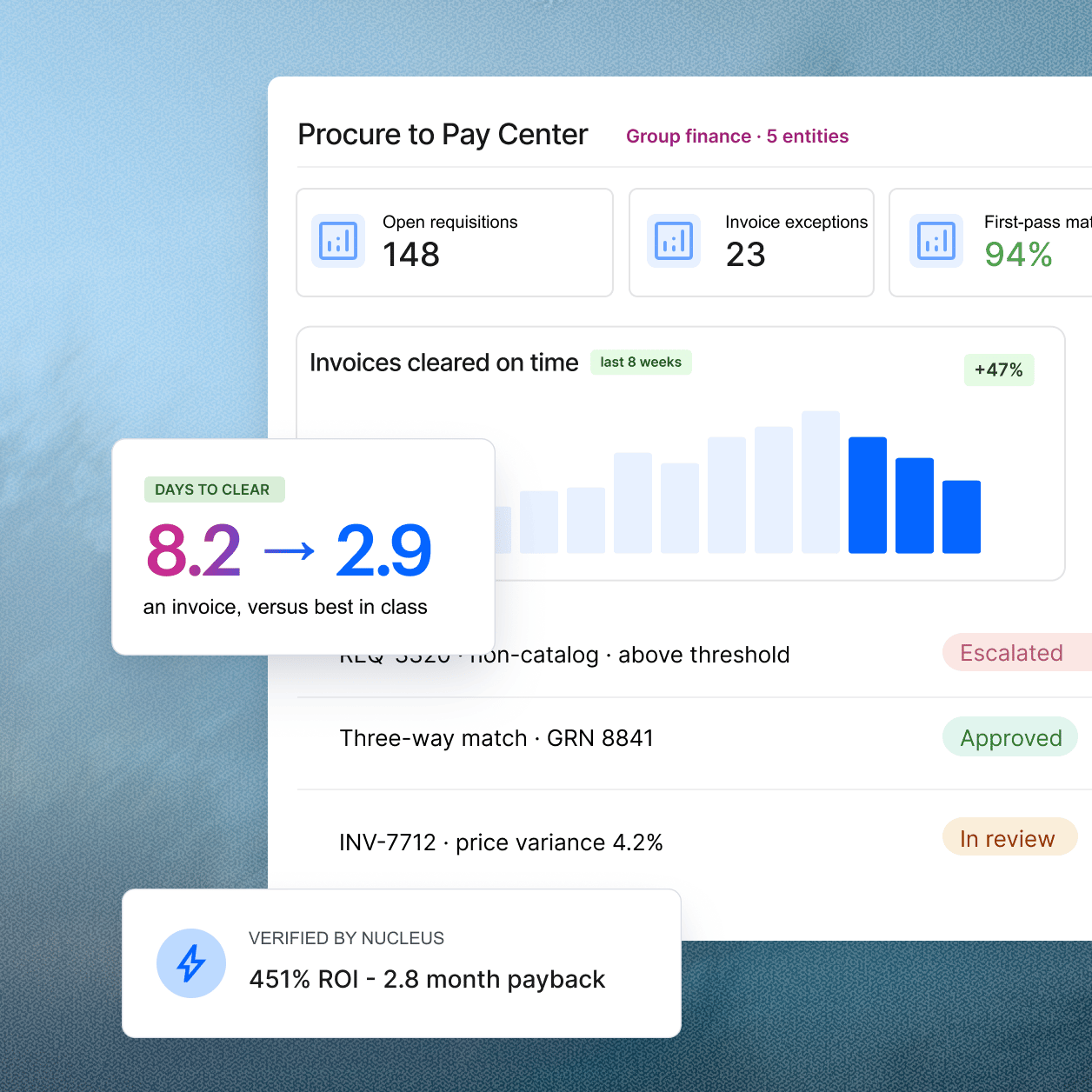
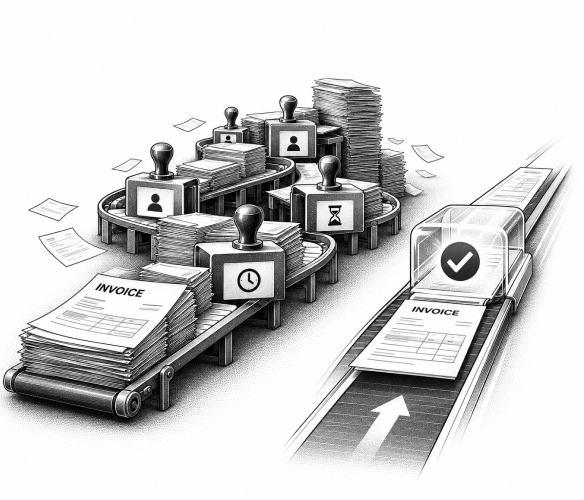
8.2 days to clear one invoice

Best-in-class teams do it in 2.9 days. Most of that gap sits in approvals rather than anywhere in the ledger.
8_2_days_to_clear_one_invoice

Nearly one in five invoices is an exception

The exception rate climbed from 14 percent to 18.4 percent in a single year, and every one of them lands on a person rather than a system.

Approvals are the number one AP complaint

49 percent of accounts payable teams name slow approvals as their worst problem and 48 percent name exceptions. Both are process failures rather than software gaps.

76 percent were hit by payments fraud

Only 17 percent of organizations use AI to detect it, and invoice approval is the point where most of it enters the business.

A single purchase order costs $14 to $54

One document, and a near fourfold spread in what it costs to process. The gap is not the ERP. It is how many hands the order passes through before approval.

Your ERP stays the system of record. The workflow that runs on top of it gets one home.

Experience — the people who buy

Requesters, procurement, accounts payable, finance, and suppliers. Five groups, one shared record. Intake portal, approval inbox, supplier portal, and spend dashboards.

Governance icon
Arrow down
Kissflow — the digital operations backbone

Orchestration, escalation, and governance in one layer.

Permits Exceptions Incidents Shutdowns Field capture Contractor access
Arrow up
Systems icon
Systems of record — everything you already run

Vendor master, general ledger, purchase order records, and the payment run stay exactly where they are. Native integrations, REST APIs, and webhooks. Nothing existing moves.
SAP Oracle NetSuite Dynamics 365 JD Edwards Sage

Built for every stage of the procure to pay cycle

Intake

Intake

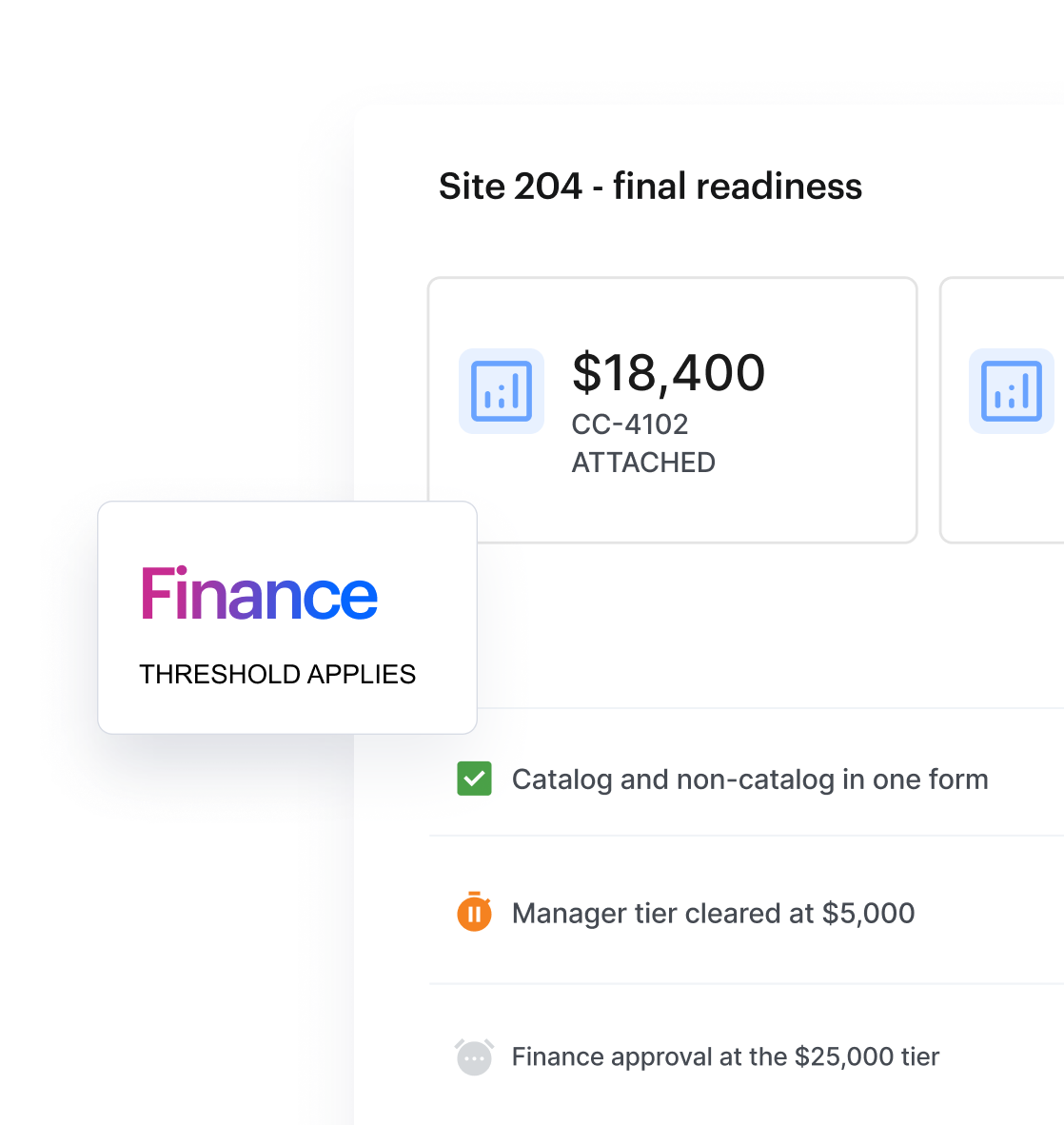
  • Catalog and non-catalog in one form
  • Thresholds escalate upon request, not at period close
  • Approved requisitions land in SAP or Oracle with the approval chain attached
intake
Sourcing & PO

Sourcing & PO

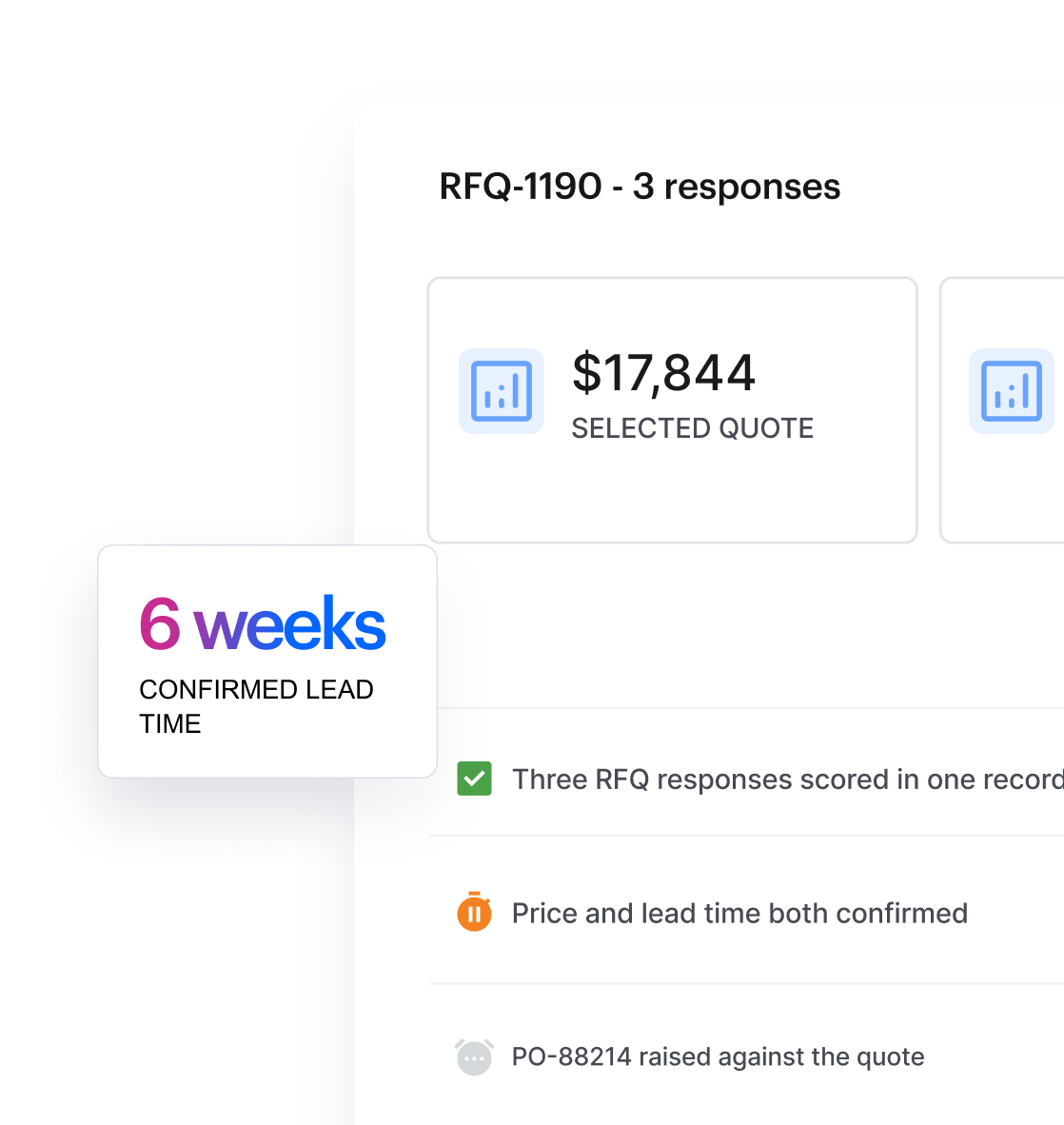
  • RFQ responses are scored side by side in one record
  • Both confirmed before the PO is raised
  • Versioned and timestamped in the ERP
sourcing_po
Receipt & match

Receipt & match

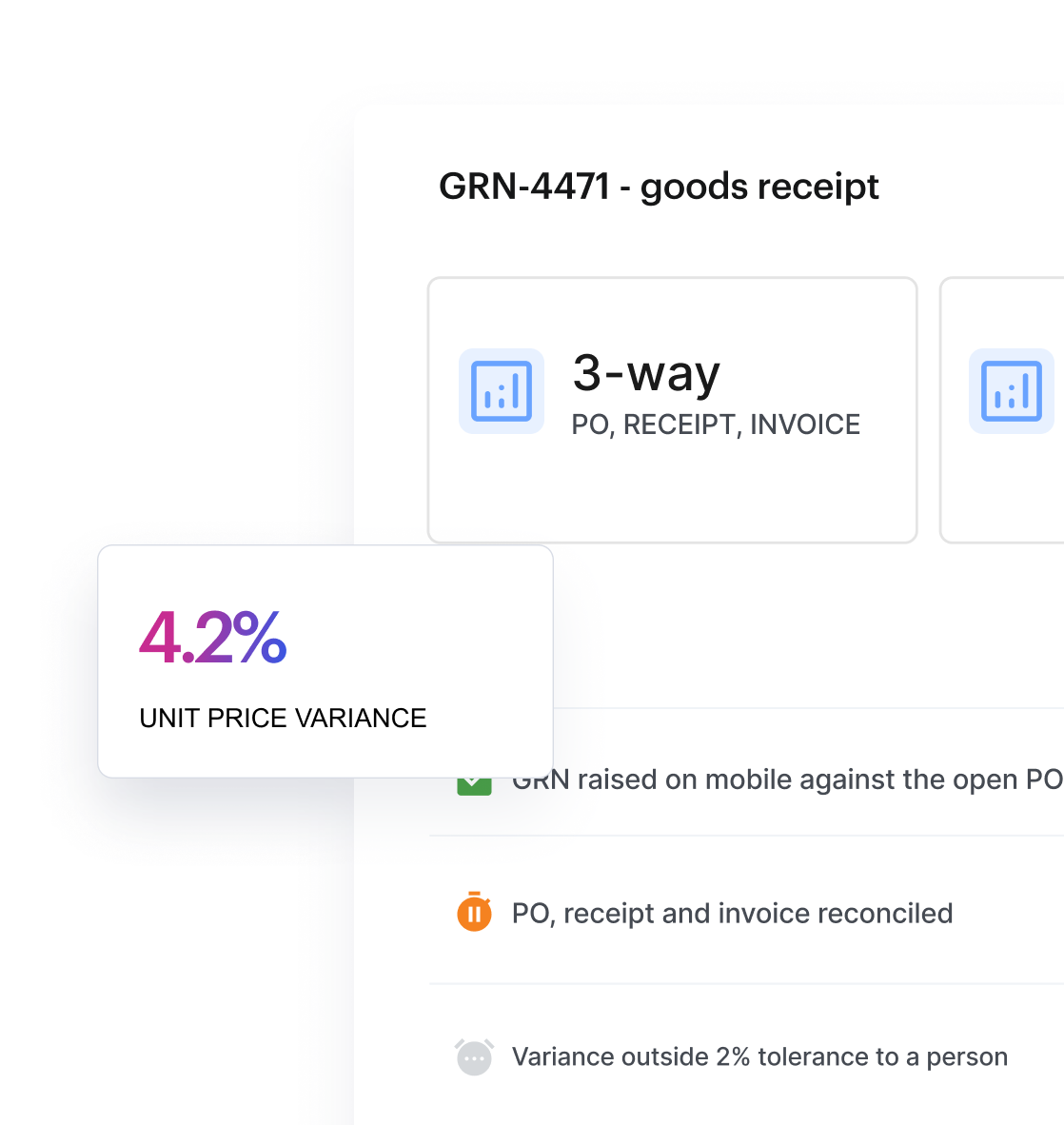
  • GRN raised on mobile or desktop, matched to the open PO
  • PO, receipt, and invoice reconciled automatically
  • Outside tolerance goes to a person with a full history
receipt_match
Invoice & payment

Invoice & payment

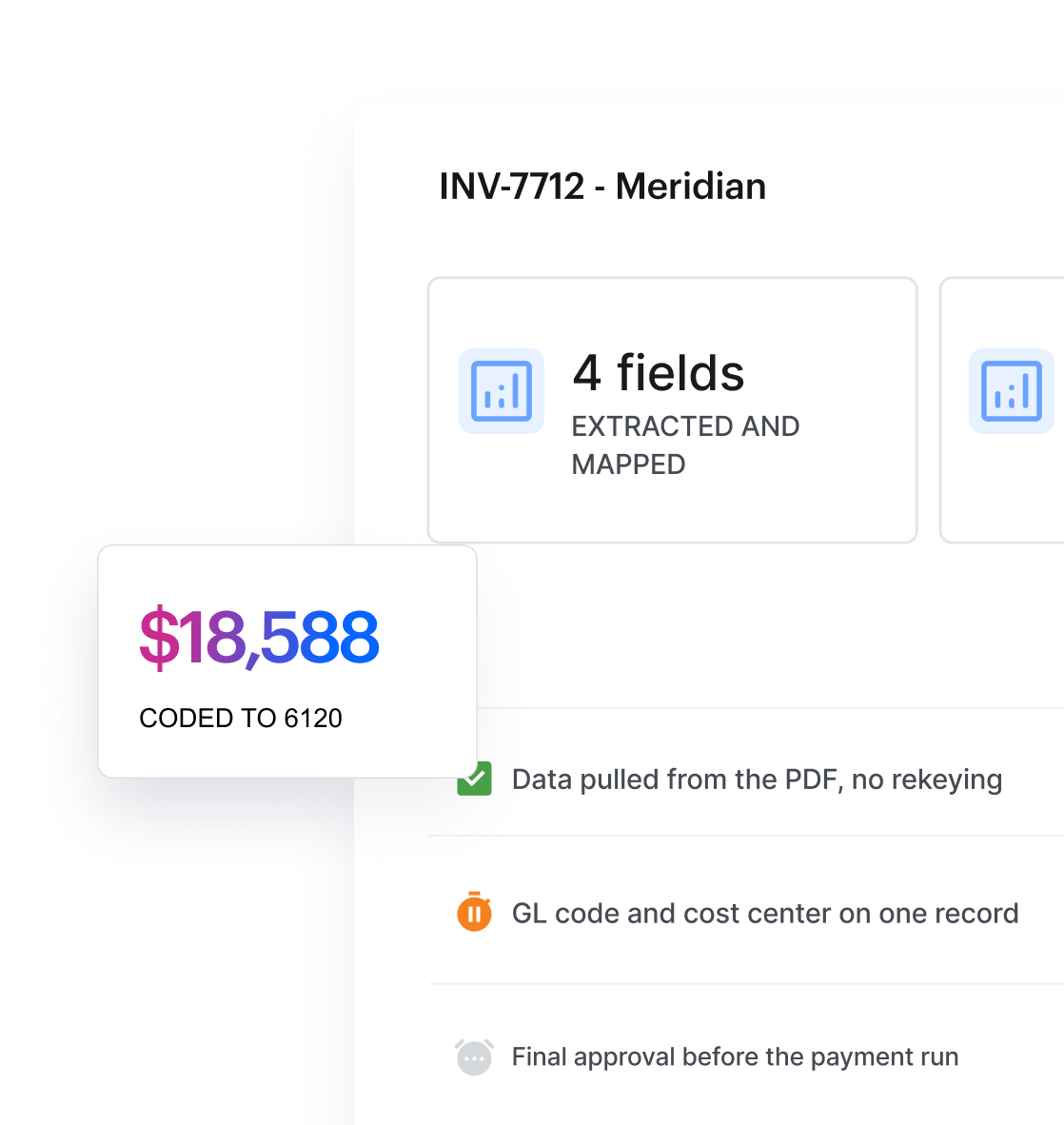
  • Data pulled from PDF or email, mapped to fields, no rekeying
  • GL codes, cost centers, and approvals on one record
  • Payment runs where it runs today
invoice_payment
Intake

Intake

  • Catalog and non-catalog in one form
  • Thresholds escalate upon request, not at period close
  • Approved requisitions land in SAP or Oracle with the approval chain attached
intake
Sourcing & PO

Sourcing & PO

  • RFQ responses are scored side by side in one record
  • Both confirmed before the PO is raised
  • Versioned and timestamped in the ERP
sourcing_po
Receipt & match

Receipt & match

  • GRN raised on mobile or desktop, matched to the open PO
  • PO, receipt, and invoice reconciled automatically
  • Outside tolerance goes to a person with a full history
receipt_match
Invoice & payment

Invoice & payment

  • Data pulled from PDF or email, mapped to fields, no rekeying
  • GL codes, cost centers, and approvals on one record
  • Payment runs where it runs today
invoice_payment

We don't replace your procurement suite or your ERP. We run the work between them.

Exception-driven procure to pay

Exception-driven procure to pay

Pre-configured flows handle standard requisitions, matches, and approvals, so only the exceptions that genuinely need a person ever surface.

Live in eight weeks, changed in days

Live in eight weeks, changed in days

Run your first orchestrated cycle inside a quarter, and change an approval threshold the following week without raising a vendor ticket.
Audit trail generated, not assembled-1

Audit trail generated, not assembled

Immutable logs, timestamped approvals, and segregation of duties and delegation of authority are enforced inside the workflow rather than documented beside it.

Connects to every system you run-1

Connects to every system you run

Kissflow connects with SAP S/4HANA and ECC, Oracle, NetSuite, Dynamics 365, JD Edwards, and Sage through native integrations, REST APIs, and webhooks, without moving existing systems.

AI where it actually helps

AI where it actually helps

Document extraction on invoice capture, anomaly detection on exceptions, and natural-language questions against live spend data. Every AI action is logged, attributable, and inside the same guardrails as everything else.

Governed autonomy for IT and procurement

Governed autonomy for IT and procurement

IT sets the guardrails for security, integrations, and audit logs, while procurement operations change approval matrices and spend categories within them. No tickets, no shadow spend.
Finance and procurement teams already running procure to pay on Kissflow

nana_direct

“Kissflow allows any level of customization. It is easy to use and is flexible enough. It is also a business process-compliant system.”

Mohamed Shifan

Nana Direct
citizensuk

“Kissflow is incredibly flexible. It helped us create various workflows for several use cases and it's very user friendly.”

Jawed Neshat

Citizens UK

Previous
    Next

    Your procure to pay, on one system.

    Get a procure to pay demo

    The questions procurement and finance leaders ask before the demo

    Book a Demo

    Kissflow doesn't replace either of them. Your suite is the system of record for contracted, catalog-enabled spend and it does that job well. What it doesn't solve is the layer around it: intake, non-catalog and blanket purchase orders, one-off approvals, and the departmental processes that feed procurement in the first place. Kissflow runs that layer and writes clean, approved records into the system you already own.

    No. Kissflow is the orchestration layer on top of your ERP. Vendor master, general ledger, purchase order records, and the payment run stay authoritative and stay where they are. The workflow that connects them gets one home.

    Most teams run their first orchestrated cycle in eight weeks. Weeks one and two connect systems and data. Weeks three and four configure the intake and approval flows. Week five runs the pilot on a single entity or spend category. The more useful number is what comes after, because changing an approval threshold or adding a spend category takes days rather than a vendor release cycle.

    SOC 2 Type II, ISO 27001, immutable audit logs, RBAC through SSO, and timestamped approvals. Approval limits, delegation of authority, and requester restrictions are enforced inside the workflow rather than documented beside it. Evidence is generated as the work runs, so when an auditor asks who approved what and under which authority, the answer is a report rather than a week of reconstruction.

    The full cycle from intake through requisition, purchase order, goods receipt, three-way match, and invoice approval. Where Kissflow stops is worth naming plainly: it doesn't operate a supplier network, doesn't act as a certified electronic invoicing access point, and doesn't execute payment. Those connect through your existing providers, and the process around them runs here.

    A fixed annual agreement based on the applications you run and the people using them, with no separate charge for AI or API usage. Talk to us and we will size it against your actual transaction volume.