Every project has constraints. The ones that matter most are not the unusual ones that appear mid-project. They are the ones that were present from the start and either managed carefully or ignored until they became crises.
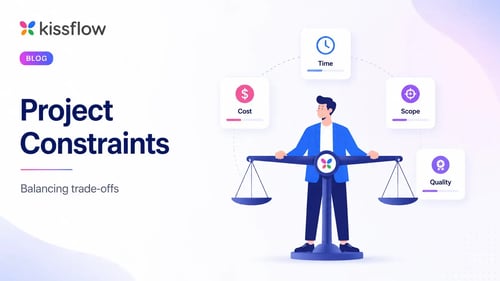
The classic framing is the iron triangle: scope, time, and cost are interdependent. Change one and the others are affected. This framing is correct and useful. It is also incomplete. Modern projects involve constraint dimensions that the original triangle does not capture: quality standards that cannot be compromised, resource limitations that go beyond budget, regulatory and organizational boundaries that constrain how the project can be executed, and risk thresholds that differ across stakeholders.
More importantly, the iron triangle is a diagnosis tool, not a management tool. Knowing that your constraints are interdependent does not tell you how to communicate about them with stakeholders, how to make good trade-off decisions under pressure, or how to structure your project environment so constraints are visible before they become binding.
This guide covers all of that.
The three primary constraints and how they interact
Scope: what the project will deliver
Scope is the set of deliverables, features, and outcomes the project is committed to producing. It is defined in the scope statement at the start of the project and forms the reference point for everything that follows. When scope is clear, everyone on the project knows what success looks like. When it is not, different stakeholders hold different versions of the goal and conflicts emerge at the delivery stage.
Scope creep, meaning the gradual addition of requirements beyond the original scope, is one of the most common causes of project failure. It typically happens incrementally, with each addition seeming reasonable in isolation, until the accumulated scope is significantly beyond what the original timeline and budget can support.
The practical management question is not how to prevent scope change, since some change is inevitable, but how to evaluate each proposed change against the project's constraints and make explicit decisions about what the change requires.
Time: when the project will deliver
Time constraints set the outer boundary for project execution. Some are hard constraints: a regulatory deadline, a product launch tied to an event, a contract commitment. Others are soft constraints: internal targets that reflect business preferences but could be adjusted with stakeholder agreement.
Understanding which time constraints are hard and which are soft is essential before the project begins. Project managers who treat soft time constraints as hard ones make unnecessarily painful trade-offs. Project managers who treat hard time constraints as soft ones create compliance or contractual exposure.
Time constraints interact with scope and cost in predictable ways. Compressing the schedule typically requires either reducing scope, increasing cost (to add resources), or accepting quality risk. There is no fourth option. When stakeholders ask for faster delivery without adjusting anything else, the project manager's job is to make this choice explicit, not to absorb it silently into the plan.
Cost: what the project is allowed to spend
Budget constraints define the total resources available for the project, including personnel, technology, third-party services, and contingency. Budget is almost always a binding constraint rather than a preference: organizations allocate capital to projects through a planning process, and changing a project budget mid-execution requires justification and approval.
The most common budget management error is not tracking costs against the budget throughout the project. Teams often discover budget problems late, when they are already committed to expenditure that exceeds the allocation, rather than early, when there is still room to adjust. Regular budget tracking, at least weekly on complex projects, is the basic preventive measure.
Beyond the iron triangle: three additional constraints that shape modern projects
Quality
Quality is distinct from scope. Scope describes what will be delivered. Quality describes the standard to which it will be delivered. A project can deliver everything in scope at a quality level that makes the deliverable unusable or fails regulatory requirements. Quality constraints define the minimum acceptable standard and should be specified before the project begins, not discovered at delivery.
Quality and time are often in direct tension. When schedule pressure mounts, quality is frequently the first thing traded, sometimes explicitly and often implicitly. Project managers who want to protect quality need to make the quality constraint visible and agreed-upon before the pressure arrives.
Resources
Budget covers financial resources. The resource constraint is broader: it includes the availability of specific skills, equipment, facilities, and third-party capacity. A project that is fully funded can still be constrained by the unavailability of the specialist it needs, the booking lead time for the facility it requires, or the capacity of the vendor it depends on.
Resource constraints are particularly acute in organizations where project work competes with operational work for the same people. A team member allocated to two projects at 50 percent each rarely delivers 100 percent of their capacity to either. Resource planning that accounts for actual availability, not theoretical allocation, produces more reliable project plans.
Risk tolerance
Every project operates within a risk threshold that reflects the organization's and stakeholders' tolerance for uncertainty, failure, and adverse outcomes. A high-visibility project with executive sponsorship typically has a lower tolerance for surprise than an internal improvement project. A regulated project in financial services has different risk constraints than a marketing campaign.
Risk constraints affect how the project is planned and managed: how much contingency is built in, how frequently risk is reviewed, what risk response strategies are available. They also affect trade-off decisions: a stakeholder with low risk tolerance will accept a higher cost to maintain a lower schedule variance.
How to manage constraint trade-offs with stakeholders
The most important constraint management skill is communicating trade-offs clearly. Stakeholders who understand the relationship between constraints make better decisions. Stakeholders who do not understand it, or who do not believe the relationship is real, make decisions that put the project manager in an impossible position.
Make the constraint model visible at project initiation
At the start of every project, have an explicit conversation with key stakeholders about which constraint is the most fixed. Is there a hard delivery date that cannot move? Is the budget truly a ceiling or is there flexibility with justification? Is the scope fully defined or will it evolve?
Establishing this hierarchy upfront means that when trade-off decisions are required, and they will be, the basis for the decision is already agreed. The conversation is about applying the framework, not about establishing it under pressure.
Present trade-offs as options, not problems
When a constraint is threatened, the instinct is to present it as a problem: "we are over budget" or "the timeline is at risk". The more useful framing is to present it as an option set: "we can maintain the current timeline by reducing scope, or maintain the current scope by extending the timeline by four weeks, or maintain both by adding two contractors for six weeks at an additional cost. Which do you prefer?"
This framing puts the decision where it belongs, with the stakeholder who has the authority and context to make it, while making clear that the project manager cannot resolve the constraint without a decision.
Document every constraint decision
Constraint trade-offs made verbally in meetings are reliably forgotten or misremembered. Every decision to adjust scope, extend a timeline, increase a budget, or accept additional risk should be documented in writing and confirmed with the relevant stakeholders. This protects the project manager and provides a clear record if the decision is later revisited.
How project management software helps manage constraints
Project management software helps with constraint management in two ways: visibility and early warning.
Visibility means that scope, schedule, and budget information is available in real time to everyone who needs it, rather than existing in the project manager's spreadsheets and updated weekly. When a task slips, the schedule impact is immediately visible. When spend increases, the budget position updates automatically.
Early warning means that the system surfaces constraint stress before it becomes binding. A task approaching its deadline without updates, a budget approaching its ceiling with significant work remaining, a resource allocated across too many concurrent commitments: these are signals that allow course correction before the constraint breaks.
Kissflow's workflow platform provides both. Project status, task progress, and workload are visible in real time across the team. Deadline monitoring and dependency tracking surface risks before they become crises. And because Kissflow connects project work to the broader workflow and approval environment, the constraints that live outside the project, including procurement approvals, compliance requirements, and resource allocations governed by other processes, are connected to the project view rather than managed separately.
Frequently asked questions
What are the three main project constraints?
The three primary project constraints are scope (what the project will deliver), time (when it will deliver), and cost (what it is allowed to spend). These three are interdependent: changing any one affects the others. Modern project management also recognizes quality, resources, and risk tolerance as additional constraint dimensions that significantly affect how projects can be managed.
What is the iron triangle in project management?
The iron triangle is a model that describes the interdependence of scope, time, and cost in project management. If the scope increases, either the time or the cost must also increase. If the timeline is compressed, either the scope must decrease or the cost must increase. The model is useful for communicating trade-offs with stakeholders who want to adjust one constraint without changing the others.
How do you manage scope creep?
Scope creep is best managed through a formal change control process: any proposed addition to the project scope is evaluated against its impact on time, cost, and quality before being accepted or rejected. The scope statement, agreed at project initiation, is the reference document. Changes should be explicit decisions, not gradual accumulations.
What happens when project constraints conflict?
Conflicting constraints require a trade-off decision. The decision belongs to the stakeholder who has the authority and context to make it, not to the project manager. The project manager's role is to present the options clearly: maintain schedule and reduce scope, or maintain scope and extend schedule, or increase budget to maintain both, and ensure the decision is documented.
How do you communicate project constraints to stakeholders?
The most effective approach is to establish the constraint hierarchy at project initiation, specifically which constraint is most fixed, and use that framework when trade-off conversations are needed later. When a constraint is threatened, present options rather than problems: give stakeholders a clear choice with the implications of each option laid out explicitly.
.webp)