Project closure is the phase that teams most reliably underinvest in. The pressure that drove the project is gone. The deliverables are done or nearly done. The team is ready to move on. Whatever comes next feels more urgent than wrapping up something that already happened.
The cost of this underinvestment is not obvious immediately. It shows up later: in the next project that runs into the same problems this one did, in the institutional knowledge that leaves with the team members who moved on before a retrospective happened, in the client relationship that felt strong at delivery and eroded because the closure was handled carelessly, in the contract dispute that arose because paperwork was not completed properly.
Project closure done well is not bureaucratic overhead. It is the mechanism by which the organization learns, the client relationship is secured, the team's work is properly recognized, and the next project starts from a better position than this one did. This guide covers all of it.
What project closure actually covers
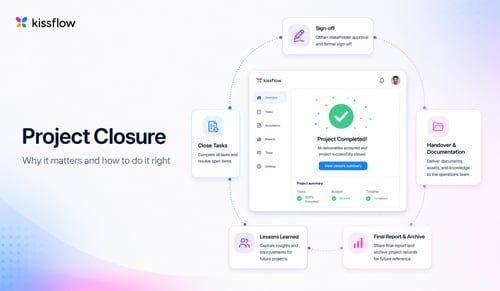
Project closure is a process, not an event. It involves a specific set of activities that convert a completed project into a closed one, and each activity has a purpose beyond administrative completion.
Deliverable transfer and acceptance
The first step is confirming that everything the project committed to deliver has been delivered and accepted. This means going back to the scope document and verifying each deliverable, not assuming that because the work was done, the deliverable was accepted.
Acceptance matters because it is the formal moment at which responsibility for the deliverable transfers from the project team to the client or recipient. A deliverable that has been built but not formally accepted is still the project's problem. Getting acceptance documented properly protects both parties and closes the ambiguity that leads to disputes later.
Contract and financial closure
All contracts and vendor agreements opened for the project need to be formally closed. This includes confirming that all invoices have been submitted and paid, releasing any committed resources that are no longer required, and obtaining sign-off from external vendors and contractors that their engagements are complete.
Contract closure is particularly important for projects that involved significant vendor relationships. Vendor contracts left open after project completion create ongoing financial and legal exposure. Vendor contracts closed without proper documentation create disputes about what was and was not delivered.
Resource release
Team members and resources committed to the project need to be formally released so they are available for other projects. This is partly administrative, covering tasks like updating resource allocation records, and partly human: recognizing the contribution of team members before they disperse to other work.
Resource release without recognition is a missed opportunity. The project closure is often the only moment at which a project team is gathered with the explicit purpose of reflecting on what was accomplished together. Using that moment only for administrative tasks squanders the motivational and relational value it carries.
Documentation and knowledge archive
The documentation generated over the course of a project, including the project plan, the risk register, the issue log, the scope decisions, and the lessons learned, is organizational capital. It represents the accumulated knowledge of how this type of project works: what takes longer than expected, what vendors are reliable, what stakeholders need to see at which stages.
Most organizations do not capture this capital in a usable form. The documentation exists but is scattered across individual files and email threads rather than organized into a searchable archive. The next project manager working on a similar project starts from scratch rather than from the accumulated experience of their predecessors.
How to know when a project is actually done
The question seems straightforward but produces more disagreement than expected. The task list may be complete while a deliverable has not been accepted. The deliverable may be accepted while a contract has not been closed. The contract may be closed while the lessons learned session has not happened.
A useful definition: a project is done when all four of the following are true. The deliverables have been formally accepted by the appropriate parties. All contracts and financial commitments are closed. The project documentation has been archived in a form that is accessible for future reference. The team has completed a retrospective.
None of these is bureaucratic. Each serves a specific function. Formal acceptance establishes legal and relational clarity. Contract closure eliminates ongoing financial exposure. Documentation archiving preserves organizational knowledge. The retrospective converts experience into learning. A project that skips any of these has not fully closed.
Running a project retrospective that actually produces learning
The retrospective is the most valuable part of the closure process and the one most frequently reduced to a cursory meeting that produces a document no one reads.
A retrospective that produces real learning requires preparation, psychological safety, and a deliberate output that connects to future action. Without these three elements, the conversation stays surface-level, and the insights generated have no path to implementation.
Preparation
The facilitator should review the project record before the meeting: the original plan versus what actually happened, the risks that materialized versus those that did not, the scope changes that were requested and approved, and the issues that were escalated. This review identifies the specific moments and decisions the retrospective should examine.
Participants should be invited to submit reflections in advance, anonymously if necessary, on what went well, what did not, and what they would do differently. Collecting these before the meeting rather than asking for them in the meeting produces more honest and considered input.
Psychological safety
A retrospective that turns into a blame-assignment session is worse than no retrospective. The facilitator needs to establish clearly at the start that the purpose is learning, not accountability, and that the output will be shared with the intent of improving the next project, not assigning fault for this one.
This is harder when the project has had significant problems. The more difficult the project, the more important the retrospective, and the more carefully the environment needs to be managed. If the power dynamics in the room make honest reflection unsafe, the retrospective should be restructured: smaller groups, anonymous input, external facilitation.
Deliberate output
The output of a retrospective should be a small number of specific, actionable recommendations for the next similar project. Not a comprehensive list of everything that happened. Not a document that covers every observation made in the meeting. Three to five concrete process changes, each with an owner and a timeline.
Retrospective documents that capture everything are rarely read again. Retrospective outputs that commit to three specific changes are implementable. The difference between a learning organization and one that repeats the same mistakes is not the quality of its retrospectives. It is whether the recommendations from retrospectives get acted on.
Measuring project success at closure
Project success is typically measured at closure against the original goals: was the project delivered on time, within budget, and at the expected quality? These are the right starting metrics. They are not sufficient on their own.
Projects that exceed their original budget and timeline can still be organizational successes if the outcome they delivered was worth more than the cost overrun. Projects that deliver on time and on budget can still fail if the delivered product does not achieve the business objective it was designed for.
A complete success assessment at closure asks: did the project deliver the intended business value? Are the stakeholders satisfied with the outcome? What did the project cost, in total, compared to the value delivered? And what has the organization learned that will make the next similar project better?
How project management software supports closure
Project management software supports closure by providing a structured environment for each closure activity: a deliverable checklist tied to the original scope document, task assignments for contract and financial closure activities, a documentation repository that organizes project artifacts into a searchable archive, and a survey or feedback tool for retrospective input collection.
Kissflow gives project managers the task management and reporting tools to run a structured closure process. The project record, including all tasks, milestones, and status updates, is available for retrospective review. Documentation can be attached to project tasks and archived with the project record. Closure tasks can be assigned to the appropriate owners with deadlines and status tracking.
Because Kissflow connects project work to the broader workflow environment, contract closure activities that require procurement approval or finance sign-off can be handled within the same system rather than being routed through a separate process. The closure process stays in one place rather than being managed across multiple tools.
Learn more: Kissflow's workflow platform
Frequently asked questions
What is project closure?
Project closure is the formal process of completing a project, covering deliverable acceptance, contract and financial closure, resource release, and documentation archiving. It is the mechanism by which the project's open commitments are resolved, its knowledge is captured, and the organization learns what will make the next similar project better.
Why is project closure important?
Project closure matters for four reasons: it establishes formal acceptance of deliverables, which resolves the legal and relational ambiguity that leads to disputes; it closes financial and contract commitments, eliminating ongoing exposure; it archives knowledge that makes future projects better; and it provides the team with formal recognition of their work, which affects motivation and retention.
What should a project closure report include?
A project closure report should cover the original project objectives and the extent to which they were met, a summary of schedule and budget performance, a list of all deliverables with confirmation of acceptance, a summary of key lessons learned, and recommendations for future similar projects. It should be concise enough to be read by stakeholders who were not involved in the day-to-day project.
How long should project closure take?
The time required for closure varies significantly with project size and complexity. A small internal project can be properly closed in a week. A multi-year program may require a month of closure activity. The most common error is allocating no time for closure: assuming that because the deliverables are done, the project is finished. Closure tasks are real work that requires real time.
What is the difference between project closure and a project retrospective?
A project retrospective is one activity within the project closure process. It is the meeting or structured session in which the team reflects on what went well, what did not, and what they would do differently. Project closure is the full set of activities required to formally end the project, of which the retrospective is an important but not sufficient component.
.webp)