Open Source No-Code Platforms: Complete Comparison Guide
Open source no-code platforms offer free source code that organizations can self-host and customize for application development. While they eliminate licensing costs, they require technical expertise for setup, maintenance, security patches, and scaling, making the total cost of ownership higher than many commercial alternatives for enterprise use.
Using an open-source no-code platform has its advantages. They’re free to use, easily customizable, and have a lot of people investing efforts into improving the source code. But they also with some limitations.
When you’re looking to choose a no-code platform for your business, you have the option of choosing between an open-source tool and a closed-source or proprietary alternative.
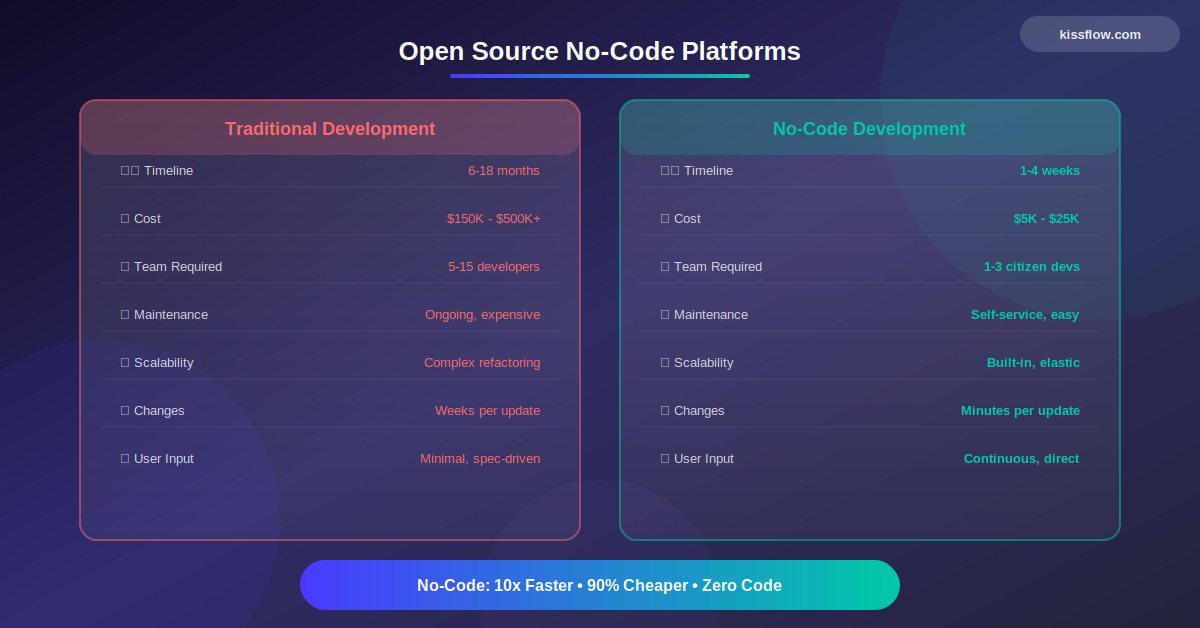
Whether you select an open-source solution or invest in a commercial no code workflow automation platform, understanding the trade-offs between cost savings and enterprise-grade features is crucial for making the right decision. Going for the open-source option can pose many challenges.
Let's examine why open-source no-code platforms should not be your choice and why you should choose proprietary software instead.
Why open-source no-code platforms should not be your business choice
1. Security
The top concern with open-source no-code platforms is the risk of vulnerabilities. Open-source platforms feature freely-editable sources available for anyone to inspect and modify. The implication is that people with malicious intent can also see this code.
The implication is a heightened risk of the deliberate creation of viruses to infect hardware or software, steal data, or commit fraud. Security breaches of this sort are less likely with proprietary platforms since there are more stringent protocols to keep the platform secure.
2. Integration
Integration problems with no-code platforms can take different forms. Open-source no-code platforms depend on the integration of several third-party components to work optimally. The resulting complexity can be challenging to manage.
But for open-source projects, the opposite of this situation arises. Many open-source platforms do not have the standardized protocols needed to connect with the business tools you're already using. Proprietary software is often designed with integration in mind and can integrate seamlessly with other software products with relative ease.
3. Support:
Reliable support from whatever platform you sign up on is a must-have. This way, you can always contact the vendor if anything goes wrong. With an open-source platform, no one takes responsibility for support. This means if anything goes wrong, there's no one specifically to call for help. Many open-source products have an active community of developers that may offer support when you need it, but this isn't always as robust as what you get from a proprietary tool.
4. Usability
Many open-source platforms prioritize functionality over ease of use. While they may work as intended, they're not very user-friendly and there's no incentive to make the platform easier to navigate for users.
With closed-source platforms, usability is always a priority. The company behind the company includes user-friendly features and an intuitive interface that is simpler for users at all skill levels.
What are the alternatives of open source no-code platforms?
Kissflow is a perfect example of a closed-source no-code platform. It has higher benefits compared to the open-source no-code platform in many areas. As an alternative to an open-source platform, Kissflow is a secure, highly flexible, and highly intuitive platform. This proprietary software solution prioritizes ease of use. But more importantly, it offers 24/7 support to help users troubleshoot issues and navigate the platform seamlessly.
Since this is not an open-source platform, no one but the vendor can make changes to the code, add features or upgrade it. It offers enterprise-level security and the latest encryption to secure the platform from hacking and other cyber attacks.
Unlike open-source platforms, closed-sourced solutions are built for profit. This provides an incentive for frequent updates and feature upgrades to keep up with industry standards, ensure customer satisfaction and compete effectively with other no-code.
See the full story → McDermott: Enterprise-Proven 10x ROI with No-Code Approach
As organizations aim to build apps without coding, comparing no-code vs low-code vs pro-code becomes critical in planning for the future of no-code. Evolving no-code trends are driving no-code digital transformation, enabling teams to build apps without developers while reducing dependency on traditional engineering resources. This shift is supported by a growing no-code ecosystem that brings together platforms, integrations, and communities to help businesses scale application development efficiently.
Benefits of using a closed no-code platform
no-code development platforms simplify app development by allowing users to build fully-functional enterprise applications without writing a line of code. While there are several open-source and proprietary solutions for building apps with no coding, Kissflow is a best-in-class option for several reasons.
Some of the features and benefits of this proprietary no-code platform over both open-source and closed-source alternatives include:
1. Unified development toolkit
Accelerate the process of building and deploying enterprise-grade apps by using a solution that streamlines and centralizes app development. Kissflow offers everything you need to manage your development lifecycle from start to finish but without the hassles of writing custom code from scratch. Kissflow also simplifies app development, allowing you to modify your apps and release new builds without stress, all from the same place.
2. Build with no limit
Build, test, and launch unlimited applications for different use cases using Kissflow. Businesses across various industries will find Kissflow useful for their unique development and business process management needs.
3. Simplicity
Kissflow helps you build functional apps on the go with a simple drag-and-drop editor. You can also expand app functionality, and update and upgrade your app on the go. It is handy when you want to focus more on performing your best work rather than wrestling with complex lines of code.
4. Extensive integrations
Kissflow helps you build apps with widgets, advanced forms, and powerful workflows. Additionally, the platform supports integrations with multiple platforms to further extend the core functionality of your no-code app.
5. Insights and analytics
You can build real-life apps with Kissflow and keep track of your app through a robust reporting and data-management feature and advanced data visualization and analytics.

 Free eBook
The Ultimate Buyer's Guide to No-Code

Thank you for reaching downloading!
Kissflow - A trusted No-code platform
Explore leading open-source no-code companies that are offering flexible platforms for building applications and automating processes without code.
Kissflow is just as feature-rich as any open-source tool and is free from all the downsides of using a community-based platform to build apps for your business. Signup for a free trial to see Kissflow in action.
FAQs:
1. What limitations do open-source no-code platforms have in enterprise use?
Open-source platforms face significant enterprise limitations. They often lack advanced governance frameworks, granular access controls, comprehensive audit logging, and compliance certifications (SOC 2, ISO 27001, HIPAA). Integration capabilities are limited to common APIs, requiring custom development for enterprise systems like SAP or Oracle. Performance optimization for high-volume workloads typically isn't prioritized, creating scalability concerns. Enterprise features like multi-tenancy, advanced caching, and disaster recovery configurations are often absent. Documentation is community-driven and incomplete. Release cycles are unpredictable—security patches may be delayed, and backward compatibility isn't guaranteed. Total cost of ownership is often higher than expected: enterprises must invest in hosting, dedicate developers for maintenance, handle security hardening, and build missing features themselves.
2. How risky is governance and security in open-source platforms?
Governance and security risks are substantial. Open-source platforms typically lack sophisticated administration consoles for centralized control and policy enforcement. Without built-in governance, IT struggles to prevent shadow IT, track application proliferation, and enforce standards. Security concerns include: no regular professional security audits, delayed critical patches dependent on volunteer contributors, and missing enterprise security features like SAML-based SSO, MFA, and field-level encryption. Security depends on proper configuration by your team—misconfigurations can expose data. Supply chain security is problematic with third-party libraries potentially containing unpatched vulnerabilities. For regulated industries, lack of formal compliance certifications makes approval nearly impossible for production environments handling sensitive data.
3. Are open-source platforms scalable enough for enterprise workloads?
Open-source platforms generally struggle with enterprise-scale workloads. While they may handle departmental applications adequately, they falter with thousands of concurrent users, millions of transactions, or large datasets. Common issues include: basic database optimization lacking sophisticated caching or connection pooling, inability to scale horizontally without significant architectural work, absent API rate limiting allowing resource exhaustion, and bottlenecks in session management and state handling. File storage isn't optimized for enterprise scale. Reporting features may lock database tables during execution. Load testing tools and performance monitoring are limited. Most critically, when scalability issues arise, enterprises are on their own without vendor support for optimization guidance or emergency assistance. This makes open-source unsuitable for mission-critical workloads where downtime means revenue loss or regulatory penalties.
4. What support gaps exist compared to enterprise-grade tools?
Support gaps are substantial. Open-source relies on community forums and GitHub issues—response times are unpredictable, answers may be incorrect, and there's no accountability. During critical production issues, there's no support hotline, no SLA, and no escalation path. Enterprises must maintain in-house platform expertise, allocate developers to investigate bugs, manage upgrades without guidance, and accept some issues won't be resolved. Training is limited to community tutorials versus professional certification programs. There's no customer success team for architectural review or best practices. Security advisories aren't proactively communicated—you monitor security lists yourself. Most significantly, there's no legal entity with contractual obligations, warranties, or liability coverage. For enterprises where downtime costs thousands per hour and data breaches trigger lawsuits, these gaps represent unacceptable operational risks.
5. Why do CIOs prefer proprietary platforms for mission-critical apps?
CIOs prefer proprietary platforms for contractual accountability—formal SLAs guaranteeing uptime (99.9%+), guaranteed response times, escalation paths, and financial penalties for failures. Enterprise capabilities are comprehensive: advanced security, compliance certifications, disaster recovery architecture, enterprise integrations, governance frameworks, and monitoring. Vendor R&D ensures continuous innovation aligned with enterprise needs. Professional services provide implementation consulting, training programs, and 24/7 support. The vendor ecosystem offers partnerships with integrators and consultants. From risk management perspective, vendors carry cybersecurity insurance, undergo regular third-party security audits, and provide security documentation for IT assessments. TCO analysis often shows proprietary platforms are more economical than open-source when factoring infrastructure, personnel, and opportunity costs of self-managing at enterprise scale.
.webp)

Related Articles

6 MINUTES READ
No-Code Ecosystem: Platforms, Integrations & Trends

6 MINUTES READ
Avoid No-Code Platform Mistakes: How to Choose the Right One