TL;DR
- AI low-code builds general-purpose apps fast. A BPM suite orchestrates and governs processes across departments and systems with BPMN and audit trails.
- Low-code serves business builders and developers seeking speed. BPM serves process architects and operations teams focused on governance.
- On the BPM side, AI adds process mining, bottleneck detection, and predictive routing.
- The two categories are converging into unified platforms that pair AI-assisted building with deep process orchestration.
Most CIOs stop framing this as a binary the moment a fourth department asks for its own app. The real question is which layer you need for the work in front of you. An AI low-code platform is a tool for rapidly building custom applications, user interfaces, and data models with visual drag-and-drop editors and AI that generates forms and logic from a prompt. A BPM suite is a methodology-driven framework for modeling, orchestrating, and governing structured business workflows across departments, with compliance controls, audit trails, and Business Process Model and Notation (BPMN) at its core.
What follows sets out the four axes the two categories differ on, where they are converging, and how to pick between a low-code platform, a BPM suite, and one that does both.
What are AI low-code platforms and BPM suites?
OutSystems, Mendix, and Microsoft Power Platform are examples of AI low-code platforms. Appian, Pega, and Camunda are examples of BPM suites. The categories were built for different jobs.
An AI low-code platform reduces IT dependency by letting people build and modify applications through a visual interface, with AI translating natural-language prompts into app components. The output is an application: a form, a workflow, an interface, a data model. A 2025 KPMG survey of 2,170 IT and business executives found that 78 percent of companies were actively developing or planning to develop low-code apps infused with AI within the following 12 months.
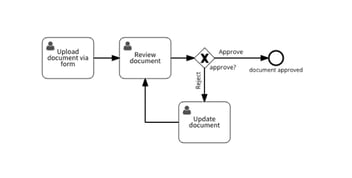
A BPM suite starts with the process. It is the discipline of discovering, modeling, orchestrating, measuring, and optimizing how work moves across departments and systems. Its markers are BPMN diagrams, strict compliance auditing, task routing, and visibility across the whole process. Where AI enters a BPM suite, it powers process mining to surface bottlenecks, predictive routing, and exception handling. For a fuller treatment, see what is wrong with traditional BPM software and the business process management overview.
What are the core differences between AI low-code and BPM suites?
The clearest way to separate the two is along four axes: primary focus, how AI is used, target users, and governance.
Primary focus: apps versus processes
An AI low-code platform is built for creating applications quickly, so a department can go from idea to working app without a release cycle. A BPM suite is built to orchestrate a process from start to finish, so a loan approval or invoice workflow moves through every stage under defined rules.
How AI is used: app generation versus process intelligence
On the low-code side, AI turns natural-language prompts into forms, logic, and interface components. On the BPM side, AI runs process mining, detects bottlenecks, and predicts routing. The distinction that matters is what the AI hands back: depending on the platform, AI produces either application code or structured configuration (metadata) the platform runs.
Target users: builders versus process architects
Low-code platforms serve business builders and professional developers who want speed. BPM suites serve process architects, business analysts, and operations teams accountable for governance and compliance. A unified platform puts both groups on the same footing: business teams build, IT governs what they build, and developers extend it when the logic gets hard.
Governance and compliance: configured versus native
BPM suites enforce audit trails and BPMN standards by design. Low-code platforms vary widely, and on some, governance is set up after the build. On a unified platform, governance is built in from the start: IT controls what goes live, and every change is recorded in one audit trail, whether a person or AI made it.
For what that governance looks like day to day, see how process owners govern AI-generated workflows.
Comparison at a glance: low-code, BPM suites, and Kissflow
Choosing the comparison axes determines the decision you are making. These four decide most enterprise evaluations.
|
Axis
|
AI low-code platforms
|
BPM suites
|
Kissflow
|
|
Who can build
|
Developers and some business builders
|
Process architects, business analysts, IT
|
Business teams build, IT governs, and developers extend
|
|
Governance model
|
Varies by platform
|
Native to the process engine
|
Platform-native audit trail, with AI changes and manual edits in one log
|
|
How AI works
|
Generates code or configuration, forms, and UI
|
Process mining, bottleneck detection, predictive routing
|
Generates inspectable blueprints
|
|
Change speed
|
Fast app delivery
|
Slower, methodology-driven change
|
Delivery compresses from weeks to days
|
Where AI low-code and BPM suites are converging
Process orchestration and app generation increasingly appear in the same product, and the practical result is one platform that combines AI-assisted, visual building with deep process orchestration. The pull comes from both directions. A departmental app built on low-code often grows into work that crosses finance, HR, and IT, and at that point it needs routing, approvals, and an audit trail.
A process modeled in a BPM suite often needs new forms, screens, and small apps at its edges, and waiting in a development queue for each one slows the work down. For buyers, the useful question becomes which platform can carry an app from its first build to a governed process that spans departments. For how low-code platforms developed, see the history of low-code development platforms.
Where Kissflow fits between low-code and BPM
Kissflow, an AI-powered enterprise application platform, fits this convergence as the governed execution and exception layer around your systems of record. It works alongside SAP, Oracle, Salesforce, and Workday and never replaces them. It handles the structured work that falls at the edges of what those core systems were built to do: procurement and vendor approvals, HR onboarding and exception routing across HR, IT, and finance, IT service requests, and finance approvals. Kissflow needs no new system of record.
Kissflow was founded in 2012, serves over 1,200 customers worldwide, and holds SOC 1 Type II, SOC 2 Type II, SOC 3, ISO/IEC 27001, HIPAA, GDPR, and CCPA certifications. Godrej Consumer Products displaced Mendix with Kissflow. Aswaq Management and Services evaluated Power Apps and Creatio before choosing Kissflow.
How does governed app generation change the comparison?
This is the slot neither pure low-code nor pure BPM occupies: a platform where governance is native from the start and AI output can be inspected.
Code-generation tools can build a working app. The trouble often shows up later, when an AI-written change breaks a feature no one reviewed, or when the code needs a developer to explain it to an auditor. Teams can end up rebuilding more than once, with little that lasts, because what these tools build can be hard to govern, maintain, and audit over time.
Kissflow’s answer is the blueprint. AI generates structured metadata a developer can open and read, and every artifact is a standard Kissflow component. AI Builder, generally available as of May 2026, generates a complete working app from a single prompt or an uploaded requirements document, and people refine the result through conversation, with a human in the lead.
People own and review the blueprints, and AI changes use the same audit log as manual edits, with every action timestamped and attributed. Learning from outcomes and self-correction are in active development. Delivery compresses from weeks to days, and governance is what makes that speed safe at enterprise scale.
Against Appian, Pega, and ServiceNow, Kissflow competes on accessibility, time to deploy, cost of ownership, and business builders working under IT governance. ServiceNow is built for IT service management, and that work stays there. The business workflows around it can move faster on a platform business teams operate directly. Compare the approaches in depth at Kissflow vs ServiceNow.
How to choose between low-code, a BPM suite, and a unified platform
The decision comes down to what you are building and who governs it. Work through it in this order:
- Name the process or app, and the departments and systems it crosses
- Decide who will build it and who must govern it
- Check the compliance and audit record the work needs
- Match your answers to one of the three options below
- Choose a BPM suite when you need deep compliance auditing in regulated work, with complex multi-department orchestration that demands BPMN-level modeling and a dedicated process team to maintain it.
- Choose an AI low-code platform when you need rapid, department-level app delivery and the flexibility to adapt applications without waiting on IT.
- Choose a unified platform like Kissflow when you want both: enterprise-grade governance with low-code speed, AI-generated blueprints, and business builders working under IT control on one audit log.
Most enterprises past a handful of departmental apps should stop shopping by category and start shopping by governance model, because that is the axis that decides whether an application survives its second year.
Frequently asked questions
Who is responsible for governance when business users build their own apps?
On platforms that separate building from governance, business users create and modify applications while IT retains control over what they build through defined permission sets. This lets business teams build without routing around IT, with platform-native audit trails so every action is timestamped and attributed.
Map one process before you choose
If your approvals still live in email and spreadsheets while SAP or Oracle sits at your core, map one process to a governed platform first and see how a build behaves. Book a demo to see that process built and governed on Kissflow.