TL;DR
-
A digital workplace is not a collection of apps. It is the governed environment where employees access the tools, data, and workflows they need, from any location, on any device.
-
The more SaaS applications an organization adds without a unifying platform, the harder it becomes for IT to see, manage, and protect what is running.
-
The biggest risk in most digital workplace rollouts is not adoption. It is the absence of governance over who builds what, who approves what, and whether any of it is auditable.
-
AI tools that generate code to build applications create a new version of this problem: fast to deploy, impossible to govern.
-
Kissflow is an enterprise application platform where business teams and IT build, automate, and govern their work from a single environment, using AI that generates auditable blueprints, not disposable code.
The problem with how most organizations define "digital workplace"
Ask ten IT leaders to define a digital workplace and most will describe their current software stack. Microsoft 365. A collaboration tool. Cloud storage. Maybe an ITSM platform and an ERP.
That is not a digital workplace. That is a technology inventory.
The distinction matters because organizations that treat "digital workplace" as a synonym for "the apps we use" consistently underinvest in the things that make those apps work together, and consistently overinvest in tools that duplicate each other, create data silos, and leave IT unable to answer the most basic governance question: what work is actually happening, and where?
What a digital workplace actually is
A digital workplace is a cloud-based, governed environment that gives employees access to every application, dataset, and process they need to complete their work, without IT losing visibility or control over what is running.
Three properties define a genuine digital workplace:
Access. Any device, any location. Employees should not need to be on a corporate network or at a specific machine to do their work.
Integration. Applications do not operate in isolation. A digital workplace connects them so work flows between systems without manual handoffs, duplicate data entry, or email threads bridging the gaps.
Governance. IT can see what exists, who built it, who uses it, and what it touches. Access is controlled, changes are tracked, and the organization can answer a compliance question without a three-week investigation.
Most organizations have the first two. Very few have the third, and that gap is where digital workplace investments stall.
Why app sprawl is the enemy of a real digital workplace
According to Okta's Businesses at Work 2024 report, the average large enterprise runs more than 211 applications across its workforce. Mid-market organizations average around 93.
Those numbers should concern any CIO, but not for the reason most assume.
The real problem is the absence of an operational layer between those applications. When each tool handles its own approval logic, its own data model, and its own access controls, IT is not managing a digital workplace. It is managing dozens of disconnected environments that happen to share a single-sign-on screen.
Research from Asana found that knowledge workers switch between applications more than 25 times a day. That context-switching has a direct cost: time lost, decisions made without the right data in view, and work that falls through the seam between one tool and the next.
Approval requests that live in email. Process exceptions handled in chat. Decisions never recorded anywhere a regulator could find them.
That is the digital workplace most organizations actually have.
Three misconceptions that derail digital workplace investments
It is not an intranet
A company intranet is a private network for storing documents and posting announcements. It is a read layer on top of the organization, not an operational layer through it. An intranet cannot track a process, enforce an approval sequence, assign a task, or trigger a notification when something is overdue.
Conflating the two leads organizations to underinvest in the operational infrastructure their employees actually need.
It is not just a collaboration tool
Collaboration platforms like Teams and Slack improve communication. They do not improve how work moves through an organization. A message is not a workflow. A channel is not a process. And no amount of chat history makes a reliable audit trail.
It is not a one-time technology purchase
Treating a digital workplace as a procurement decision rather than a strategy is the single most common reason these investments underdeliver.
A digital workplace is continuous. It evolves as the organization evolves. The platform you choose shapes what kind of evolution is possible: whether business teams can build their own workflows or must wait in a development queue, whether IT can govern new applications at platform level or must audit them manually, whether the organization can move fast without creating risk.
The governance layer most organizations skip, and why it matters most
Governance is the least discussed and most consequential element of any digital workplace strategy. It is also the element that separates platforms built for IT leaders from tools built around individual teams.
Governance in a digital workplace means four specific things:
Access control across the platform, not just individual applications. When an employee leaves, can their access be revoked across every system they touched from a single place? When a contractor is onboarded, can their permissions be scoped precisely to the work they are doing?
Application versioning and change tracking. When a business process changes, is there a record of what changed, who changed it, and when it went live? Can a previous version be restored if the change creates problems?
Audit trails that satisfy compliance requirements. When a regulator asks who approved a transaction, who modified a record, or who had access to a dataset during a specific period: can the organization answer without a manual investigation?
Visibility into what exists. Does IT know which applications are running, who built them, and how they are being used? Or are there processes running outside any system IT manages?
Organizations that skip the governance layer often see short-term productivity gains. They also accumulate compliance and operational risk that surfaces at the worst possible times: during an audit, after a breach, or when a key employee leaves and takes undocumented process knowledge with them.
According to Gallup's 2023 State of the Global Workplace report, low employee engagement costs the global economy approximately $8.9 trillion each year. Much of that disengagement traces back to poor process environments. Employees work around systems that do not support them, duplicate effort, and wait on approvals that should have been automated years ago.
The digital workplace is the fix. Governance is what makes the fix durable.
AI and the digital workplace: the new governance problem
Every CIO is now fielding requests from business teams to use AI tools to build applications faster. Vibe coding tools, code-generation assistants, and prompt-driven app builders have become genuinely capable at producing working software from a plain-language description. The demos are impressive.
The problem surfaces later.
AI tools that generate code can produce a functional application quickly. What they cannot produce is an application that is visible, auditable, and controllable by the organization over time. The code they generate is opaque to anyone who did not write it, fragile when business requirements change, and effectively unauditable in any compliance context.
For an IT leader, this creates a familiar problem in a new form: shadow IT, but faster. Business teams build what they need without IT involvement, IT has no visibility into what is running, and the organization accumulates applications it cannot govern, cannot audit, and cannot safely change.
The correct response is not to block AI-driven development. It is to insist on AI that generates something governable.
Why blueprints beat code for enterprise applications
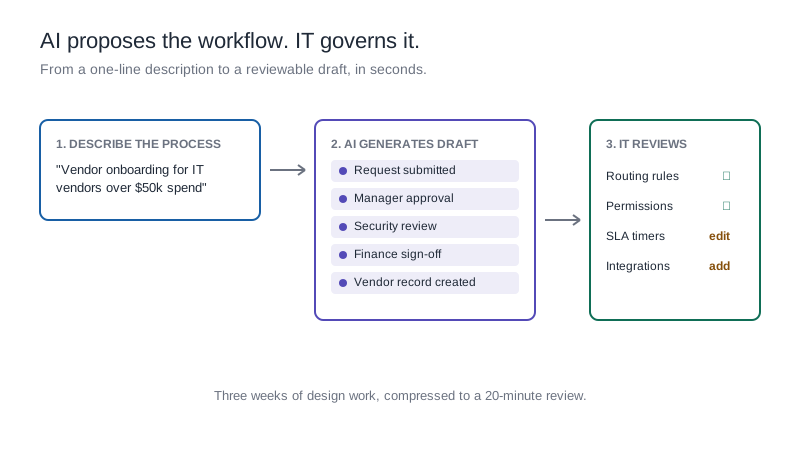
Kissflow's approach to AI is built around a specific architectural distinction. Rather than generating code, Kissflow's AI generates blueprints: structured descriptions of business logic in human-readable, auditable form.
A blueprint describes what an application does in business terms that any stakeholder can read. It is deterministic: the same inputs produce the same outputs every time. It is stable: changes are tracked and versioned, and do not silently break other parts of the application. It is transparent: business logic is visible to IT, to compliance teams, and to the people running the process, not locked inside generated code that requires a developer to interpret.
The practical difference is significant. An application built through AI-generated code may work perfectly on day one and become a liability by month three, when a business rule changes, a compliance question arises, or the original developer is no longer available. An application built through AI-generated blueprints on Kissflow can be read, modified, and governed by the people who understand the business, without needing the original developer in the room.
This is not a limitation of Kissflow's AI. It is a deliberate architectural choice. Code generation is optimized for speed of initial creation. The blueprint approach is optimized for the full application lifecycle, covering the months and years after the initial build.
What IT leaders should actually evaluate in a digital workplace platform
Most platform evaluations focus on features. The more important questions are architectural.
Does the platform unify work or connect tools? A platform that runs work natively on shared infrastructure creates less complexity than an integration layer that connects separate systems. Every point-to-point integration is a potential failure, a potential gap in the audit trail, and a potential source of duplicated data.
Can business teams build and modify their own processes? A platform that requires a developer for every workflow change creates a permanent bottleneck. The organizations that run digital workplaces most effectively are the ones where the people who understand the work best, including operations managers, finance teams, and HR leads, can build and modify their own applications within guardrails IT sets.
Is governance native or added on? Access control, environment management, application versioning, and audit trails should be built into the platform's core architecture. Governance bolted on through third-party tools or manual processes fails precisely when it matters most.
Does AI generate something IT can govern? This is the question most platform evaluations do not yet ask. As AI-driven development becomes standard, the governance question applies to AI output as much as to anything else. Platforms whose AI generates auditable, versioned business logic are fundamentally safer to deploy at enterprise scale than platforms whose AI generates code.
Can IT see everything that is running? A unified view of all applications, covering who built them, who uses them, and what processes they contain, is the baseline for managing risk and demonstrating compliance.
How Kissflow approaches the digital workplace
Kissflow is an enterprise application platform. Since 2012, it has served more than 1,200 customers on the principle that the people closest to a business problem, not only the people who write code, should have the tools to solve it.
On Kissflow, business teams build workflow automations, departmental applications, and process-driven case management tools without needing a developer for every change. AI assists at every stage: generating an initial application, form, workflow, or integration from a natural language prompt, with the output produced as a blueprint the team can review, refine, and govern, not as code that requires interpretation.
IT teams govern the platform. They manage access controls, set environment standards, approve applications for production, and maintain audit trails that satisfy SOC 2 Type II, ISO/IEC 27001, HIPAA, and GDPR requirements.
The production application mix reflects real enterprise work: around 35 percent of what customers build on Kissflow is workflow and process automation, 30 percent is departmental or line-of-business applications, and roughly 20 percent extends existing systems of record like SAP and Salesforce. Business users and professional developers work on the same platform, meaning a mixed team can collaborate on a single application without moving between tools.
The result is a digital workplace where IT has full visibility and governance, business teams have the capability to act without creating shadow IT risk, and AI-driven development produces applications that last, not just applications that demonstrate well.
Frequently asked questions
What is a digital workplace?
A digital workplace is a cloud-based, governed environment where employees access the applications, data, and workflows they need to do their jobs from any device or location. It combines collaboration, process automation, project management, and application access under a single governance layer controlled by IT. The defining characteristic is not the breadth of tools it contains but the governance that makes those tools visible, auditable, and manageable at scale.
What is the difference between a digital workplace and digital transformation?
Digital transformation is the broader organizational shift to technology-driven ways of working. A digital workplace is the operational environment, comprising the platform, the tools, and the governance layer, through which that transformation happens day-to-day. Transformation is the strategic goal; the digital workplace is the infrastructure it runs on.
How is a digital workplace different from an intranet?
An intranet is a private document and communication network. Employees read from it and post to it, but work does not move through it. A digital workplace is an active operational environment where processes run, tasks are assigned, approvals are tracked, and data is generated in auditable form. Most organizations need both, but conflating them leads to chronic underinvestment in the process layer.
What are the biggest risks in a digital workplace rollout?
The three most common failure modes are: deploying collaboration tools without an operational process layer; allowing business teams to build their own tools outside IT governance; and treating the digital workplace as a one-time technology purchase rather than an ongoing governance strategy. A fourth, emerging risk is AI-driven development that generates ungovernable code: fast to build but impossible to audit.
How many applications does the average enterprise manage?
According to Okta's Businesses at Work 2024 report, large enterprises manage more than 211 applications on average. The governance question matters more than the count: does IT know what all of those applications do, who has access to them, and what data they contain?
What is the right role for AI in a digital workplace?
AI in a digital workplace should accelerate how business teams build and modify processes, not generate technical debt. The distinction is between AI that produces code, which business users cannot read or govern, and AI that produces auditable business logic that IT and the business can both inspect, version, and maintain. Platforms that generate blueprints rather than code are better suited to enterprise governance requirements over the long term.
How should IT leaders measure the success of a digital workplace investment?
The most reliable indicators are process cycle time, approval delay rate, compliance incident frequency, and employee time reclaimed from manual tasks. Organizations that baseline these metrics before rollout and track them quarterly can model return on investment with precision.
The measure of a digital workplace is not what it includes but what IT can see and govern
Every organization already has a digital workplace of some kind. The question is whether that environment is one IT can govern, one the business can trust, and one that holds up when the organization is twice its current size and when AI is generating new applications every week.
Getting there requires more than the right tools. It requires a platform architecture where governance is native, business teams can build without creating risk, and AI-driven development produces applications that the whole organization can read, audit, and maintain.
.webp)