
What is Rapid Application Development (RAD)? An Ultimate Guide for 2026
In an era when CIOs relentlessly drive innovation, and business technology partners advocate for transformative IT initiatives, RAD serves as a powerful ally in the quest for faster, more efficient software development. As we step into 2025, the dynamic landscape of software engineering has evolved, and RAD is poised to play a pivotal role.
What is Rapid Application Development (RAD)?
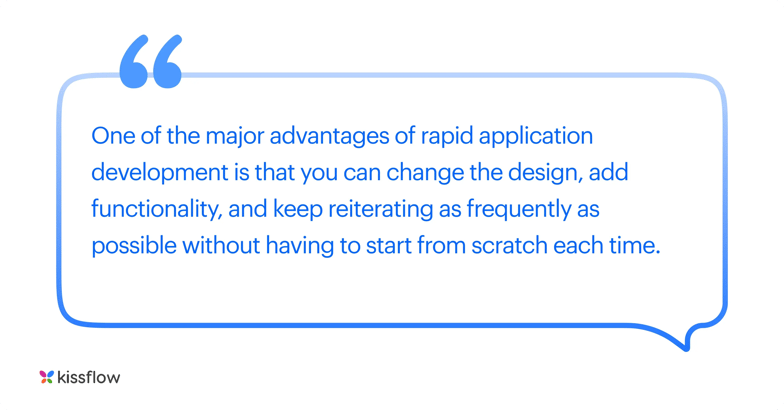
Rapid Application Development, or RAD, means an adaptive software development model based on prototyping and quick feedback with less emphasis on specific planning. In general, the RAD approach prioritizes development and building a prototype rather than planning. With rapid application development, developers can quickly make multiple iterations and updates to the software without starting from scratch. This helps ensure that the final outcome is more quality-focused and aligns with the end users’ requirements.
A major challenge with the waterfall model is that once the product moves into the testing phase, the tester cannot go back to reiterate and make changes to the core functions and features. This essentially leaves teams with software that may or may not fit the end-users’ evolving requirements.
Rapid Application Development (RAD) was conceived in the 1980s, so it’s definitely not something new. But unlike the waterfall model, it’s not singular. It’s a continuous evolution of development philosophies according to the requirements at that particular time compared to application development platform.
The worldwide market for Rapid Application Development is projected to grow at a compound annual growth rate (CAGR) of 42.8%[1] from 2022 to 2027.
Initially, Barry Boehm, James Martin, and a number of others saw that software was not limited to traditional methods of engineering. It wasn’t a singular resource that required a fixed structure. It was malleable to suit the needs of the user.
Why do you use rapid application development?
RAD is the best approach to develop prototypes swiftly for testing software functionalities without worrying about any effects on the end product. Businesses opt for the RAD approach as it requires little focus on the planning phase while enabling the team to design, review, and iterate features and functionalities quickly.
Initially, rapid application development took the shape of the Spiral model [2], where one or more development models were used to work on a particular project.
RAD is best suited for projects like web application development where the requirements are expected to evolve or are not well-defined from the start.
Over time, RAD phases have changed. It molded itself to fit the requirements of the time while retaining some core development guidelines. The RAD approach is driven by user interface needs and is perfect for application development requiring quick development and deployment. With visual interface tools and pre-built modules, RAD helps create software apps quickly and easily. Businesses adopt different types of rapid app development because of their agility, flexibility, and scalability.
Steps in rapid application development
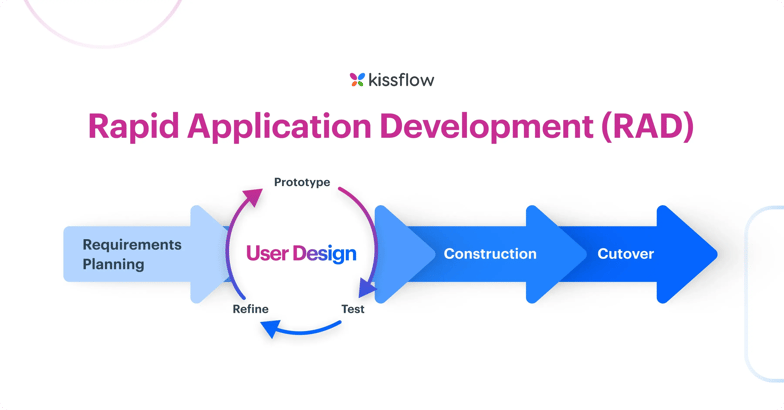
Here are the four basic steps of RAD:
1. Define the requirements
At the very beginning, rapid application development sets itself apart from traditional software development models. It doesn’t require you to sit with end users and get a detailed list of specifications; instead, it asks for a broad requirement. The broad nature of the requirements helps you take the time to segment specific requirements at different points of the development cycle.
2. Prototype
This is where the actual development takes place. Instead of following a rigid set of requirements, developers create prototypes with different features and functions as fast as they can. These prototypes are then shown to the clients who decide what they like and what they don’t.
More often than not, these prototypes are quickly made to work to showcase just the key features. This is normal, and the final product is only created during the finalization stage, where the client and developer are in alignment with the final product.
3. Construction
The construction stage is a crucial stage of development. Engineers and developers work tirelessly to flesh out a working system from a working model. Feedback and reviews are crucial at this stage, and most bugs, issues, and alterations are addressed. This stage can be particularly long, especially in cases where clients change directions or feedback is intensive.
4. Deployment
The final stage of RAD involves deploying the built system into a live production environment. The deployment phase involves intensive scale testing, technical documentation, issue tracking, final customizations, and system simulation. Teams also spend time debugging the app and running final updates and maintenance tasks before going live. In the dynamic process of RAD, especially during the prototyping and construction stages, developers frequently need to experiment with various features quickly. Understanding ways to delete a git stash can be incredibly beneficial for managing interim development versions without cluttering the repository with unnecessary snapshots.
Benefits of rapid application development model
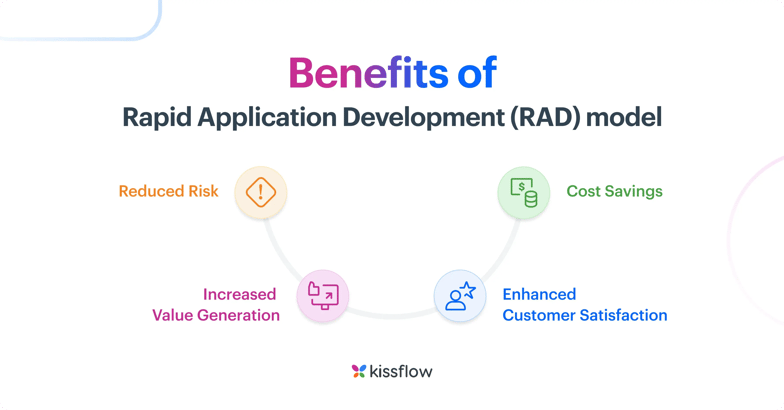
Rapid Application Development (RAD) is a software development methodology that prioritizes rapid prototyping and quick feedback over long, drawn-out development and testing cycles. Here's how RAD's accelerated development cycles contribute to overall value generation for businesses:
Faster time-to-market:
RAD uses iterative development and prototyping, which means that usable parts of the software can be delivered quickly. This allows businesses to bring their products to market faster, which can provide a significant competitive advantage.
Cost savings:
Since RAD involves continuous user feedback, errors and issues are identified and rectified early in the development process. This reduces the cost and effort required for extensive debugging later on. Additionally, since the product reaches the market quicker, the revenue stream begins sooner, contributing to better financial performance.
Increased value generation:
RAD allows for the frequent release of smaller features, which not only keeps the end-users engaged but also provides them with immediate value. Moreover, as the end-users are involved throughout the development process, the final product tends to be more aligned with their needs, thereby increasing its overall value.
Reduced risk:
With its focus on incremental development, RAD reduces the risk of project failures. Since each small iteration is manageable and can be easily tested, the risk of any major issue affecting the entire project is significantly reduced.
Enhanced customer satisfaction:
By involving users throughout the development process, RAD ensures that the final product meets user expectations and requirements. This leads to increased customer satisfaction, which can drive customer loyalty and retention.
RAD principles align closely with citizen application development, where business analysts and operations leads build and iterate on apps alongside — or independently of — the core engineering team.

RAD promotes cross-functional collaboration
User involvement:
RAD encourages active user involvement throughout the development process. Users are often considered part of the development team, providing continuous feedback and input. This ensures that the final product meets user needs and expectations, which is particularly important in enterprises where the software must support complex business processes.
Communication and collaboration:
RAD places a strong emphasis on communication and collaboration. Regular meetings, reviews, and discussions are held with all stakeholders. This helps to ensure everyone understands the project goals, the progress being made, and any issues that arise. It also allows for quick decision-making and problem-solving.
Iterative development:
The iterative nature of RAD means that prototypes are developed, tested, reviewed, and refined in repeated cycles. This allows business stakeholders to see progress and provide feedback on an ongoing basis. It also allows IT teams to understand and address any technical challenges early on.
Flexibility:
RAD is highly flexible, allowing changes to be made quickly in response to feedback from business stakeholders or end users. This flexibility can help to ensure alignment between the technology and the business needs.
Shared ownership:
Because all stakeholders are involved throughout the development process, there's a sense of shared ownership of the final product. This can lead to higher satisfaction levels and greater commitment to the success of the software.
Rapid application development vs. Other software development models
When compared to other software development models, the RAD framework varies considerably. Obviously, the major difference is how rapid application development focuses on speed when compared to other models, which usually focus on bringing a working product to the customer.
RAD |
Waterfall |
Agile |
|---|---|---|
|
Builds a functional, working model of the application in the fastest way possible |
Emphasizes intensive planning and follows through on set objectives |
Builds the app by breaking down large objectives into smaller ‘sprints’ |
|
Perfect for projects that require the shortest time to complete |
Projects are thoroughly planned, and execution is typically time-consuming |
Helps develop projects in periodical milestones or ‘sprints’ |
|
Can adjust to changing requirements |
Does not allow for changes once planning is done |
Can quite easily adjust to changes even at later stages |
|
Involves clients throughout the development cycle |
Only involve clients during the planning stage |
Involves clients throughout the development |
|
Prioritizes functionality over aspects of UI/UX |
Considers all aspects of the app before deployment |
UI/UX takes as much priority as functionality |
When can you use the rapid application development methodology?
1. When you can reliably test your prototypes
If you’ve got a pool of users who can give consistent and reliable feedback on the prototypes you make, then rapid application development is a great model to follow. Prototypes built through the rapid application development model depend on feedback from previous iterations, so reliable feedback from dependable sources can be immensely helpful.
2. When you’ve got the budget
Compared to other development models, rapid application development is relatively inexpensive, but there are some instances where the developments can be expensive due to RAD characteristics. Hiring talented staff means you’ll need to give them appropriate salaries. The bright side is, if you’ve got the staff, you can get the idea from concept to end product a lot quicker than other models.
3. When you need a project done quickly
If you’ve got a tight deadline, rapid application development is the best bet. If you’re under pressure to deliver something that works, then opting for a RAD platform can be the best choice. If you don’t have the time to go through a long requirement planning and design phase, then rapid application development software is your best bet. Rapid application development takes an on-the-fly approach, which makes sense for quick development, which can change direction on a dime.
An example of rapid application development case study - Centric consulting
Rapid application development is particularly useful for small businesses that need software done quickly, whilst having a lot of input during the development process.
Centric Consulting, a developer familiar with rapid application development and agile development methodologies, had a client[3] come to them with a requirement for software that would interface with their customers, one of which had over 35,000 employees for procurement, invoicing, and payment.
Centric Consulting was able to use agile and rapid application development methodologies to quickly understand what the client needed, speed up the development process using Ruby on Rails, and keep costs low using rapid application development open source infrastructure.
Throughout the development process, the customer was able to provide input as to what functionalities were required. All those functionalities were rapidly added as and when they were demanded, and ultimately, the product was delivered to the client.
In the end, Centric Consulting not only met the demands of its clients but was also able to meet their needs and grow its business
Unlock rapid application development with Kissflow
Kissflow is a low-code platform that helps in rapid application development. It enables business users to develop their own automated processes and custom applications without relying on the IT team. Kissflow can be used by a single person to work on developing an application.
This is rapid application development taken to a new level–making applications that are ready to use instantly by the entire company.
With visual interface tools to create models quickly and easily, pre-built modules where you don’t have to do the heavy lifting, and drag-and-drop coding to provide a means of customization to those who don’t have the proper coding knowledge, Kissflow is designed keeping in mind that companies want tools that make their lives easier. Rapid application development tools like Kissflow are the best way to develop software. Rapid application development tools like Kissflow are the best way to build applications with minimal reliance on IT teams. Find out more about the benefits of the Kissflow Platform. IT Developers and IT Heads need a faster way to build, deploy, and scale enterprise apps. With Kissflow’s low-code platform, coding complexity is reduced while flexibility remains.
If you are ready to put RAD principles into practice, Kissflow's app builder gives you the visual prototyping environment, drag-and-drop forms, and iterative workflow tools that RAD demands.
Learn more: How IT developers can build faster.
The no-code RAD approach takes the philosophy of rapid prototyping further — business users build and iterate directly, compressing feedback cycles to hours instead of sprint cycles.
Frequently Asked Questions (FAQs)
What does RAD stand for?
RAD stands for Rapid Application Development, a model focused on speed and iterative prototyping.
What are the phases of RAD?
The four phases are requirements planning, user design, rapid construction, and cutover.
When should you use RAD?
Use RAD when requirements may change, the project is small-to-mid sized, and you need to deliver quickly with active user feedback.
Is RAD the same as Agile?
No. Agile works in fixed sprints; RAD prioritizes the fastest possible prototyping. RAD is often described as a faster, prototype-first relative of Agile.
What are the advantages of using rapid application development?
The advantages of Rapid Application Development (RAD) include faster development cycles, increased user involvement, and the ability to adapt to changing requirements. RAD emphasizes quick prototyping and iterative development, letting teams deliver functional components faster and incorporate user feedback throughout. This reduces the risk of misaligned requirements and ensures the final product better meets user needs. Tools that enable rapid prototyping, easy modifications, and continuous iteration help teams deliver quality applications in less time.
-May-19-2025-11-22-41-6975-AM.png)