Agentic Workflows: The Complete Guide for Enterprise Leaders
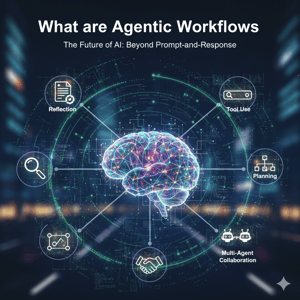
Agentic workflows are advanced, AI-driven automated processes where intelligent agents autonomously plan, execute, and adapt multi-step tasks to achieve complex goals, moving beyond rigid rules of traditional automation by using reasoning, learning, and tools with minimal human oversight. These workflows leverage Large Language Models (LLMs) and AI for self-correction, dynamic scenario handling, and problem-solving across industries like customer service, data analysis, and software development.
From rigid automation to goal-driven, intelligent systems that redefine how work gets done
Traditional workflows were built for a simpler time. They followed predictable paths, executed predefined steps, and broke the moment real-world complexity entered the equation. But enterprise operations rarely follow neat, linear patterns. Conditions shift, exceptions multiply, and the systems designed to streamline work often become the very bottlenecks that slow it down.
Enter agentic workflows, a fundamental shift in how enterprises approach process automation. These are not incremental improvements to existing systems. They represent an entirely new paradigm where AI agents understand context, make decisions, act across systems, and continuously improve without relying on rigid, rule-based flows.
According to Gartner, 40 percent of enterprise applications will integrate task-specific AI agents by the end of 2026, up from less than 5 percent today. This is not a distant future scenario. The shift is happening now, and enterprise leaders who understand this evolution will be positioned to transform their operations while competitors remain stuck in legacy thinking.
What are agentic workflows?
Agentic workflows use autonomous or semi-autonomous AI agents that go far beyond simple task automation. Unlike static, rule-based systems that execute predetermined steps, these workflows are powered by decision-making AI agents that understand context, evaluate options, take purposeful actions, and learn from outcomes over time.
Think of traditional automation as a GPS that can only follow pre-programmed routes. Agentic workflows function more like an experienced driver who can navigate traffic, find alternate routes, and make judgment calls based on current conditions, all while keeping the destination firmly in mind.
The core characteristics that define truly agentic workflows include:
Goal-orientation: Rather than simply executing steps, agentic workflows pursue outcomes. They understand what success looks like and work toward it, even when conditions change.
Context-awareness: These systems draw on documents, policies, historical data, and prior outcomes to inform decisions. They do not operate in isolation but leverage institutional knowledge to make better choices.
Self-direction: Agentic workflows can determine the best path to achieve an objective without being explicitly told every step to take. They evaluate options, assess constraints, and choose approaches based on the situation at hand.
Human oversight: Enterprise agentic workflows keep humans as approvers, exception handlers, and policy owners. This ensures trust, accountability, and governance remain intact even as systems gain autonomy.
Continuous learning: Outcomes feed back into the system, improving future decisions and performance. Each completed workflow makes the next one smarter.
McKinsey's State of AI Global Survey 2025 found that 88 percent of enterprises now report regular AI use in their organizations, signaling that AI has moved from experimental to operational for the vast majority of large organizations. Agentic workflows represent the next evolution of this adoption curve.
How agentic workflows differ from traditional automation
Understanding what makes agentic workflows distinct requires examining the automation approaches that came before them and recognizing why each approach has limitations that the next generation addresses.
Rule-based workflows: Predictable, linear, and fragile
Traditional workflows were designed for stable environments with predictable conditions. They operate on simple if-then logic: if condition A occurs, execute action B. This approach works well for routine, repetitive tasks where variation is minimal and exceptions are rare.
The problem is that enterprise reality rarely matches these assumptions. Real business processes involve judgment calls, exceptions, and situations that fall outside predefined parameters. When a rule-based workflow encounters something unexpected, it typically stops, fails, or produces incorrect results.
Consider a procurement approval workflow. A rule-based system might route all requests over a certain dollar amount to a senior manager. But what happens when that manager is unavailable, when the request is time-sensitive, when the vendor has a history of issues, or when the purchase falls into a gray area between categories? The rigid workflow cannot account for these nuances.
Intelligent automation and RPA: Faster execution, limited reasoning
Robotic Process Automation addressed some limitations of rule-based workflows by enabling software bots to interact with multiple systems, handle high volumes of transactions, and execute tasks faster than human workers. RPA dramatically improved speed and scale for structured, repetitive processes.
However, RPA remains fundamentally instruction-bound. These bots follow scripts with precision, but they cannot truly decide or adapt. When confronted with situations outside their programming, they escalate to humans or fail. They lack the reasoning capabilities to handle unstructured data, interpret context, or make judgment calls.
The workflow automation market reached 23.77 billion dollars in 2025 and is forecast to grow to 37.45 billion dollars by 2030. Much of this growth now comes from organizations seeking to move beyond basic RPA toward more intelligent automation approaches.
Agentic workflows: Systems that decide how to achieve outcomes
Agentic workflows represent a fundamental departure from both rule-based automation and RPA. Rather than executing predefined steps, these systems dynamically choose paths, coordinate actions across multiple agents and systems, and optimize results based on goals rather than instructions.
The key difference is purpose versus procedure. Traditional automation asks: "What steps should I execute?" Agentic workflows ask: "What outcome should I achieve, and what is the best way to get there given current conditions?"
Gartner predicts that by 2028, at least 15 percent of day-to-day work decisions will be made autonomously through agentic AI, up from zero percent in 2024. Additionally, 33 percent of enterprise software applications will include agentic AI by 2028, up from less than one percent in 2024. This represents a fundamental shift in how business operations will function.
What makes a workflow truly agentic?
The term "agentic" has become popular, but many vendors are engaging in what Gartner calls "agent washing," rebranding existing products like AI assistants, RPA, and chatbots without substantial agentic capabilities. Understanding what truly makes a workflow agentic helps cut through the marketing noise.
AI agents explained without the hype
AI agents are software entities that combine large language models, business rules, specialized tools, and memory systems to make informed decisions and take purposeful actions. They observe their environment, reason about what they perceive, decide on courses of action, and execute those decisions.
A helpful framework for understanding AI agents is the observe-reason-decide-act cycle. The agent observes its environment by gathering data from relevant sources such as documents, databases, system states, and user inputs. It reasons about this information by analyzing context, identifying patterns, and evaluating options against goals and constraints. It decides on a course of action by selecting the best approach given current conditions. Finally, it acts by executing tasks, coordinating with other systems, or escalating to humans when appropriate.
What distinguishes true AI agents from simpler automation is their ability to handle ambiguity, adapt to changing conditions, and pursue goals rather than simply follow instructions.
Single-agent versus multi-agent workflows
Simple processes may rely on a single agent handling end-to-end tasks. More complex enterprise workflows increasingly use multiple specialized agents working together, each with distinct capabilities and responsibilities.
Think of multi-agent workflows like a well-coordinated team. One agent might specialize in data gathering and analysis. Another handles communications and stakeholder interactions. A third manages compliance checks and approvals. A fourth coordinates the overall process and ensures everything stays on track.
Gartner predicts that by 2027, one-third of agentic AI implementations will combine agents with different skills to manage complex tasks within application and data environments. This multi-agent approach allows enterprises to tackle sophisticated processes that would overwhelm any single automated system.
Human-in-the-loop versus human-on-the-loop
A critical distinction in enterprise agentic workflows is the role humans play in the system. Two models dominate:
Human-in-the-loop keeps humans directly involved in key decision points. The agent prepares information, makes recommendations, and handles routine tasks, but critical decisions require human approval before proceeding. This model is appropriate for high-stakes processes where errors could have significant consequences.
Human-on-the-loop allows agents greater autonomy while humans maintain oversight and can intervene when needed. Humans monitor agent activities, review outcomes, and step in for exceptions or policy violations. This model works well for processes where speed matters and the agent has demonstrated reliability.
Most enterprise implementations blend both approaches, using human-in-the-loop for critical decisions and human-on-the-loop for routine operations. This ensures that automation accelerates work without removing the human judgment that governance and accountability require.
The anatomy of an agentic workflow
Understanding how agentic workflows are structured helps enterprise leaders evaluate solutions and design effective implementations. Every agentic workflow consists of several key components working together.
Intelligent triggers
Traditional workflows start from predefined events: a form submission, a scheduled time, or a system notification. Agentic workflows expand the trigger possibilities dramatically. They can start from goals stated in natural language, anomalies detected in data patterns, signals indicating potential issues, or human intent expressed conversationally.
This flexibility means workflows can be proactive rather than purely reactive. An agentic system might notice that inventory levels are trending toward a stockout and initiate procurement processes before anyone submits a request.
Context and memory layer
Agents make better decisions when they have access to relevant context. The memory layer provides access to documents, policies, historical data, prior outcomes, and institutional knowledge that inform decision-making.
This context awareness is what allows agentic workflows to handle situations that would stump rule-based systems. When evaluating a vendor proposal, the agent can consider not just the current request but also the vendor's performance history, similar purchases made by other departments, relevant policy requirements, and budget constraints.
Reasoning and decision engine
At the core of agentic workflows is the ability to reason about situations and make decisions. The agent evaluates options, considers constraints, assesses risks, and determines the best path forward. This is not simple pattern matching but genuine inference about how to achieve goals given current conditions.
The decision engine handles questions like: Should this request be approved or escalated? Which vendor offers the best combination of price, quality, and reliability? What is the fastest way to resolve this customer issue? How should resources be allocated across competing priorities?
Action and orchestration layer
Once decisions are made, the action layer executes them across enterprise systems. This might involve updating records in ERP systems, sending communications through email or messaging platforms, creating tickets in service management tools, triggering additional workflows, or coordinating with other agents.
The orchestration capability is crucial. Enterprise processes rarely live in a single system. Agentic workflows can coordinate actions across ERP, CRM, ITSM, communication tools, document management systems, and approval platforms to execute end-to-end processes seamlessly.
Feedback and learning loop
What separates agentic workflows from earlier automation approaches is their ability to improve over time. Outcomes feed back into the system, informing future decisions and continuously enhancing performance.
When an agent's decision leads to a successful outcome, that reinforces similar approaches in the future. When outcomes fall short, the system adjusts its reasoning. Over time, this creates workflows that become increasingly effective at achieving their goals.
Real-world use cases of agentic workflows
Agentic workflows are transforming operations across enterprise functions. Understanding where these systems deliver the most value helps leaders identify high-impact implementation opportunities.
Operations and back-office
Back-office operations involve countless decisions that traditional automation handles poorly. Dynamic approvals that consider context beyond simple thresholds. Intelligent task routing that matches work to the right people based on skills, workload, and availability. SLA-aware escalation that prevents bottlenecks before they impact service levels.
Agentic workflows excel in these environments because they can handle the variability inherent in operational work. Rather than routing every purchase request through the same approval chain regardless of context, an agentic system can assess urgency, risk, and strategic importance to determine appropriate handling.
Organizations achieve up to 70 percent cost reduction by automating workflows with agentic AI systems, with savings compounding as implementations expand across business functions.
IT and service management
IT service management has long struggled with the tension between automation and the need for human judgment. Simple issues can be handled automatically, but more complex problems require expertise. Traditional systems either over-escalate, wasting skilled resources on routine matters, or under-escalate, leaving users waiting for help that never arrives.
Agentic workflows offer a better approach. AI agents can assist with incident triage, analyzing symptoms and historical patterns to identify likely root causes. They can recommend remediation steps, gather relevant information for technicians, and handle routine resolutions autonomously while escalating appropriately when human expertise is needed.
Finance and procurement
Finance and procurement processes involve significant decision-making under uncertainty. Spend anomaly detection requires understanding what patterns are normal versus concerning. Compliance-aware purchasing must balance efficiency with regulatory requirements. Approval workflows need to consider context that goes far beyond dollar amounts.
Agentic workflows bring intelligence to these controls. They can flag unusual spending patterns while distinguishing genuine anomalies from legitimate business needs. They can ensure compliance requirements are met while minimizing friction for routine transactions. They can route approvals based on risk assessment rather than rigid hierarchies.
Insurance company Aviva reported that transforming its motor claims domain saved the company more than 60 million pounds in 2024, with AI-powered claim management achieving five to ten times faster claim cycles through intelligent process automation.
HR and employee experience
Human resources processes are inherently personal. Employees expect experiences tailored to their situations, not one-size-fits-all bureaucracy. Yet HR teams are stretched thin, often unable to provide the individual attention people deserve.
Agentic workflows can help by handling routine requests intelligently while freeing HR professionals for work that truly requires human touch. From onboarding new employees to responding to policy questions, processing time-off requests, and managing benefits inquiries, agents can interpret policies and tailor experiences based on individual circumstances.
Industry-specific scenarios
Highly regulated industries face unique challenges that make agentic workflows particularly valuable. Healthcare organizations must balance patient care with complex compliance requirements. Financial institutions navigate intricate regulatory frameworks. Manufacturing companies manage safety and quality standards.
In these environments, agentic workflows provide decisioning capabilities with embedded governance. The agent knows the rules and applies them consistently while adapting to the specifics of each situation. This combination of flexibility and compliance is difficult to achieve with traditional automation approaches.
Why agentic workflows matter for enterprises
The business case for agentic workflows extends beyond efficiency gains. These systems fundamentally change how enterprises can approach work design, decision-making, and human-machine collaboration.
Speed without losing control
A common concern about automation is that it sacrifices control for speed. Agentic workflows challenge this assumption by providing guardrails that maintain governance while accelerating execution.
Built-in approval checkpoints ensure humans remain involved in critical decisions. Audit trails capture agent reasoning and actions for compliance and review. Policy enforcement happens automatically, reducing the risk of violations. The result is automation that moves faster precisely because governance is embedded rather than bolted on.
Reducing cognitive load on humans
Knowledge workers increasingly struggle with information overload and task fragmentation. They spend their days switching between systems, gathering information, coordinating with colleagues, and handling administrative work that distracts from their core expertise.
Agentic workflows can absorb much of this cognitive burden. Agents handle coordination, gather relevant information, and prepare decisions for human review. This allows people to focus on judgment, strategy, and the work that truly requires human capabilities.
McKinsey research indicates that automation technologies could save firms up to 15 trillion dollars in wages annually by 2030, with over 30 percent of operations in 60 percent of all occupations potentially automatable.
From process efficiency to outcome optimization
Traditional automation measures success by whether the workflow ran correctly. Did each step execute as designed? Were the rules followed? This process-centric view often misses the bigger picture.
Agentic workflows shift focus to outcomes. Did we achieve the business goal? Was the customer satisfied? Did we make the best decision given the available information? This outcome-oriented approach aligns automation with what actually matters to the business.
Agentic workflows and low-code platforms
The intersection of agentic AI and low-code platforms is where enterprise implementation becomes practical. Neither technology reaches its full potential in isolation, but together they create powerful capabilities for transforming how work gets done.
Why low-code is the natural home for agentic workflows
Low-code platforms combine visual workflow design, AI decisioning capabilities, and enterprise governance at scale. They provide the infrastructure that agentic workflows need while making implementation accessible beyond specialized technical teams.
According to Gartner, by 2025, 70 percent of new applications developed by enterprises will utilize low-code or no-code technologies, a significant jump from less than 25 percent in 2023. This adoption is driven by the urgent need for digital transformation and the reality that traditional development cannot keep pace with business demands.
The global low-code development market is projected to reach 44.5 billion dollars by 2026, reflecting enterprise confidence in these platforms as critical infrastructure.
Fusion teams: Business, IT, and AI working together
Agentic workflows enable a new model of collaboration between business experts, IT professionals, and AI systems. Domain experts understand the processes and can identify where intelligent automation would help. IT teams provide governance, integration, and technical oversight. AI agents contribute decision-making capabilities and continuous learning.
This fusion team approach addresses a persistent challenge in enterprise automation: the gap between what business needs and what IT can deliver. With 72 percent of IT leaders reporting being blocked from strategic work due to project backlogs, empowering business teams to build their own solutions while maintaining IT governance is essential.
Low-code platforms make this collaboration possible by providing visual tools that business users can work with while maintaining the controls IT requires.
Governance, security, and compliance
Enterprise adoption of agentic workflows requires non-negotiable governance capabilities. Role-based access control ensures only authorized users and agents can access sensitive data and perform critical actions. Audit trails capture decision reasoning for compliance review. Policy enforcement happens automatically within the workflow.
Security survey data reveals that 75 percent of technology leaders list governance as their primary concern when deploying agentic AI. This concern is driving demand for platforms that enforce multi-user authorization, tool-level controls, and complete audit trails for agent actions.
Platforms designed for enterprise use build these capabilities in from the start rather than treating them as afterthoughts.
Challenges and risks of agentic workflows
Despite their promise, agentic workflows are not without challenges. Understanding potential pitfalls helps leaders implement these systems responsibly and avoid common mistakes.
Over-automation and trust gaps
The power of agentic workflows can tempt organizations to automate more than they should. When autonomy goes too far, systems can make decisions that erode trust or produce unintended consequences. Finding the right balance between agent autonomy and human oversight is critical.
Gartner predicts that over 40 percent of agentic AI projects will be canceled by the end of 2027 due to escalating costs, unclear business value, or inadequate risk controls. Many of these failures stem from organizations pursuing agentic AI driven by hype rather than clear strategic purpose.
Starting with assistive agents that augment human decision-making before moving toward higher autonomy helps build trust gradually while learning what works in specific contexts.
Data quality and context limitations
Agentic workflows are only as effective as the data, context, and systems they can access. Agents cannot make good decisions without good information. Organizations with fragmented data, poor documentation, or disconnected systems will struggle to realize the benefits of agentic automation.
The number of enterprises with agentic AI pilots nearly doubled in a single quarter, from 37 percent in Q4 2024 to 65 percent in Q1 2025. However, full deployment remains stagnant at only 11 percent as enterprises face significant challenges with integration, infrastructure, and data maturity.
Investing in data quality and system integration is often a prerequisite for successful agentic workflow implementation.
Governance and accountability
When an AI agent makes a decision, who is responsible for the outcome? Enterprises must clearly define ownership, escalation paths, and accountability for agent decisions. This includes determining when human approval is required, how decisions are documented, and how issues are addressed when agents make mistakes.
Clear governance frameworks ensure that agentic workflows enhance accountability rather than obscuring it. Every decision should be traceable, explainable, and ultimately owned by a responsible human.
How to get started with agentic workflows
Moving from interest in agentic workflows to successful implementation requires a thoughtful approach. The following guidance helps leaders begin their journey effectively.
Identify decision-heavy processes
The best candidates for agentic workflows involve significant judgment, frequent exceptions, and dynamic conditions. Look for processes where rules alone cannot capture the complexity, where skilled workers spend time on routine decisions, and where variability makes traditional automation brittle.
Good starting points often include: approval workflows with complex criteria, exception handling processes, customer service escalation, vendor evaluation and selection, compliance review and monitoring, and resource allocation decisions.
Avoid starting with processes that are either too simple, where basic automation suffices, or too critical, where mistakes would have severe consequences. Build experience and trust before tackling high-stakes workflows.
Start with assistive agents
Beginning with agents that assist humans rather than replace them builds trust and reduces risk. Assistive agents can gather information, prepare decisions, make recommendations, and handle routine aspects of work while humans retain final authority.
This co-pilot approach allows organizations to learn how agents perform in their specific environment, identify where they need guardrails or adjustments, and build stakeholder confidence before expanding autonomy.
As agents demonstrate reliability and value, their scope can gradually expand. The goal is to find the right balance of human and agent involvement for each process.
Design for transparency and control
Trust in agentic workflows depends on visibility into what agents do and why. Design systems that provide clear explanations of agent reasoning, comprehensive logs of actions taken, straightforward ways for humans to review and override decisions, and obvious escalation paths when situations exceed agent capabilities.
Transparency is not just about compliance. It builds the trust necessary for stakeholders to embrace agentic workflows and helps identify opportunities for improvement.
The future of agentic workflows
The trajectory of agentic workflows points toward fundamental changes in how enterprises operate. Understanding where this technology is heading helps leaders prepare for what comes next.
From workflows to digital operations
As agentic workflows mature, they will increasingly become the backbone of how enterprises run. Rather than discrete automated processes, organizations will operate with integrated systems where agents coordinate across functions, anticipate needs, and continuously optimize operations.
This evolution transforms the role of technology from supporting business operations to being inseparable from how work actually happens. The distinction between "the business" and "the systems" becomes less meaningful when intelligent agents are embedded throughout.
Analyst signals and market direction
Major analyst firms point to the convergence of agentic AI and low-code platforms as a defining trend. Gartner identifies agentic AI as one of the top 10 strategic technology trends for 2025, positioning it alongside other fundamental technologies that will reshape business operations.
The agentic AI market is projected to expand from 5.25 billion dollars in 2024 to 199 billion dollars by 2034, growing at a 43.84 percent compound annual growth rate. This extraordinary growth reflects enterprise expectations for transformative impact.
What this means for leaders
CIOs, COOs, and CDOs must move beyond thinking about automation as a way to do existing work faster. Agentic workflows enable entirely new approaches to how work is designed, how decisions are made, and how humans and machines collaborate.
Leaders who embrace this shift will have opportunities to rethink processes from the ground up, designing for intelligent automation rather than retrofitting it onto legacy approaches. Those who wait risk falling behind competitors who are already building the capabilities this new paradigm enables.
How Kissflow helps enterprises adopt agentic workflows
Implementing agentic workflows requires a platform that combines intelligent automation with enterprise-grade governance, and that is exactly where Kissflow delivers value.
Kissflow's low-code and no-code platform enables organizations to design, automate, and optimize workflows without waiting on IT backlogs. Business teams can build intelligent processes using visual tools while IT maintains oversight and control. This fusion approach addresses the reality that 84 percent of enterprises adopt low-code platforms specifically to reduce IT backlogs and accelerate application delivery.
The platform's workflow capabilities go beyond simple task routing to support the context-aware, goal-oriented processes that define agentic automation. Organizations can embed decision logic, connect across enterprise systems, maintain comprehensive audit trails, and continuously improve processes based on outcomes.
Kissflow was named a Strong Performer in Forrester's Wave for Low-Code Platforms for Citizen Developers, earning top scores for platform roadmap and developer experience. This recognition validates Kissflow's approach of making powerful workflow capabilities accessible to business users while maintaining the governance enterprises require.
For leaders ready to move beyond rigid automation toward intelligent workflows that adapt, decide, and deliver outcomes, Kissflow provides the foundation to make that transformation real.
Ready to transform your enterprise workflows with intelligent automation?
Related Articles