Every time your email app flags spam, your streaming service recommends a show, or a chatbot answers your support question — an AI model is doing the heavy lifting behind the scenes. But here's the thing: not all AI models are built the same. A model that detects credit card fraud is fundamentally different from one that writes marketing copy or generates product images.
So what are the different types of AI models, and why does it matter which one you use? This guide breaks down every major AI model type in plain language — and explains how no-code platforms are making it possible for non-technical teams to actually deploy these models in real-world workflows.
What Is an AI Model?
At its core, an AI model is a mathematical structure that has been trained on data to identify patterns and produce outputs. Think of it like a highly specialized intern: you show it thousands of examples (training data), it learns the patterns, and then it applies what it learned to new situations.
AI models sit at the heart of modern business software — from automated workflows to intelligent document processing. But the term 'AI model' covers a wide family of architectures, each with different strengths, limitations, and ideal use cases.
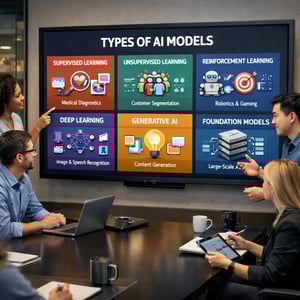
The 6 Major Types of AI Models (Explained Simply)
1. Supervised Learning Models
Supervised learning models are trained on labeled data — meaning each example in the training set comes with the correct answer. The model learns to map inputs to outputs based on these labeled examples.
Classic use cases: email spam detection, customer churn prediction, loan approval scoring, medical diagnosis. If your business has historical data where you already know the outcomes, supervised learning is almost always the right starting point.
Common algorithms: Linear regression, logistic regression, decision trees, random forests, support vector machines (SVMs).
2. Unsupervised Learning Models
Unsupervised learning models work with unlabeled data — they identify patterns and groupings without being told what to look for. These models are valuable when you don't know what you're looking for yet.
Use cases: customer segmentation, anomaly detection, market basket analysis, dimensionality reduction. They're particularly useful in exploratory data analysis and in situations where labeling data at scale is impractical.
Common algorithms: K-means clustering, DBSCAN, principal component analysis (PCA), autoencoders.
3. Reinforcement Learning Models
Reinforcement learning takes a different approach entirely. Instead of learning from a static dataset, the model (called an agent) learns by taking actions in an environment and receiving rewards or penalties based on outcomes. Over thousands of iterations, it develops a strategy that maximizes reward.
Use cases: robotics, game-playing AI (like AlphaGo), supply chain optimization, dynamic pricing engines, self-driving vehicle control systems. Reinforcement learning is computationally intensive but uniquely powerful for sequential decision-making problems.
4. Deep Learning Models (Neural Networks)
Deep learning is a subset of machine learning that uses artificial neural networks — multi-layered architectures loosely inspired by how the brain works. These models are exceptionally good at processing unstructured data: images, audio, video, and text.
Use cases: image recognition, natural language processing, speech-to-text, video analysis, medical imaging. Deep learning has powered most of the major AI breakthroughs of the last decade.
Subtypes: Convolutional Neural Networks (CNNs) for images, Recurrent Neural Networks (RNNs) for sequences, and Transformers for language tasks.
5. Generative AI Models
Generative AI models are designed to produce new content — text, images, video, audio, or code — rather than simply classify or predict. This is the category that includes large language models (LLMs) like GPT-4, as well as image generators like DALL-E and Stable Diffusion.
Use cases: content creation, customer service automation (conversational AI), code generation, document summarization, personalized marketing. Generative AI represents the fastest-growing segment of enterprise AI adoption today.
Key architectures: Large Language Models (LLMs) based on the Transformer architecture, Generative Adversarial Networks (GANs), and Diffusion Models.
6. Foundation Models & Large Language Models (LLMs)
Foundation models are large-scale AI models trained on broad, general datasets and designed to be fine-tuned for specific tasks. LLMs like GPT-4, Claude, and Gemini are the most well-known examples. They represent a paradigm shift in AI development — rather than building task-specific models from scratch, teams fine-tune a foundation model for their specific needs.
Use cases: enterprise chatbots, document processing, knowledge management systems, workflow automation, code assistance. Foundation models have dramatically lowered the barrier to sophisticated AI capabilities.
AI Model Types: Quick Comparison Table
|
AI Model Type
|
Training Data
|
Core Capability
|
Enterprise Use Cases
|
|
Supervised Learning
|
Labeled datasets
|
Classification, prediction
|
Email spam, loan approval, medical diagnosis
|
|
Unsupervised Learning
|
Unlabeled datasets
|
Pattern discovery, clustering
|
Customer segmentation, anomaly detection
|
|
Reinforcement Learning
|
Environment interactions
|
Sequential decision-making
|
Robotics, dynamic pricing, game AI
|
|
Deep Learning
|
Large unstructured data
|
Image/audio/text processing
|
Image recognition, NLP, speech-to-text
|
|
Generative AI
|
Massive text/image corpora
|
Content generation
|
ChatGPT, DALL-E, code generation
|
|
Foundation Models (LLMs)
|
Broad internet-scale data
|
Multi-task reasoning
|
Enterprise chatbots, document AI
|
How No-Code Platforms Are Changing AI Model Deployment
Historically, leveraging AI models in enterprise applications meant hiring data scientists, machine learning engineers, and dedicated AI ops teams. For most businesses — especially mid-market organizations — that barrier was simply too high.
No-code platforms like Kissflow are eliminating that barrier. Here's how:
-
Pre-built AI integrations: Connect to LLMs, computer vision APIs, and classification models without writing a single line of code
-
Visual workflow orchestration: Define the logic for when and how AI models are triggered within business processes
-
No-code app builder: Create front-end interfaces that surface AI model outputs to business users without developer dependency
-
Real-time data pipelines: Route structured and unstructured data to AI models through drag-and-drop configuration
-
Enterprise-grade governance: Manage AI model access, audit trails, and compliance through a centralized platform — no custom code required
The result: a product manager, operations lead, or business analyst can build an AI-powered document processing workflow, customer escalation system, or intelligent approval engine — in days instead of months.
Real-World AI Model Use Cases Across Industries
-
Healthcare: Supervised learning models for predictive diagnostics; NLP models for clinical note processing
-
Financial Services: Anomaly detection (unsupervised) for fraud; LLMs for automated report generation
-
Retail & E-commerce: Recommendation engines (collaborative filtering); generative AI for product description writing
-
Manufacturing: Reinforcement learning for predictive maintenance scheduling; computer vision for quality control
-
HR & Operations: Document classification models for resume screening; conversational AI for employee self-service
Frequently Asked Questions (Schema-Ready)
What are the most common types of AI models?
The most common types of AI models include supervised learning models, unsupervised learning models, reinforcement learning models, deep learning models (neural networks), generative AI models, and foundation models/LLMs. Each type is suited to different tasks — supervised models for prediction, generative models for content creation, and so on.
What is the difference between AI models and machine learning models?
All machine learning models are AI models, but not all AI models are machine learning models. AI is the broader category, while machine learning specifically refers to models that learn from data. Deep learning, generative AI, and reinforcement learning are all subsets of machine learning. Rule-based AI systems, by contrast, are AI but not machine learning.
What makes generative AI different from other AI models?
Generative AI models are trained to produce new content — text, images, code — rather than classify or predict based on existing data. Traditional discriminative AI models learn the boundary between classes; generative models learn the underlying distribution of data and can sample from it to create new examples.
How can non-technical teams use AI models?
No-code platform like Kissflow allow non-technical teams to build AI-powered applications and workflows without writing code. They can connect to pre-trained AI models, define when those models are triggered, and surface their outputs in custom business applications — all through visual interfaces.
How many types of AI models are there?
There are six primary categories of AI models: supervised learning, unsupervised learning, reinforcement learning, deep learning, generative AI, and foundation models. Within each category there are dozens of specific architectures and algorithms — bringing the total number of distinct AI model types to well over 50 when you include specialized variants.