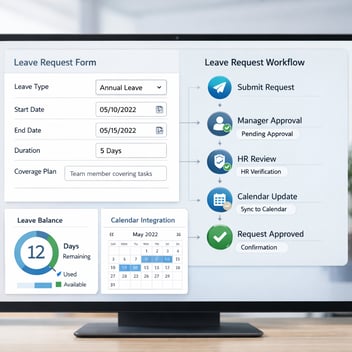
Performance review automation using no-code tools gives HR leaders and People Ops managers the ability to design, schedule, and execute complete review cycles — from self-assessments to manager evaluations, calibration sessions, and outcome approvals — without developer involvement. Kissflow lets HR teams build review workflows that enforce deadlines, aggregate feedback, and route for approval automatically, so review season becomes manageable instead of chaotic.
If your organization's performance review cycle involves manually sending spreadsheets, chasing managers for overdue reviews, and reconciling data from six different email threads — this is the article you needed three cycles ago.
Why Performance Reviews Feel Like Chaos Every Cycle
Performance reviews are universally dreaded not because they are inherently difficult, but because the coordination overhead makes them unnecessarily painful. HR sends reminder emails that get buried. Managers procrastinate because the process is unclear. Employees submit self-assessments with no confirmation that they were received. Calibration sessions are scheduled without access to the underlying data. Final ratings are communicated inconsistently.
Every one of these failure points is a process coordination problem, not a performance management problem. And process coordination is exactly what workflow automation solves.
What a Modern Performance Review Workflow Includes
A complete performance review workflow covers six stages. Each stage has defined inputs, owners, deadlines, and outcomes:
Goal setting and mid-year check-in: At the start of the review period, employees document goals in a structured form that connects to the year-end review. Mid-year check-ins are triggered automatically and linked to the same goal record.
Self-assessment: At the designated start of the review cycle, employees receive an automated notification with a structured self-assessment form and a completion deadline.
Manager evaluation: Upon employee self-assessment completion (or deadline, whichever comes first), the manager receives notification to complete their evaluation — with the employee's self-assessment accessible in the same interface.
Peer feedback (if applicable): Where 360-degree feedback is part of the process, the workflow manages peer nomination, feedback request routing, and response collection with a structured deadline.
Calibration: Manager ratings are aggregated into a calibration view for department or organizational-level review. The workflow tracks which managers have submitted and flags incomplete evaluations before the calibration session.
Outcome communication and approval: Final ratings, compensation adjustments, and development plans are documented in the workflow and routed through the appropriate approval chain before being communicated to employees.
Which Parts of the Review Process Can Be Automated
The distinction between what to automate and what to keep human is important in performance management — this is not a process where you want AI making decisions, but one where you want administration eliminated so humans can focus on the judgment calls that matter:
Automate: Cycle kick-off notifications, self-assessment routing, deadline enforcement and escalation, peer feedback request management, data aggregation into calibration views, approval routing for final outcomes, and completion tracking dashboards.
Keep human: The actual performance judgments, calibration discussions, compensation decisions, career development conversations, and outcome communications. These require managerial and HR expertise — automation creates the space for them to happen well.
Building Your No-Code Review Workflow: Step by Step
-
Define the review cycle parameters. Set the review period dates, the self-assessment window, the manager evaluation window, the calibration date, and the outcome communication deadline. These parameters drive the automated reminder and escalation schedule.
-
Create the self-assessment form. Build a structured form with sections for goal achievement rating, competency ratings, development highlights, and areas for growth. Use rating scales consistently across the organization for calibration comparability.
-
Configure the manager evaluation form. The manager form mirrors the self-assessment structure with an additional narrative section and a calibration rating field. Display the employee's self-assessment in the manager's evaluation interface for direct comparison.
-
Set up deadline enforcement and escalation. Configure a reminder email at 50% of the assessment window, a warning at 80%, and an escalation to the HR business partner at the deadline if the review is incomplete. This takes the chasing task away from HR entirely.
-
Build the calibration aggregation view. Create a dashboard view that shows all manager ratings for the department — distribution of ratings, outliers, and completion status — automatically populated from submitted evaluations.
-
Configure the outcome approval workflow. Final ratings and compensation recommendations route through the required approval chain (HRBP, department head, compensation team) before outcomes are communicated to employees.
Reminder Automation and Deadline Enforcement
The most impactful single feature in a review automation workflow is automated reminder escalation. When HR no longer has to manually track who has and has not completed their reviews, and the workflow handles reminders and escalation automatically, completion rates improve dramatically — typically from 60-70% on time to 90%+ in the first cycle after automation.
Configure reminder emails to come from the HR team's email address (using Kissflow's custom sender settings) rather than from a no-reply automation address. Employees and managers are more likely to act on reminders that feel personal, even when they are automated.
Aggregating and Reporting Review Data
One of the least appreciated benefits of review automation is the data it generates. When every assessment goes through a structured workflow, the outcome data is clean, consistent, and reportable — unlike the ratings scattered across spreadsheets and email attachments in a manual process.
Kissflow's reporting tools let HR leaders view rating distributions by department, tenure, and manager. This data surfaces calibration issues before the calibration session, helps HR business partners prepare targeted coaching for managers who are rating outliers, and provides the historical record for future compensation and promotion decisions.
Automate Your Next Review Cycle
The best time to implement performance review automation is the cycle before you need it — not in the middle of review season when the urgency creates pressure to take shortcuts. Build the workflow now, test it with a pilot group, refine the forms and escalation logic, and launch it fully for the next cycle.