AI Readiness: How IT Leaders Prepare Their Enterprise for AI at Scale
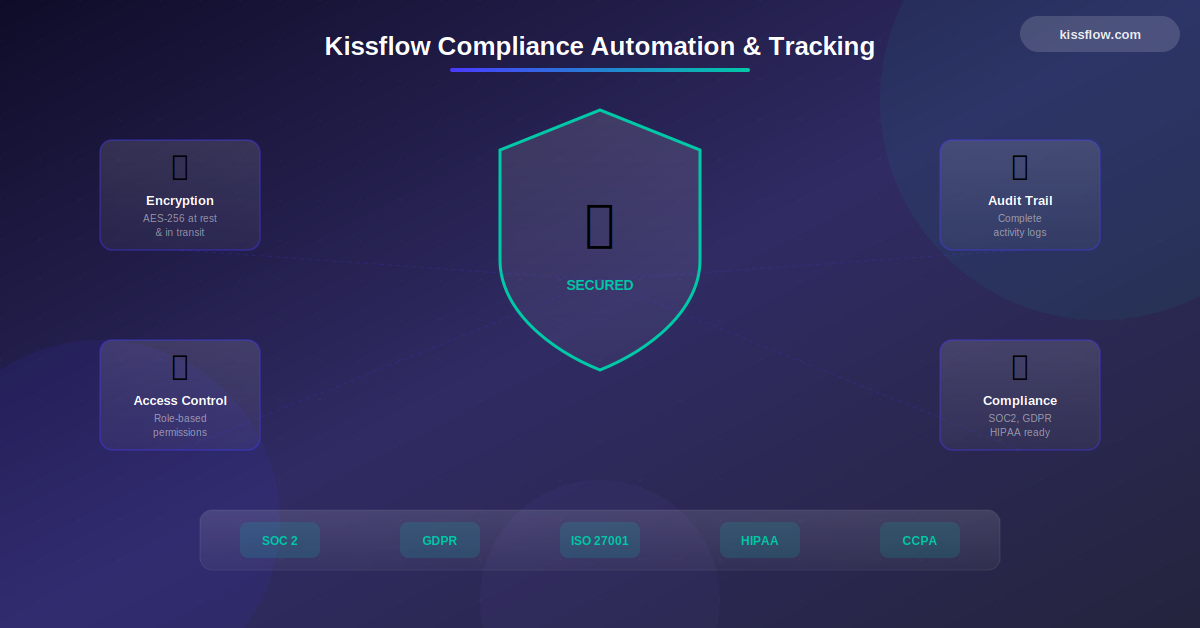
Kissflow compliance automation provides real-time tracking of regulatory requirements, policy adherence, and audit documentation through visual workflow tools. Compliance teams build automated processes that enforce policies, collect evidence, maintain audit trails, and generate compliance reports without development resources.
AI readiness is the degree to which an organization has the data infrastructure, process maturity, governance frameworks, and cultural alignment needed to deploy artificial intelligence effectively. It is not about whether you have bought AI tools. It is about whether your enterprise can actually use them to produce reliable, governed, and measurable outcomes.
For CIOs and CTOs, AI readiness has become a board-level concern. Gartner estimates that through 2025, 85% of AI projects failed to deliver intended outcomes, largely because organizations lacked the process foundations, data quality, and governance structures needed to operationalize AI effectively. The technology is not the bottleneck. Organizational readiness is.
What does AI readiness actually mean?
AI readiness spans five dimensions:
-
Data readiness: Is your data clean, accessible, governed, and available in formats that AI models can consume? Organizations with siloed, inconsistent, or poorly documented data will struggle to train or deploy AI effectively.
-
Process maturity: Are your business processes standardized, documented, and digitized? AI works best when layered on top of structured processes. If your workflows still run on email and spreadsheets, AI has nothing consistent to learn from or enhance.
-
Technology infrastructure: Do you have the compute, storage, integration, and deployment infrastructure to support AI workloads? This includes not just GPU clusters but also API gateways, data pipelines, and model serving infrastructure.
-
Governance and compliance: Do you have policies for AI ethics, bias monitoring, data privacy, model auditability, and regulatory compliance? Without governance, AI deployments create legal and reputational risk.
-
Talent and culture: Does your workforce have the skills to work alongside AI? Do teams trust AI-assisted decisions? Is leadership committed to AI adoption beyond pilot projects?
Why most enterprises are not AI-ready
The gap between AI ambition and AI readiness is wide. Most enterprises have experimented with AI in isolated pockets - a chatbot here, a predictive model there - but have not built the foundational infrastructure to deploy AI at scale.
Process fragmentation blocks AI adoption
AI needs structured, repeatable processes to enhance. When approvals happen over email, data lives in personal spreadsheets, and workflows differ by department, there is no consistent process for AI to optimize. The first step toward AI readiness is digitizing and standardizing your operational processes.
Data silos prevent AI from seeing the full picture
AI models are only as good as the data they consume. When customer data lives in the CRM, operational data lives in spreadsheets, compliance data lives in shared drives, and financial data lives in the ERP, AI cannot connect the dots. Breaking down data silos through integrated platforms is a prerequisite for effective AI deployment.
Governance gaps create risk
Deploying AI without governance is deploying risk. Who is accountable when an AI model makes a biased recommendation? How do you audit the decision chain? What happens when regulations change? Organizations that rush to deploy AI without governance frameworks face compliance violations, reputational damage, and operational failures.
See the full story → SN Aboitiz Power Built a Legal & Regulatory Compliance Registry for Real-Time Tracking
How to build AI readiness: a practical framework
Step 1: Digitize and standardize your processes
Before layering AI on top of your operations, ensure your processes are digital, structured, and consistent. Every manual workflow that runs on email, paper, or tribal knowledge is a blind spot for AI. Low-code and no-code platforms are the fastest path to process digitization because they let business teams formalize workflows without waiting for IT.
Step 2: Unify your data
Connect your systems of record through integration platforms so data flows between them. AI readiness requires data that is accessible, consistent, and governed - not locked in departmental silos.
Step 3: Establish AI governance
Define policies for data usage, model auditing, bias monitoring, and compliance. Establish an AI governance committee with cross-functional representation. Ensure every AI deployment has a documented purpose, owner, and review cycle.
Step 4: Start with high-value, low-risk AI use cases
Do not attempt enterprise-wide AI transformation on day one. Identify processes where AI can deliver measurable value with manageable risk: automated document classification, intelligent routing of service requests, predictive maintenance alerts, compliance anomaly detection.
Step 5: Build feedback loops
AI readiness is not a destination. It is an ongoing capability. Establish mechanisms to measure AI performance, collect user feedback, retrain models, and continuously improve governance.
The compliance connection: why compliance automation is an AI readiness accelerator
Compliance automation is one of the highest-value starting points for AI readiness. It checks multiple boxes simultaneously: it digitizes a critical business process, it structures data in auditable formats, it establishes governance workflows, and it creates the kind of consistent, documented process that AI can eventually enhance.
Organizations using platforms like Kissflow for real-time compliance tracking are building AI readiness infrastructure without necessarily calling it that. Every compliance workflow that is digitized, every audit trail that is automated, every exception that is tracked through a structured process becomes a data asset that AI can use for pattern detection, risk prediction, and decision support.
How Kissflow builds your enterprise's AI readiness
Kissflow serves as the digital backbone that creates the process foundation AI needs to work. By digitizing and standardizing your business processes on a single platform, Kissflow does three things that directly accelerate AI readiness:
-
Process standardization: Every workflow built on Kissflow is structured, documented, and auditable. This creates the consistent process data that AI models need to learn and enhance.
-
Data unification: Kissflow integrates with ERP, CRM, HRMS, and other enterprise systems, breaking down the data silos that block AI adoption.
-
Governance infrastructure: Kissflow's built-in governance controls (role-based access, audit trails, approval workflows, compliance tracking) provide the governance layer that responsible AI deployment requires.
Kissflow AI capabilities are already embedded in the platform, helping teams auto-generate process maps, detect bottlenecks, and recommend optimizations. But the bigger value is structural: by running your operations on Kissflow, you are building the process maturity and data infrastructure that makes every future AI investment more effective.
Related Articles

3 MINUTES READ
Retail Store Operations Automation for Audits & Supply Chain