For most enterprise IT leaders, the daily reality looks the same. Business teams are queuing up requests for new applications. Developer capacity is finite. ERP and SIS systems are too rigid for the work that actually happens around them. And every quarter, the gap between what the business needs and what IT can deliver gets a little wider.
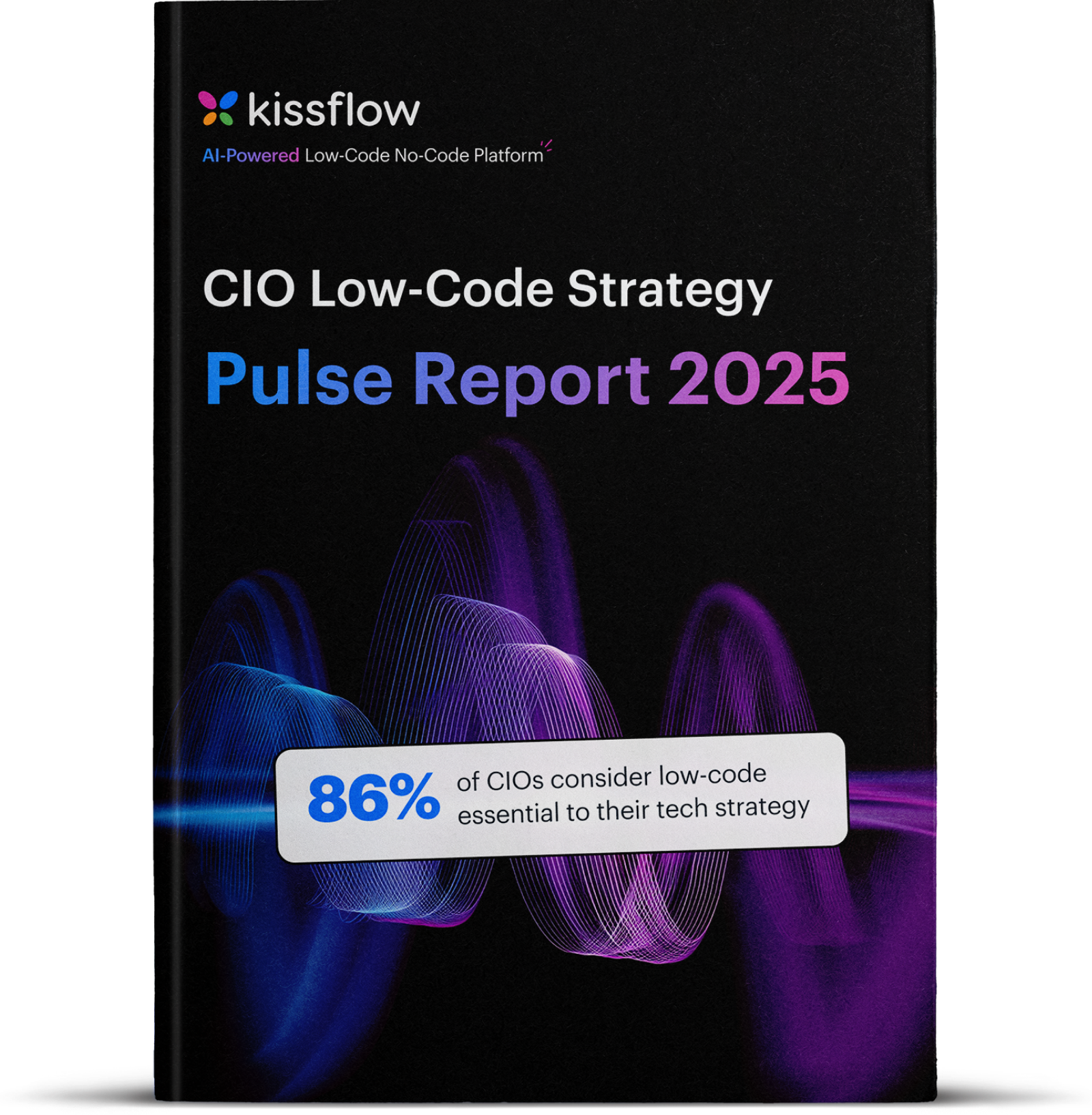
A low-code solution is how a growing number of CIOs are closing that gap, without rebuilding their core systems or losing control of governance. By 2026, 70 percent of new applications built inside enterprises will use low-code or no-code technologies, up from less than 25 percent in 2020. The category has moved from emerging to essential.
This guide is for IT and business leaders deciding what a low-code solution actually is, where it fits in an enterprise stack, and how to choose one without inheriting another silo.
What is a low-code solution?
A low-code solution is a software platform that lets teams build, deploy, and govern business applications using visual modeling tools, drag-and-drop interfaces, and pre-built components instead of writing most of the code by hand. It combines forms, workflows, integrations, dashboards, and access controls into one environment, so professional developers and business users can build together.
Unlike traditional development, where every form, workflow, and integration is hand-coded, a low-code solution provides reusable building blocks for the parts of an application most enterprises need over and over: forms, approvals, data tables, dashboards, role-based access, and connectors to systems like SAP, Workday, or Salesforce. Where a team needs custom logic or a specialized integration, they can still drop into code.
The result is a platform that serves two audiences at once. Professional developers ship faster because they are not rebuilding the same plumbing. Business users, often called citizen developers, can build their own apps for departmental needs while IT keeps oversight, security, and standards intact.
A typical low-code solution includes:
-
A visual app builder for forms, workflows, and interfaces
-
A workflow engine for approvals, routing, and process logic
-
An integration layer with prebuilt connectors and APIs
-
An admin layer for governance, access, audit logs, and deployment
-
An AI layer for assistance, intelligent routing, and decision support
Why low-code solutions matter for the modern enterprise
The case for a low-code solution is not really about coding speed. It is about operational coherence.
1. Most enterprises today run on fragmentation. Systems do not talk to each other. Workflows live in spreadsheets and email threads. Critical processes have no clear owner. That scattering is what creates IT backlog, shadow IT, and failed transformations. A low-code solution addresses fragmentation in three ways.
2. It removes the development bottleneck
The worldwide low-code development technologies market reached $26.9 billion in 2023, growing nearly 20 percent year over year, because enterprises have realized they cannot hire their way out of the application backlog. Low-code shifts a meaningful share of app delivery to fusion teams, with business and IT building together.
3. IT governs citizen development
Without a sanctioned platform, business teams build apps anyway, just in tools IT cannot see. Gartner expects half of all new low-code clients to come from business buyers outside IT by the end of 2025. A low-code solution gives IT a way to enable that demand instead of fighting it. This is the foundation of effective citizen development, where departments build with IT-approved guardrails.
4. It connects work without rip-and-replace
A low-code solution sits as an execution layer around existing systems of record. Core ERP, SIS, EMR, or HRMS stay where they are. The processes, approvals, exceptions, and case work that happen between those systems get unified, governed, and visible.
Core capabilities of an enterprise-grade low-code solution
Not every low-code platform is enterprise-ready. When evaluating a low-code solution for a regulated, multi-system enterprise, these are the capabilities that separate serious platforms from departmental tools.
1. Visual app and workflow builder. Teams should be able to build a working application, including forms, logic, approvals, and notifications, without writing code. Pro developers should be able to extend with custom scripts where needed.
2. Workflow and process automation. A real low-code solution treats workflow solution as a first-class citizen. Multi-step approvals, conditional branching, parallel paths, SLA tracking, escalations, and exception handling should all be configurable visually.
3. Pre-built integrations and APIs. The platform must connect to SAP, Oracle, Salesforce, Microsoft 365, Workday, ServiceNow, and modern SaaS tools through connectors and REST or SOAP APIs. Without integrations, every app becomes another data island.
4. Governance and access control. Role-based permissions, environment management for development, test and production, version control, audit trails, and centralized administration are non-negotiable for IT-led adoption.
5. Scalability and reliability. Enterprise-grade SLAs, multi-region cloud hosting, and the ability to handle thousands of concurrent users matter once a low-code solution becomes part of daily operations.
6. Embedded AI and automation. Modern platforms now embed AI for form generation, intelligent routing, document understanding, and decision support. This layer is fast becoming a buying criterion rather than a nice-to-have.
7. High-impact use cases for a low-code solution
The strongest low-code platforms are deployed across functions, not just one department. A few patterns appear across nearly every enterprise.
8. Procurement and finance. Vendor onboarding, purchase requisitions, invoice approvals, expense management, and contract approvals are universally stuck in email and spreadsheets. A low-code solution standardizes them with audit trails and SLAs.
9. HR operations. Onboarding, offboarding, leave, performance reviews, and internal transfers each involve forms, approvals, and integrations with HRMS, which is a near-perfect fit for low-code.
10. IT and service requests. Access provisioning, asset management, change requests, and IT ticket triage become governed and trackable instead of scattered across inboxes.
11. Customer and partner operations. Case management, complaint handling, channel partner onboarding, and service requests can be built and iterated quickly without burning developer cycles.
12. Industry-specific operations. In higher education, that means admissions, faculty onboarding, grant compliance, and student grievance workflows. In manufacturing, it is quality incidents, deviation handling, and supplier audits. In banking, it is customer onboarding and exceptions to core systems. The same platform, configured for very different processes.
How to evaluate a low-code solution
Most low-code buying mistakes come from choosing a tool optimized for one team and then trying to scale it across an enterprise. A simple evaluation framework keeps the decision honest.
-
Who builds on it. Business users only, developers only, or fusion teams. The best enterprise low-code solutions serve all three.
-
What it can build. Departmental apps only, or end-to-end operational workflows that span functions and systems.
-
How it integrates. Native connectors to your top 10 systems, or constant custom development for every new use case.
-
How IT governs it. Role-based admin, environment isolation, audit trails, and policy enforcement built in, not bolted on.
-
Where AI sits. Surface-level assistant, or embedded inside the workflow itself with context awareness.
-
Total cost of ownership. Licensing, implementation, and ongoing maintenance, not just per-seat pricing.
-
Time to value. A working pilot in weeks is the realistic benchmark, not months.
Common pitfalls and how to avoid them
The same mistakes show up again and again in low-code rollouts.
Treating low-code as a tool, not a program. Without governance, training, and a center of excellence, low-code quietly becomes the new shadow IT.
Choosing a platform built only for developers. The whole point of a low-code solution is to broaden who can build. A platform that requires a developer for every change defeats the purpose.
Underestimating integration. A low-code solution with weak connectors becomes a beautiful UI bolted onto a manual data entry process.
Skipping change management. Adoption depends on business teams trusting the platform. Pilots, success stories, and a clear request process matter more than feature lists.
The business case: what ROI looks like
The financial case for a low-code solution is built on three numbers most CIOs already track: app delivery cost, app delivery time, and rework cost.
A typical pattern across mid-market and enterprise deployments looks like this:
-
Substantial reduction in app delivery time compared to traditional development
-
Smaller IT backlog as departmental apps shift to citizen developers under IT governance
-
Lower total cost of ownership through consolidation, with one platform replacing multiple point tools
-
Faster compliance and audit response because workflows are standardized and traceable
If your IT team is currently spending more time maintaining legacy custom apps than building new value, the math usually works in low-code's favor. Pair this with broader digital transformation goals, and the platform pays for itself in the first one or two flagship use cases.
Why Kissflow is the best low-code solution
Kissflow is the low-code platform built to help IT teams build and run enterprise operations, bringing process automation, app development, and case management into a single governed environment. Where most low-code tools focus on either pro developers or business users, Kissflow is designed for both, with a no-code experience for departmental teams and full extensibility for IT.
Customers like the University of Pennsylvania, Queen's University, and Pontificia Universidad Católica del Perú use Kissflow to digitize academic, administrative, and research operations without disrupting their SIS, ERP, or grants systems. Procurement teams run vendor onboarding and AP on the same platform that HR uses for onboarding, that academic affairs uses for faculty workflows, and that IT uses to govern citizen development across the enterprise.
The result is operational coherence: workflows, data, and decisions moving in one coordinated motion, with intelligence placed inside the work itself rather than bolted on after the fact. No silos. No lost handoffs. No operational drift. Just a BPM and workflow platform that finally lets IT and business move at the same speed.
Frequently asked questions
1. What is the difference between a low-code solution and a no-code platform?
Low-code platforms allow some custom coding for advanced logic and integrations, making them suitable for both business users and developers. No-code platforms are designed exclusively for business users with no programming required. Most enterprise platforms today combine both experiences in one solution.
2. Is a low-code solution secure enough for regulated industries?
Enterprise-grade low-code solutions support SOC 2, ISO 27001, GDPR, HIPAA, and similar standards, along with role-based access, audit trails, and environment isolation. Banks, hospitals, and universities run regulated workloads on low-code platforms today.
3. Can a low-code solution handle complex enterprise workflows?
Yes. Modern low-code platforms support multi-step approvals, parallel routing, exception handling, SLAs, integrations with core systems, and case management. The same complexity traditional BPM suites were built for is now native to enterprise low-code platforms.
4. Will a low-code solution replace our developers?
No. Low-code shifts routine app delivery to business users and frees developers to focus on differentiated, high-value work. Most enterprises see a fusion model where IT and business build together rather than in separate tracks.
5. How long does a typical low-code implementation take?
A focused pilot can be live in two to six weeks. Enterprise-wide adoption is typically a 90-day to 12-month rollout, depending on the number of processes, integrations, and teams involved.
6. Does a low-code solution work alongside our existing ERP and SIS?
Yes. A well-designed low-code solution sits as an execution layer above systems of record, connecting to ERP, SIS, EMR, HRMS, and other core systems through APIs and connectors instead of replacing them.
7. What is the biggest mistake enterprises make with low-code?
Skipping governance. Without a center of excellence, naming conventions, environment policies, and a clear approval process, low-code becomes shadow IT in a different package.