What Is No-Code AI? A Complete Guide for Enterprise Teams
No-code AI refers to tools and platforms that let business users leverage artificial intelligence capabilities without writing code or understanding machine learning. It makes AI accessible through visual interfaces where users can configure AI-powered features like document processing, classification, predictions, and natural language understanding.
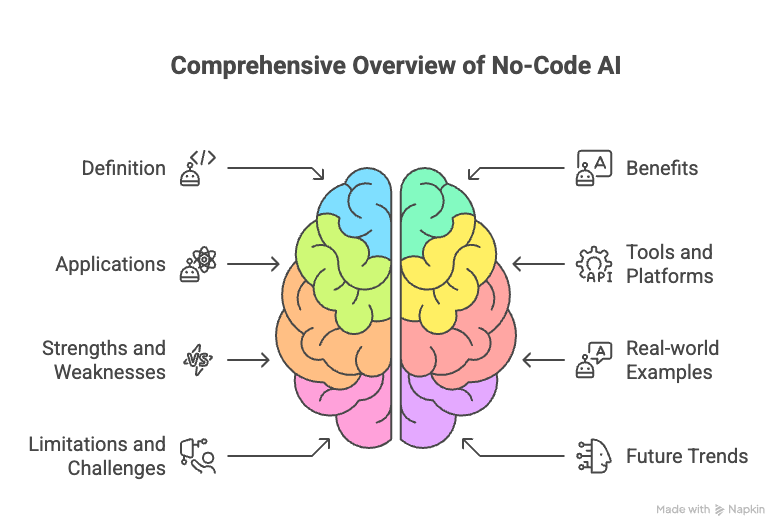
This document provides a comprehensive overview of the burgeoning field of No-Code AI. It explores the definition, benefits, applications, and future trends of No-Code AI platforms, highlighting how they are democratizing access to artificial intelligence and empowering individuals and businesses without requiring extensive coding knowledge. We will delve into the various tools and platforms available, discuss their strengths and weaknesses, and examine real-world examples of how No-Code AI is transforming industries. Finally, we will address the limitations and potential challenges associated with No-Code AI, offering a balanced perspective on its capabilities and future potential.
What is No-Code AI?
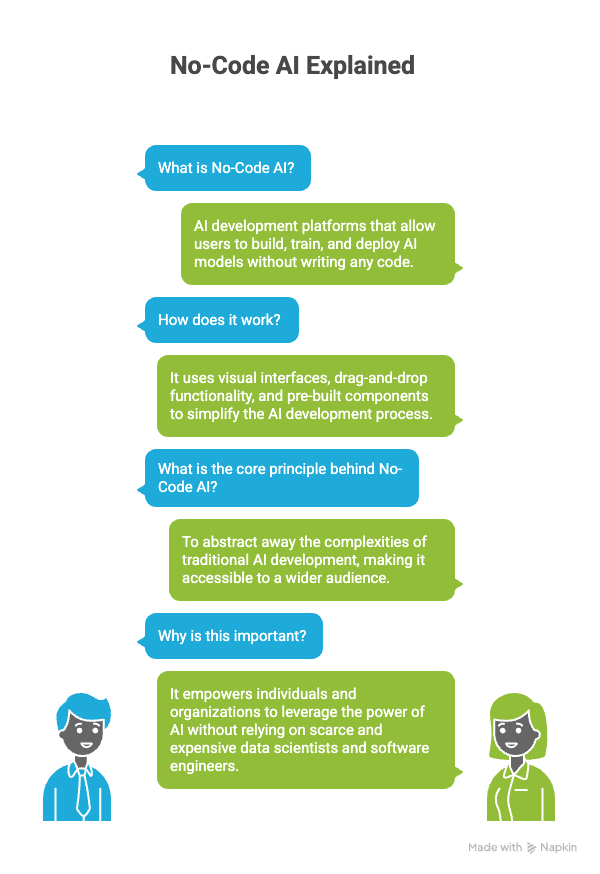
No-Code AI refers to artificial intelligence development platforms that allow users to build, train, and deploy AI models without writing any code. These platforms typically utilize visual interfaces, drag-and-drop functionality, and pre-built components to simplify the AI development process. Instead of writing complex algorithms, users can focus on defining the problem, selecting appropriate data, and configuring the model's behavior through intuitive interfaces.
The core principle behind No-Code AI is to abstract away the complexities of traditional AI development, making it accessible to a wider audience, including business users, domain experts, and citizen developers. This democratization of AI empowers individuals and organizations to leverage the power of AI without relying on scarce and expensive data scientists and software engineers. No-code AI brings artificial intelligence capabilities directly into a no-code platform, enabling business users to leverage AI without coding or data science skills. For a deeper exploration, see how generative AI is powering no-code development with specific use cases, enterprise applications, and implementation patterns.
Benefits of No-Code AI
No-Code AI offers a multitude of benefits, including:
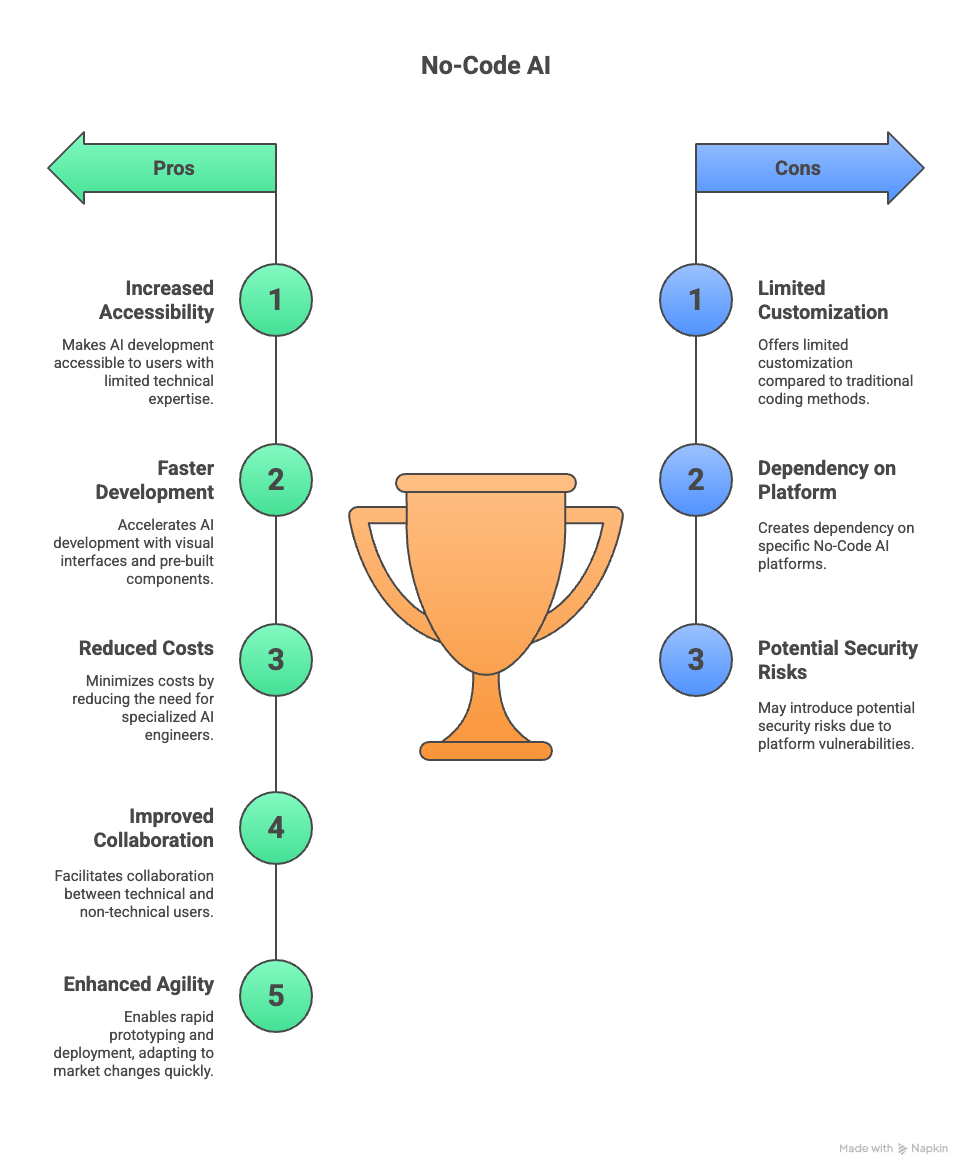
- Increased Accessibility: By eliminating the need for coding skills, No-Code AI makes AI development accessible to a broader range of users, including those with limited technical expertise.
- Faster Development Cycles: Visual interfaces and pre-built components significantly accelerate the AI development process, allowing users to build and deploy models in a fraction of the time compared to traditional coding methods.
- Reduced Costs: No-Code AI can significantly reduce the costs associated with AI development by minimizing the need for specialized AI engineers and streamlining the development process.
- Improved Collaboration: No-Code platforms often facilitate collaboration between technical and non-technical users, enabling domain experts to contribute their knowledge and insights to the AI development process.
- Enhanced Agility: No-Code AI empowers businesses to quickly adapt to changing market conditions and customer needs by enabling them to rapidly prototype, test, and deploy AI-powered solutions.
- Focus on Business Problems: By abstracting away the technical complexities of AI development, No-Code AI allows users to focus on solving business problems and creating value.
Applications of No-Code AI
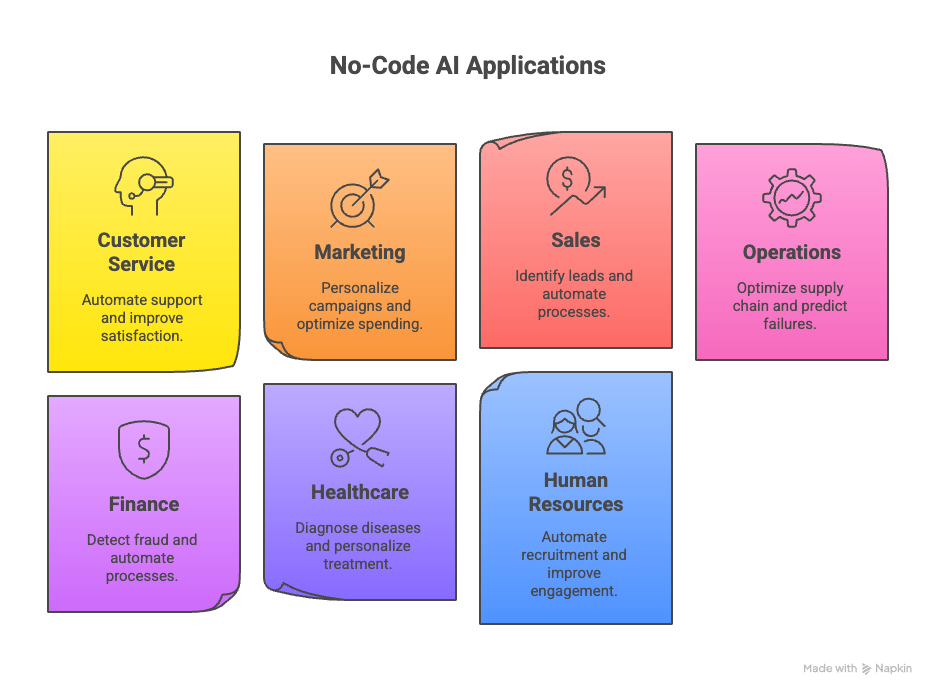
No-Code AI is being applied across a wide range of industries and use cases, including:
- Customer Service: Building chatbots and virtual assistants to automate customer support interactions and improve customer satisfaction.
- Marketing: Personalizing marketing campaigns, predicting customer behavior, and optimizing marketing spend.
- Sales: Identifying sales leads, predicting sales outcomes, and automating sales processes.
- Operations: Optimizing supply chain management, predicting equipment failures, and improving operational efficiency.
- Finance: Detecting fraud, assessing credit risk, and automating financial processes.
- Healthcare: Diagnosing diseases, personalizing treatment plans, and improving patient outcomes.
- Human Resources: Automating recruitment processes, predicting employee attrition, and improving employee engagement.
Examples of No-Code AI Platforms
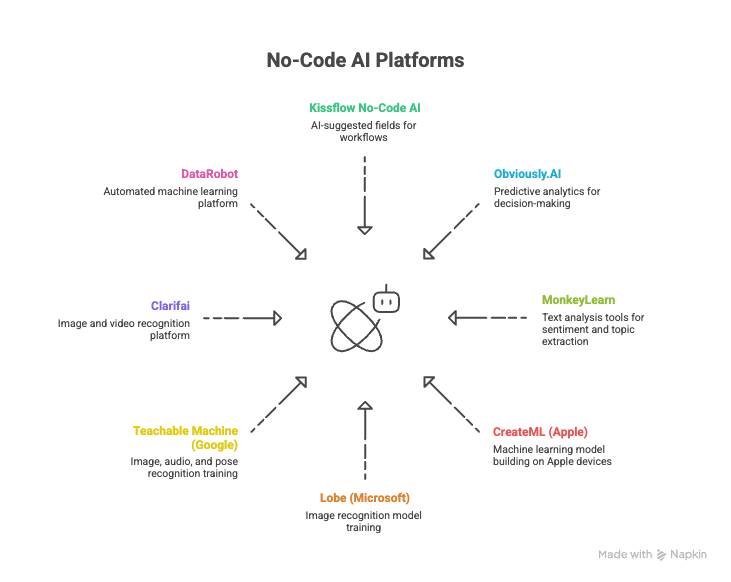
Several No-Code AI platforms are available, each with its own strengths and weaknesses. Some popular examples include:
- Kissflow No-Code AI: AI-suggested fields based on workflow type (drag-and-drop ready) and No coding or data science expertise required.
- Obviously.AI: Focuses on predictive analytics and allows users to build and deploy AI models for forecasting and decision-making.
- MonkeyLearn: Specializes in text analysis and provides tools for sentiment analysis, topic extraction, and text classification.
- CreateML (Apple): A framework for building machine learning models on Apple devices, offering a drag-and-drop interface for training models.
- Lobe (Microsoft): A free, easy-to-use desktop application for training image recognition models.
- Teachable Machine (Google): A web-based tool for training image, audio, and pose recognition models.
- Clarifai: Offers a comprehensive platform for image and video recognition, with pre-trained models and customizable training options.
- DataRobot: An automated machine learning platform that automates the entire AI lifecycle, from data preparation to model deployment.
Future Trends in No-Code AI
The field of No-Code AI is rapidly evolving, with several key trends shaping its future:
- Increased Automation: platforms are becoming increasingly automated, with features such as automated data preparation, model selection, and hyperparameter tuning.
- Improved Explainability: Efforts are being made to improve the explainability of No-Code AI models, making it easier for users to understand how the models are making predictions.
- Enhanced Integration: No-Code platforms are increasingly integrating with other business applications and data sources, making it easier to deploy AI models into existing workflows.
- Edge AI Support: No-Code platforms are beginning to support the deployment of AI models on edge devices, enabling real-time processing of data at the source.
- Generative AI Integration: No-Code platforms are starting to integrate generative AI capabilities, allowing users to create new content, such as images, text, and code, without writing any code.
See the full story → PJ Lhuillier Group Used AI-Suggested Workflows to Accelerate Automation
Limitations and Challenges of No-Code AI
While No-Code AI offers numerous benefits, it also has some limitations and challenges:
- Limited Customization: No-Code platforms may not offer the same level of customization as traditional coding methods, which can limit the ability to fine-tune models for specific use cases.
- Data Quality Dependence: The performance of No-Code AI models is highly dependent on the quality of the data used to train them. Poor data quality can lead to inaccurate predictions and unreliable results.
- Scalability Concerns: Some No-Code platforms may not be able to handle large datasets or complex models, which can limit their scalability for enterprise-level applications.
- Vendor Lock-in: Relying on a specific No-Code platform can create vendor lock-in, making it difficult to switch to another platform in the future.
- Security Risks: No-Code platforms can introduce security risks if not properly secured. It is important to ensure that the platform is compliant with relevant security standards and that data is protected from unauthorized access.
- Lack of Deep Understanding: While No-Code AI democratizes access, it can also lead to a lack of deep understanding of the underlying AI principles and algorithms, potentially hindering innovation and problem-solving in complex scenarios.
Conclusion
No-Code AI is a transformative technology that is democratizing access to artificial intelligence and empowering individuals and businesses to leverage the power of AI without requiring extensive coding knowledge. While it has some limitations and challenges, the benefits of No-Code AI, such as increased accessibility, faster development cycles, and reduced costs, are undeniable. As the field continues to evolve, we can expect to see even more powerful and user-friendly No-Code AI platforms emerge, further accelerating the adoption of AI across various industries and use cases. By understanding the capabilities and limitations of No-Code AI, organizations can strategically leverage this technology to drive innovation, improve efficiency, and gain a competitive advantage.
Frequently Asked Questions
What are AI-powered no-code workflows?
Automated business processes built with visual tools that incorporate AI for intelligent routing, predictions, document processing, and continuous optimization.
How do AI workflows improve efficiency?
AI reduces manual review steps, predicts and prevents bottlenecks, auto-classifies incoming requests, and optimizes routing based on historical performance data.
What efficiency gains can enterprises expect?
Organizations report 40-60% reduction in process cycle times, 70% fewer manual touchpoints, and 50% faster exception handling with AI-powered workflows.
Are AI-powered workflows difficult to maintain?
No. No-code platforms handle AI model updates and optimization automatically. Business users manage workflow logic through the same visual interface they used to build it.
Can existing workflows be upgraded with AI?
Yes. Most platforms let you add AI capabilities to existing no-code workflows incrementally, starting with simple intelligence like auto-classification before adding more complex features.
Related Articles