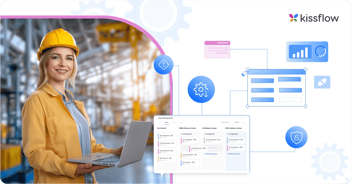
Your field technicians just completed a safety inspection at a remote drilling site. The checklist sits in a truck 200 miles from headquarters. The HSE manager won't see it until next week's office visit. Meanwhile, three critical safety issues flagged in the inspection remain unaddressed because nobody at headquarters knows they exist yet.
This isn't a communication problem. It's an architecture problem. And it's costing the industry billions in preventable incidents, compliance failures, and operational delays.
The field operations gap that the paper can't bridge
Oil and gas operations happen where infrastructure doesn't exist. Remote drilling sites, offshore platforms, pipeline corridors, and refinery perimeters all operate beyond reliable connectivity. Traditional enterprise systems assume always-on internet access and real-time data synchronization. Field operations can't deliver either.
Paper-based processes filled this gap for decades. Technicians complete checklists, safety audits, and inspection reports on clipboards. These documents travel back to offices through field supervisors, get manually entered into systems days later, and generate action items that reach operational teams a week after the original observation.
This delay kills people. Safety issues identified Monday morning that don't reach appropriate decision-makers until Friday afternoon allow preventable accidents to occur. Compliance violations observed in the field but not documented in systems until the following week create regulatory exposure. Equipment failures flagged during inspections that don't trigger maintenance orders fast enough result in unplanned downtime.
The fundamental problem isn't paper—it's latency. The time between field observation and operational action determines whether issues become minor adjustments or major incidents. Traditional IT systems reduce this latency for office workers with desktop computers. They can't reduce it for field technicians with hard hats and safety glasses.
Why traditional mobile apps fail in field operations
The obvious solution is mobile apps. Give field technicians smartphones or tablets with custom applications that digitize forms and sync data back to headquarters. Multiple oil and gas companies have tried this approach. Most have failed to achieve meaningful adoption.
Custom mobile app development is expensive. Building applications that work offline, sync reliably when connectivity returns, handle the edge cases field operations encounter, and integrate with back-office systems typically costs millions per app. Development timelines stretch to years. By the time the app deploys, field procedures have changed and the app is already outdated.
User adoption creates additional challenges. Field technicians resist learning new applications when they change frequently or when interfaces don't match operational workflows. IT departments struggle to maintain applications they don't understand because they're not familiar with field operations. The apps become shelf-ware—deployed but not used.
The deeper problem is that custom mobile development doesn't scale. When operations need modifications—adding new inspection types, changing approval workflows, integrating additional data sources—they submit change requests to IT. Change requests queue behind other priorities. Modifications that should take days require months. The application remains perpetually misaligned with operational needs.
How no-code platforms solve the field operations problem
No-code platforms address field operations challenges through offline-first architecture and business-user configuration. Applications built on these platforms work without internet connectivity, storing data locally until sync opportunities arise. This offline capability makes them viable for remote field operations where traditional mobile apps fail.
Configuration replaces custom development. Field operations managers who understand inspection procedures can build digital forms themselves without waiting for IT resources. When procedures change, they update configurations directly instead of submitting change requests. This self-service approach compresses modification timelines from months to days.
The platform handles technical complexity automatically. Data synchronization, conflict resolution, offline storage, and integration with back-office systems all operate as platform services rather than custom code requirements. Teams focus on business logic—what information to capture, how to route approvals, which conditions trigger alerts—instead of technical implementation.
Template libraries accelerate deployment further. Pre-built inspection forms, safety audit workflows, and incident reporting processes provide starting points that teams customize for specific operations. Organizations deploy functional field applications in weeks instead of years, and continuous refinement happens through configuration changes rather than development cycles.
Maintaining safety and regulatory standards in the field is now more efficient as companies use no-code to modernize oil and gas workflows , replacing manual checklists with automated, real-time tracking. Solutions like Kissflow for oil and gas provide the specific tools needed for rigorous compliance and incident reporting in hazardous environments.
Safety automation that prevents incidents
Safety management in oil and gas requires systematic oversight that manual processes struggle to deliver. Regular inspections, hazard reporting, incident investigation, and corrective action tracking all need to happen reliably across distributed field operations.
No-code platforms enable safety workflows that operate consistently regardless of location. Digital inspection checklists guide technicians through proper procedures, flag conditions requiring immediate attention, and automatically escalate critical issues to appropriate safety personnel. Geographic tagging links observations to specific locations for trend analysis.
Automated workflows ensure follow-through on corrective actions. When an inspection identifies a safety hazard, the system creates a corrective action task, assigns it to responsible personnel, sets due dates based on severity, and sends escalation notifications if deadlines approach without completion. Nothing slips through cracks because human oversight forgot to check on it.
Real-time visibility transforms safety management from reactive to proactive. Safety managers see hazard reports from across operations as they occur rather than waiting for weekly summary reports. Geographic heat maps show where safety issues concentrate. Trend analysis identifies degrading conditions before they result in incidents.
This systematic approach to safety management delivers measurable outcomes. Organizations implementing digital safety workflows through no-code typically see a decline in safety incidents of 30 percent to 50 percent within the first year, as issues are identified and addressed more quickly.
This trend toward industrial digitization is also seen in the factory, where Kissflow manufacturing automation optimizes production lines and asset maintenance. The same logic applies to the commerce sector, where retail supply chain automation ensures goods move safely and predictably. By leveraging Kissflow retail operations , organizations can enforce operational standards and achieve seamless multi-site retail automation across their entire global footprint.
Compliance tracking that auditors trust
Regulatory compliance in oil and gas requires documentation proving that required activities occurred on schedule. Equipment inspections, safety training, environmental monitoring, and maintenance procedures all have regulatory mandates specifying frequency and documentation requirements.
Paper-based compliance tracking creates gaps. Checklists get lost. Inspection dates aren't recorded accurately. Required signatures are missing. When auditors arrive, operations teams scramble to reconstruct evidence that procedures actually occurred as needed. Missing or incomplete documentation results in violations regardless of whether procedures were actually followed.
Digital compliance workflows eliminate these gaps. The system won't mark an inspection complete until all required fields are filled and all necessary signatures are captured. Date stamps and GPS coordinates prove when and where activities occurred. All documentation is automatically retained in searchable, audit-ready format.
Automated scheduling ensures compliance activities happen on time. The system generates inspection tasks based on regulatory requirements, assigns them to qualified personnel, and sends escalation notifications for overdue items. Supervisors see compliance status across all operations in real-time rather than discovering gaps during audits.
Pre-built audit reports extract required evidence directly from operational data. Instead of manually compiling documentation for auditor reviews, compliance teams generate comprehensive reports showing all required activities, their completion dates, responsible personnel, and supporting evidence. Audit preparation shifts from weeks of scrambling to hours of report generation.
Asset tracking and maintenance that reduces downtime
Oil and gas operations depend on expensive, specialized equipment distributed across vast geographic areas. Knowing what assets exist, where they're located, their maintenance status, and their operational condition is essential for planning and reliability.
Manual asset tracking fails at scale. Spreadsheets tracking equipment locations become outdated as assets move between sites. Maintenance history exists in technician notebooks rather than centralized systems. Equipment failures happen because scheduled maintenance didn't occur, because nobody knew when it was last performed.
No-code platforms provide asset management workflows that operate in field conditions. Technicians scan QR codes or RFID tags to log equipment locations, record maintenance activities, and flag conditions requiring attention. All data syncs automatically when connectivity is available.
Predictive maintenance workflows trigger based on actual usage and condition rather than rigid time intervals. When equipment exceeds specified operating hours or sensor data indicates degrading performance, the system generates maintenance tasks automatically. This condition-based approach optimizes maintenance timing—preventing failures without performing unnecessary maintenance.
Asset dashboards provide operational visibility that manual tracking can't deliver. Managers see equipment locations, maintenance status, and utilization rates across all operations. This visibility enables better deployment decisions, identifies underutilized assets, and prevents equipment shortages that delay operations.
Environmental monitoring and incident response
Environmental compliance requires continuous monitoring and rapid response to incidents. Emissions monitoring, spill containment, waste management, and environmental impact assessments all need systematic execution and comprehensive documentation.
Digital environmental workflows ensure that proper procedures are executed consistently. Monitoring checklists capture required measurements at specified intervals. Automated calculations determine whether readings exceed regulatory thresholds. Alert workflows notify environmental teams immediately when violations occur rather than waiting for manual review of paper records.
Incident response workflows coordinate activities across multiple teams. When a spill or release occurs, the system initiates response procedures automatically, notifies all required personnel, documents all response activities with timestamps and locations, and generates required regulatory reports. This systematic response reduces both environmental impact and regulatory exposure.
Geographic mapping capabilities visualize environmental data spatially. Operations see where monitoring occurred, which locations have concerning trends, and how environmental conditions vary across geographic areas. This spatial analysis identifies patterns that tabular data obscures.
How Kissflow enables field operations automation
For the oil and gas industry, top no-code providers for oil & gas help ensure safety, compliance, and operational efficiency without heavy coding.
Kissflow's no-code platform provides the offline-capable, mobile-first infrastructure that oil and gas field operations require. Applications work reliably in remote locations without internet connectivity, sync automatically when connection becomes available, and integrate with back-office systems seamlessly.
Pre-built templates for safety inspections, compliance tracking, asset management, and environmental monitoring accelerate deployment. Operations teams configure these templates to match their specific procedures without writing code. Visual workflow builders let field operations managers create automated processes themselves rather than waiting for IT development resources.
Whether you're managing drilling operations, pipeline maintenance, refinery safety, or environmental compliance, Kissflow provides the digital workflow capabilities that transform field operations from paper-based to systematically automated.
Related Topics:
Modernizing Legacy Workflows in Oil & Gas Using No-Code
Why Kissflow Is the #1 No-Code Platform for Oil & Gas Operations in 2026
No-Code for Digital Twin & Asset Management in Heavy Industries