Business Process Automation:
What It Is, and What to Automate First

Automate the processes that run the business, with evidence showing how each one ran.

Book a Demo
BPA Hero Image (1)

Trusted by leading enterprises

Motorola Solutions
NBC Universal
Southers Glazers
Essilor Luxottica
University of Michigan
NielsenIQ

Anyone can automate a process now.
The question is, who can prove how it ran.

AI made process automation fast and cheap. <br>It also made it possible to put a process into production that nobody can explain six months later.

The process is the product

The process is the product

Your ERP holds the data well. The work happens in the approvals, forms, and spreadsheets that grew up around it.

Automating a broken process makes it worse

Automating a broken process makes it worse

Speed applied to a bad sequence produces worse outcomes faster and more of them.

Agent washing is everywhere

Agent washing is everywhere

Gartner estimates that only about 130 of the thousands of vendors claiming to offer agentic AI are real. Ask what the agent decides, not what the demo shows.

Shadow automation is already running

Shadow automation is already running

Scripts, bots, and connectors built outside IT are executing production work today without a named owner.

You cannot audit what you cannot see

You cannot audit what you cannot see

A process automated in the dark has no access control, no version history, and no record of who approved what.

The frame for IT has changed-1

The frame for IT has changed

The job is no longer to automate every process. It is to own the platform where the business automates safely.

This is what governed Al app building looks like

Where each approach lands you
six months in

Every enterprise now faces the same choice. Only one of them is both fast and governable.

Approach
Point tools and RPA
AI code generation
Governed process platform
Speed
Fast for simple flows
Minutes to a working script
Weeks to production
Who builds
Individual teams, in silos
Developers with AI
Business and IT, together
What you get
A connector chain per process
Code that runs
A process you can open and read
Six months later
Sprawl across many tools
Logic nobody can explain
A change request and an audit entry
Governance
Depends on each tool
Added late, if at all
Built in from the first process
Net result
Fast but fragmented
Fast but ungovernable
Fast and governed
Factor Governed process platform Point tools and RPA Governed process platform
Speed Fast for simple flows Minutes to a working script Weeks to production
Who builds Individual teams, in silos Developers with AI Business and IT, together
What you get A process you can open and read A connector chain per process
Six months later A change request and an audit entry Sprawl across many tools
Governance Built in from the first process Depends on each tool
Net result Fast and governed Fast but fragmented

What AI changes, and what it does not

Two things are true about 2026 at the same time. Enterprise applications are absorbing task-specific AI agents faster than any capability in the last decade. And a large share of agentic AI projects will be canceled before they reach production. The distance between those two facts is governance.

Intake and document understanding

Invoices, contracts, forms, and field reports arrive as documents. AI reads them into structured data, so the process starts without somebody retyping it.

Intake and Document Understanding (1)

Exception handling

Rules cover the standard path. AI handles the cases that fall outside it and routes the ones that need a person to the right person.

Exception Handling (1)

Process discovery

AI reads how work actually flows across systems and surfaces the processes worth automating, including the ones nobody documented.

Process Discovery (1)

Blueprint generation

Describe the process in plain language and get a structured blueprint covering the data model, forms, roles, and workflow before anything is generated.

Blueprint Generation (1)

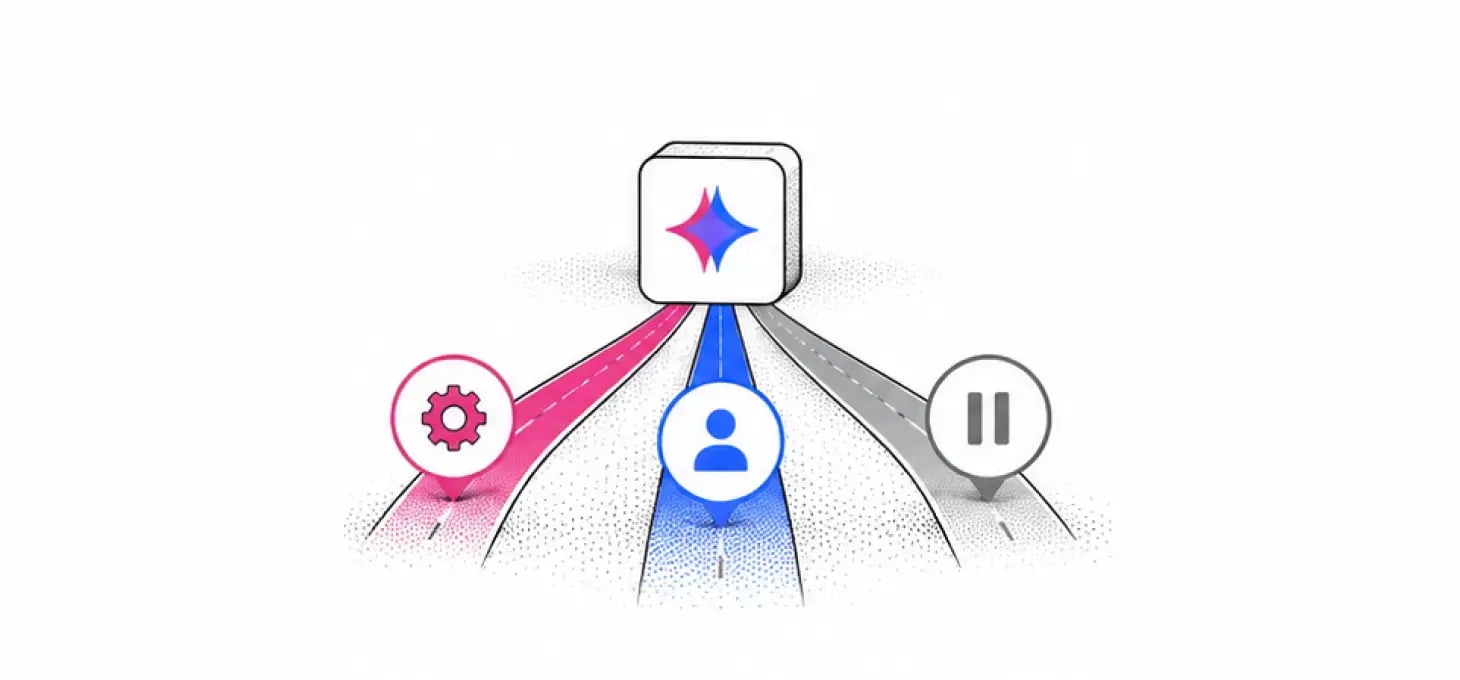
Automate, augment, or leave alone

The useful question is no longer whether to use AI in a process. It is which of the three each step deserves.
Automate Augment Leave Alone
Treatment
When it applies
What runs the step
Who is accountable
Automate
The rules are stable and the step must run identically every time
The step needs judgment, but the outcome carries consequence
Low volume, high nuance, or the cost of being wrong is too high
Augment
Deterministic logic
AI drafts, a person approves
A person
Leave alone
The process owner, through the rule
The approver, on the record
The person
Factor Automate Augment Who is accountable
When it applies Rules are stable and the step must run identically every time The step needs judgment, but the outcome carries consequence
What runs the step Deterministic logic AI drafts, a person approves
Who is accountable The process owner, through the rule The approver, on the record

Why agentic projects get canceled

Gartner puts the cancellation rate above forty percent by the end of 2027, and the reasons are consistent: pilots driven by hype rather than a named process, cost and complexity that only appear at scale, and models that are not yet mature enough to chase complex goals on their own. Agent washing compounds it, with vendors relabeling assistants that still depend on human input as agents that operate independently.

The pattern that survives is narrower than the pitch. Give an agent a step, not a process. Set the boundary in the platform rather than the prompt. Keep a payment threshold, an approval hierarchy, and a segregation-of-duties rule deterministic, because the value of those steps is that they never vary. Log what the agent did in the same audit trail as manual edits, so an agent decision is reviewable rather than merely explainable.

Kissflow AI maps natural language to platform metadata rather than generating code, so the output is inspectable and governed from the start. AI-driven changes use the same audit log as manual edits, and a person stays in the lead.

Six requirements
for business process automation software
What IT should require before the business automates anything on it.

AI under governance

AI generates an inspectable process blueprint you can review before anything runs, with every change logged and auditable.

AI Under Governance (1)

Governed citizen development

Business teams build inside guardrails IT sets, in a place IT can see, rather than in a separate tool nobody governs.

Governed Citizen Development (1)

Access control and RBAC

Permissions by role applied consistently across every process, with segregation of duties enforced rather than documented.

Audit trails and compliance

One audit log covering manual and AI-driven changes, with version history and environments, visible in real time.

Integration with systems of record

Read from and write back to SAP, Oracle, Salesforce, and Workday through supported connectors. Nothing gets replaced.

Pro-developer extensibility

Business users build the process, developers extend it with custom logic, APIs, and components without a rebuild.

Three layers, and who owns each one

Process automation is happening in your organization whether IT owns it or not.

Governance (IT owns)

Access control, environments, versioning, audit trails, and compliance. Everything the business automates, with AI or by hand, is visible and governed.

Governance icon
Arrow down
Process execution layer (business and IT)

Forms, rules, approvals, integrations, and analytics. Business teams build in no-code, developers extend in low-code, and both work on the same process.

Purchase requests Vendor onboarding Employee onboarding Change requests Access provisioning Claims and exceptions
Arrow up
Systems icon
Systems of record

SAP, Oracle, Salesforce, Workday, and existing databases. The layer reads from them and writes back. Nothing gets migrated or replaced.

SAP Oracle Salesforce Workday Existing databases

Adoption is running ahead of governance

40%

of enterprise applications will carry task-specific AI agents by the end of 2026, up from less than five percent in 2025, according to Gartner.

40%

More than 40 percent of agentic AI projects will be canceled by the end of 2027, on hype-driven pilots, cost at scale, and immature models, according to Gartner.

57%

percent of US work hours could be automated with current technology, according to McKinsey Global Institute.

Where most teams start

Support processes with high friction and low integration complexity
deliver a visible result first.

Purchase requisitions and CapEx

Purchase requisitions and CapEx

Requests routed by value and cost center, three-way matched, and written back to the ERP.

Vendor onboarding-Sep-09-2026-07-26-52-5373-AM

Vendor onboarding

Vendor requests with document collection, compliance checks, and approval routing before a record is created.

Employee onboarding-Sep-09-2026-07-26-52-5150-AM

Employee onboarding

Access provisioned, assets assigned, training scheduled, and the whole sequence closed out with an evidence trail per hire.

Access provisioning

Access provisioning

Provisioning and recertification with role-based approval routing and a full audit trail.

Quality deviations and CAPA

Quality deviations and CAPA

Deviations captured at the point of work, investigated, and closed with corrective actions on record.

Spreadsheet replacement

Spreadsheet replacement

Departmental processes moved off the spreadsheets and email chains running critical work today.

Business process automation, defined

Business process automation (BPA) is the use of software to run a defined business process from end to end: capturing the request, applying the rules, routing the approvals, updating the systems of record, and logging every step. It automates the sequence of work, not the individual tasks inside it.

The point of BPA was never to remove people from the process. It was to change what they spend the process doing. AI extends that further: the business can now describe a process and get a working one. On a governed platform, business teams build with AI while IT keeps governance, access control, audit trails, and a code path for the complex parts.

Business process automation and business process management are often used together. BPM is the discipline of mapping and improving how work runs. BPA is the execution layer that runs the improved process in software. Robotic process automation sits alongside both, driving the user interface of systems that offer no other way in. The strongest enterprise platforms run process automation and the governance around it as one thing.

Questions IT leaders ask before they automate

Straight answers on BPA, AI agents, governance, and what to automate first.

No. Robotic process automation drives the user interface of an existing application the way a person would. Business process automation runs the process itself through APIs and defined logic. RPA suits legacy systems with no API, and many enterprises use it as a bridge inside a wider BPA program.

No. Automate steps where the rules are stable and the step must run identically every time, using deterministic logic. Augment steps that need judgment but carry consequence, with AI drafting and a person approving on the record. Leave alone the steps that are low volume, high nuance, or too costly to get wrong.

On a governed platform, yes. Look for one audit log covering manual and AI-driven changes, role-based access control applied consistently across every process, versioning and environments, and data residency controls. Kissflow holds SOC 1 Type II, SOC 2 Type II, SOC 3, ISO/IEC 27001, HIPAA, GDPR, and CCPA certifications.

Business process automation is the use of software to run a defined business process from end to end: capturing the request, applying the rules, routing approvals, updating the systems of record, and logging every step. It automates the sequence of work rather than the individual tasks inside it.

Business process automation software is the platform that models a process, runs it, connects it to systems of record, and keeps an audit trail of every step. It typically includes a form builder, a workflow engine, a rules engine, integrations, access control, and reporting.

Business process management is the discipline of mapping, analyzing, and improving processes. Business process automation is the execution layer that runs the improved process in software. BPM decides what the process should be, and BPA makes it run the same way every time.

AI handles the parts of a process that fixed rules cannot: reading unstructured documents into structured data, resolving exceptions, discovering which processes are worth automating, and generating a process blueprint from a plain-language description. Deterministic rules still run the steps that must behave identically every time.

Start with support processes: approvals, requests, and exceptions such as capital expenditure approvals, vendor onboarding, and access provisioning. They carry high friction and low integration complexity, so they deliver a visible result before core processes such as procure to pay.

Agentic process automation gives an AI actor responsibility for steps inside a defined process boundary, rather than for the process as a whole. The agent handles judgment-heavy steps such as reading an unusual document or assessing an exception, while deterministic rules still run the steps that must behave identically every time, and both are covered by one audit log.

An AI assistant depends on human input and responds to requests. An AI agent performs complex, end-to-end tasks with task specialization and operates with a degree of independence. Gartner calls the practice of labeling assistants as agents agent washing, and estimates only about 130 of the thousands of vendors claiming agentic AI are real.

Gartner predicts more than 40 percent will be canceled by the end of 2027, citing pilots driven by hype rather than a named process, cost and complexity that only appear at scale, and models that are not yet mature enough to pursue complex goals autonomously. Projects that survive scope an agent to a step rather than a process, set the boundary in the platform, and keep an audit trail.

Process depth for parallel approvals and exceptions, an integration surface that reads and writes to your systems of record without a middleware project, one audit log covering AI and manual changes, role-based access control, guardrails for business builders, an inspectable AI blueprint, developer extensibility, and a cost model that holds when you add the next department.

See it running on one of your own processes

Book a demo