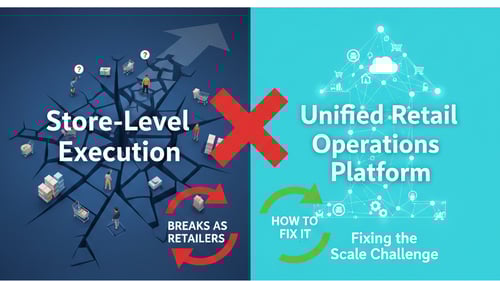
You opened your fifth store last quarter. Sales looked promising. Then came the customer complaints. Store A was running a promotion that ended two weeks ago. Store B was unaware of the new return policy. Store C was still using the old planogram.
What happened?
The same playbook that worked beautifully with a handful of locations started cracking under pressure. And you are not alone. Retailers everywhere face this painful reality: the processes that got you here will not get you there.
The growth paradox every retailer faces
Here is the uncomfortable truth about scaling. As your store count grows, so does the distance between what head office envisions and what actually happens on the shop floor. That gap does not just widen gradually. It expands exponentially.
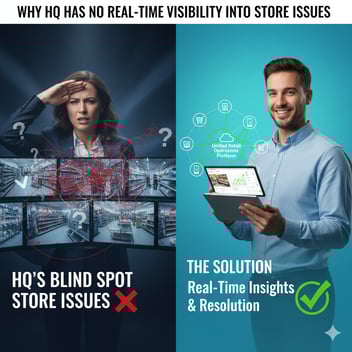
Think about it. When you had three stores, you could visit each location weekly. You knew every manager by name. If something went wrong, you heard about it the same day. But at 30 stores? At 100? Suddenly, you are relying on reports that may or may not reflect reality, passed through layers of regional managers who may or may not have the full picture.
According to Gartner, retail and wholesale organizations score lowest among industries in critical IT services resilience and operational KPIs. This exposure to outages and inefficiencies carries enormous business and reputational risk. The foundation many retailers built for five stores simply cannot support fifty.
Process drift: The silent profit killer
Every retail operation has documented procedures. Open at 9 AM. Stock shelves before noon. Process returns within 24 hours. Follow the visual merchandising guide.
Now multiply those procedures across dozens of locations, each with different store managers, different employee turnover rates, and different local challenges. What you get is process drift: the gradual deviation from standard operating procedures that happens so slowly nobody notices until it becomes a crisis.
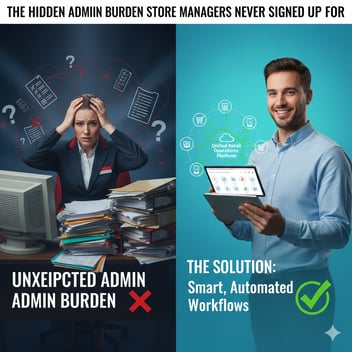
The math is brutal. Retailers spend an average of 332 hours annually on administrative tasks alone. When those tasks are inconsistent across locations, the waste compounds. One store processes inventory checks in two hours. Another takes four. A third skips them entirely when things get busy.
The result? Inconsistent customer experiences, unpredictable costs, and managers spending their time firefighting instead of leading.
When communication breaks down, everything breaks down
Multi-store retail communication presents unique challenges that single-location businesses never face. Head office sends an email about a new pricing strategy. Did every store manager read it? Did they understand it? Did they train their teams? Did the teams actually implement it correctly?
In a multi-store environment, fragmented reporting becomes the norm. Stores use different systems, different spreadsheets, and different methods to communicate back to corporate. Making consolidated reporting time-consuming and error-prone, this lack of uniformity hinders accurate data analysis and delays strategic decision-making.
The corporate versus store-level disconnect grows wider with scale. Head office initiatives, promotions, or strategic directives may not be fully understood or implemented effectively at the store level due to unclear communication or a lack of feedback loops. What looks perfect in the boardroom presentation bears little resemblance to the chaotic reality of a busy Saturday afternoon.
The technology trap
Here is where many retailers make a critical mistake. They assume technology alone will solve their scaling problems. They invest in expensive enterprise systems, expecting automation to create consistency.
But 84 percent of enterprises have adopted low-code or no-code platforms specifically to reduce IT backlogs and accelerate application delivery. Why? Because traditional enterprise software often takes months or years to implement. By the time the system is live, the business has already evolved.
The retail operations automation challenge is not just about having technology. It is about having the right technology that can adapt as fast as your business changes.
What actually works: Building systems that scale
Successful multi-store retailers share common characteristics in how they approach operations:
Standardization with flexibility. They establish clear, non-negotiable standards for core processes while allowing local adaptation where it makes sense. The return policy is the same everywhere. The way you greet customers in Miami might differ from Minneapolis.
Real-time visibility. They invest in systems that show what is happening across all locations right now, not what happened last week. When Store 17 falls behind on inventory counts, someone knows immediately.
Empowered store managers. They give local leaders the tools and authority to solve problems without waiting for corporate approval on every decision. Speed matters more than perfection in retail.
Continuous feedback loops. They create easy ways for store-level insights to flow back to headquarters. The people closest to customers often spot problems and opportunities first.
According to Gartner, by 2025, 70 percent of new applications developed by organizations will use low-code or no-code technologies. This shift reflects a fundamental change in how businesses approach retail operations automation: moving from rigid, IT-dependent systems to flexible, business-led solutions.
The hidden cost of doing nothing
Every day without proper operational infrastructure costs you money. It costs you in wasted manager time spent on manual coordination. It costs you in lost sales from inconsistent execution. It costs you in customer trust when experiences vary wildly between locations.
Research shows that 65 percent of retail businesses report their administrative workload has increased, with 58 percent feeling completely overwhelmed. This is not a minor inconvenience. It is a competitive disadvantage that compounds over time.
The retailers who thrive at scale are not the ones with the most locations or the biggest budgets. They are the ones who build operational infrastructure that grows with them instead of against them.
The path forward
Fixing store-level execution at scale requires honest assessment. Ask yourself:
Can you see what is happening across all stores right now, or are you waiting for weekly reports?
When corporate makes a decision, how long does it take to reach the store floor?
Do your managers spend more time on administrative tasks or leading their teams?
If something goes wrong at one location, how quickly do you find out?
The answers reveal where your operational gaps exist. Closing those gaps is not about working harder. It is about building systems that handle complexity without creating bureaucracy.
How Kissflow helps
Kissflow's low-code platform enables retail organizations to build and deploy operational workflows without months of IT development time. From standardized store opening checklists to automated compliance reporting, Kissflow no-code platform for create the retail operations automation infrastructure you need, adapting it as your business evolves. Whether you manage 10 stores or 1,000, Kissflow provides the visibility and consistency that scaling requires while keeping store managers focused on what matters: running great stores.
Kissflow's no-code platform allows retail teams to design and scale workflows without writing code. This ensures operational agility as store networks grow.
Seamless retail scaling depends on removing manual handoffs and delays. A scalable retail workflow automation platform enables governed execution across stores.
Related Article: