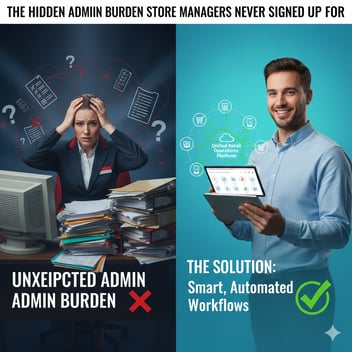
Your store manager in Phoenix needed cleaning supplies fast. The regular vendor was backordered, so she grabbed a corporate card and made a quick run to a local supplier. Reasonable decision, right? Now multiply that scenario across 50 stores, add in emergency maintenance repairs, last-minute marketing materials, and unplanned inventory fill-ins. Suddenly you are looking at thousands of dollars in off-contract spending that bypassed procurement, missed negotiated pricing, and disappeared into expense reports that nobody has time to analyze.
Controlling decentralized spend in retail is one of the most persistent challenges facing finance leaders. The tension between empowering local managers to run their stores effectively and maintaining cost control at the enterprise level creates a constant pull that, without proper systems, typically resolves in favor of convenience over discipline.
The death of margins by a thousand small purchases
Retail operates on thin margins, often in the single digits. In this environment, every percentage point matters. Yet decentralized spending erodes those margins in ways that often escape notice until quarterly reviews reveal unexplained cost overruns. A store buys printer paper at retail prices instead of through the contracted office supplier. Maintenance calls go to whoever answers the phone rather than the preferred vendor with negotiated rates. Marketing creates one-off materials through a local print shop at premium pricing.
According to McKinsey analysis, external expenditure accounts for 40 to 80 percent of a company's overall costs. When a significant portion of that spending happens outside established procurement channels, the aggregate impact on profitability becomes severe even if individual transactions seem minor.
The visibility problem compounds everything
You cannot control what you cannot see. In many retail organizations, decentralized spending disappears into expense reports that are processed for payment but never analyzed for strategic insight. Finance teams have no way to know that the organization is collectively spending $200,000 annually on a product category that could be consolidated under a single contract with better pricing.
Research shows that 70 percent of finance teams say real-time expense visibility is their top priority. The reason is clear: without visibility, cost control becomes reactive rather than proactive, addressing problems only after they have already affected margins.
The spend management automation gap in retail
Many retailers have invested heavily in inventory management systems and point-of-sale technology while leaving spend management to spreadsheets and email approvals. This creates a dangerous disconnect. You know exactly how many units of a particular product sold last Tuesday, but you have no idea how much the organization spent on non-inventory purchases that same week.
The spend management software market is valued at $15.72 billion in 2024 and growing at 12.5 percent annually. This growth reflects the recognition that spend management automation is not a nice-to-have but a necessity for protecting margins in competitive markets.
How budget control breaks down across stores
Budget allocation in multi-location retail typically happens at a high level, with annual or quarterly targets set for each store or region. But between those planning sessions and daily operations, a lot can go wrong. Store managers face unexpected needs that do not fit neatly into budget categories. Regional supervisors approve exceptions without visibility into cumulative impact. By the time finance sees the full picture, the money is already spent.
Industry data reveals that 41 percent of SMEs cite high implementation costs and integration challenges as key barriers to adopting spend management systems. Yet the cost of not implementing proper cost control often exceeds the investment required to establish it.
The cultural challenge of cost control
Store managers and regional leaders often view spending controls as obstacles rather than tools. They see procurement policies as bureaucratic delays that prevent them from solving problems quickly. This perception creates a culture where workarounds are celebrated and compliance is seen as someone else's priority.
Changing this culture requires systems that make compliant purchasing as easy as maverick spending. When using the approved supplier is just as convenient as making a local purchase, compliance becomes the path of least resistance. Modern spend management platforms focus heavily on user experience precisely because they understand that ease of use drives adoption.
From reactive firefighting to data-driven cost control
The shift from decentralized chaos to strategic cost control requires more than just policies. It requires systems that capture spending data, categorize it meaningfully, and surface insights that enable proactive decision-making. When finance leaders can see that stores in the Northeast region are consistently overspending on a particular category, they can investigate root causes and implement targeted solutions.
Research indicates that over 68 percent of businesses report adopting AI-based expense tracking tools to optimize budgets and strengthen compliance processes. These tools transform spending data from a historical record into an active management instrument.
Making the right choice the easy choice
The most successful retail organizations have learned that punishing non-compliance is less effective than removing barriers to compliance. Mobile purchasing apps that connect to approved suppliers, pre-negotiated catalogs accessible from any location, and automated approval workflows that do not create bottlenecks all contribute to a system where following the rules is genuinely easier than circumventing them.
Data shows that 52 percent of enterprises are deploying mobile-based spend tracking applications to enable employees to monitor and control costs effectively. This mobile-first approach recognizes that retail managers live on their phones, and any system that requires a desktop computer and multiple clicks will be bypassed.
How Kissflow brings spend visibility and control to retail
Kissflow enables retailers to build spend management automation workflows that balance control with operational flexibility. Purchase requests can be submitted from mobile devices, automatically routed based on category and amount, and tracked from submission through payment. Budgets can be monitored in real-time, with alerts triggered before overruns occur rather than after.
With Kissflow's no-code and low-code platform, finance teams can create custom workflows that reflect their specific approval hierarchies and spending policies. Store managers get the speed they need while corporate retains visibility and control. Analytics dashboards reveal spending patterns across locations, enabling strategic sourcing decisions that leverage the organization's full purchasing power.
Kissflow's no-code platform helps teams implement spend controls without custom development. Business users manage policies independently.
Decentralized spend weakens margin control in retail enterprises. Retail spend management automation enforces governance at scale.
Related Topics: