10 Best OutSystems Alternatives in 2026 (Compared)
This guide compares the ten strongest options on price, who can build, deployment, and lock-in. It opens with a detailed Kissflow versus OutSystems comparison, then covers nine more alternatives. Each pick lists where it is strong and where it falls short.
Key takeaways
- The strongest OutSystems alternatives in 2026 are Kissflow, Mendix, Microsoft Power Apps, Appian, and Pega.
- Most teams leave OutSystems over cost, pricing opacity, and heavy reliance on professional developers.
- OutSystems does not publish full pricing; Capterra estimates Developer Cloud entry near 36,300 dollars per year (Capterra, 2026).
- Kissflow is execution-first: business teams and IT run cross-functional processes together under central governance.
- Choose your alternative by who builds, how much IT control you need, and total cost over time.
The best OutSystems alternative depends on who builds your apps and how you want execution to run. For most teams in 2026, the top options are Kissflow, Mendix, Microsoft Power Apps, Appian, and Pega.
An OutSystems alternative is a low-code or no-code platform for building business apps with less cost, developer dependency, and lock-in.
Kissflow vs OutSystems: the short answer
Kissflow and OutSystems solve different problems. Kissflow runs cross-functional processes, with business teams and IT building together under one governance model. OutSystems builds custom web and mobile applications for professional developer teams. Pick Kissflow for governed execution across teams and predictable cost. Pick OutSystems for deep application engineering and native mobile.
|
Dimension |
Kissflow |
OutSystems |
|---|---|---|
|
Built for |
Cross-functional process execution |
Custom web and mobile apps |
|
Primary builders |
Business teams and IT |
Professional developers |
|
Change model |
Continuous, no release cycle |
Release-driven through the lifecycle |
|
Pricing |
User and usage based |
From 36,300 dollars per year, app based |
Pricing figure: OutSystems Developer Cloud entry price (Capterra, 2026). The full Kissflow versus OutSystems comparison follows below.
Why teams look for an OutSystems alternative
Teams replace OutSystems for four recurring reasons: cost, pricing opacity, developer dependency, and lock-in. None of these is about whether OutSystems builds good apps. They are about who can use it and what it costs to run over time.
- Cost: OutSystems does not publish full pricing. Capterra lists Developer Cloud entry around 36,300 dollars per year for one app and 100 internal users (Capterra, 2026).
- Pricing opacity: most OutSystems pricing is shared only by quote, so you cannot model cost upfront (Superblocks, 2026).
- Developer dependency: OutSystems centers on professional developers and a full IDE, which keeps app delivery inside IT.
- Lock-in: OutSystems detaches your code only as a one-way step at contract end, often behind extra fees (Superblocks, 2026).
These four pressures shape the shortlist below. The right alternative depends on which one matters most to you.
The 10 best OutSystems alternatives at a glance
Each platform below fits a different team and a different reason for leaving OutSystems. Match the row to your primary constraint, then read the full entry.
|
Platform |
Best for |
Who builds |
Pricing model |
|---|---|---|---|
|
Kissflow |
Cross-functional processes run under central governance |
Business teams and IT |
User and usage based |
|
Mendix |
Large developer teams building complex apps |
Professional developers |
Per app, tiered |
|
Power Apps |
Microsoft-centric organizations |
IT and power users |
Per app or per user |
|
Appian |
Process-heavy enterprise workflows |
Developers |
Per user, tiered |
|
Pega |
Complex case management at scale |
Developers |
Quote based |
|
ServiceNow App Engine |
Teams already on ServiceNow |
IT developers |
Per user, quote based |
|
Nintex |
Process automation around Microsoft 365 |
Process owners and IT |
Per workflow, tiered |
|
Quixy |
Fast no-code builds for SMB teams |
Business users |
Per user, tiered |
|
Creatio |
CRM-led process automation |
Developers and admins |
Per user, tiered |
|
Bonitasoft |
Open-source BPM with custom code |
Developers |
Open source plus paid |
Pricing models reflect each vendor's published structure. Dollar figures are quoted only where a named source supports them. Confirm cost for your scale directly with each vendor.
Kissflow: the execution-first alternative to OutSystems
Kissflow is the strongest fit for teams that want business users and IT building together while IT keeps control. Kissflow is an enterprise application platform spanning workflow, business process management, no-code, low-code, and application development.
The difference with OutSystems is not a feature list. It is a model. Kissflow is execution-first: it turns business demand into governed execution across teams. OutSystems is application-first: execution lives inside applications that developers build and release.
Both build real software. They optimize for different things. OutSystems optimizes how applications are built. Kissflow optimizes how execution runs.
Check out: Kissflow vs OutSystems: a detailed comparison.
Execution-first vs application-first: the core difference
The core difference is the execution model. In Kissflow, the process is the unit of work, and apps are one tool inside it. In OutSystems, the application is the unit of work, and the process lives inside it.
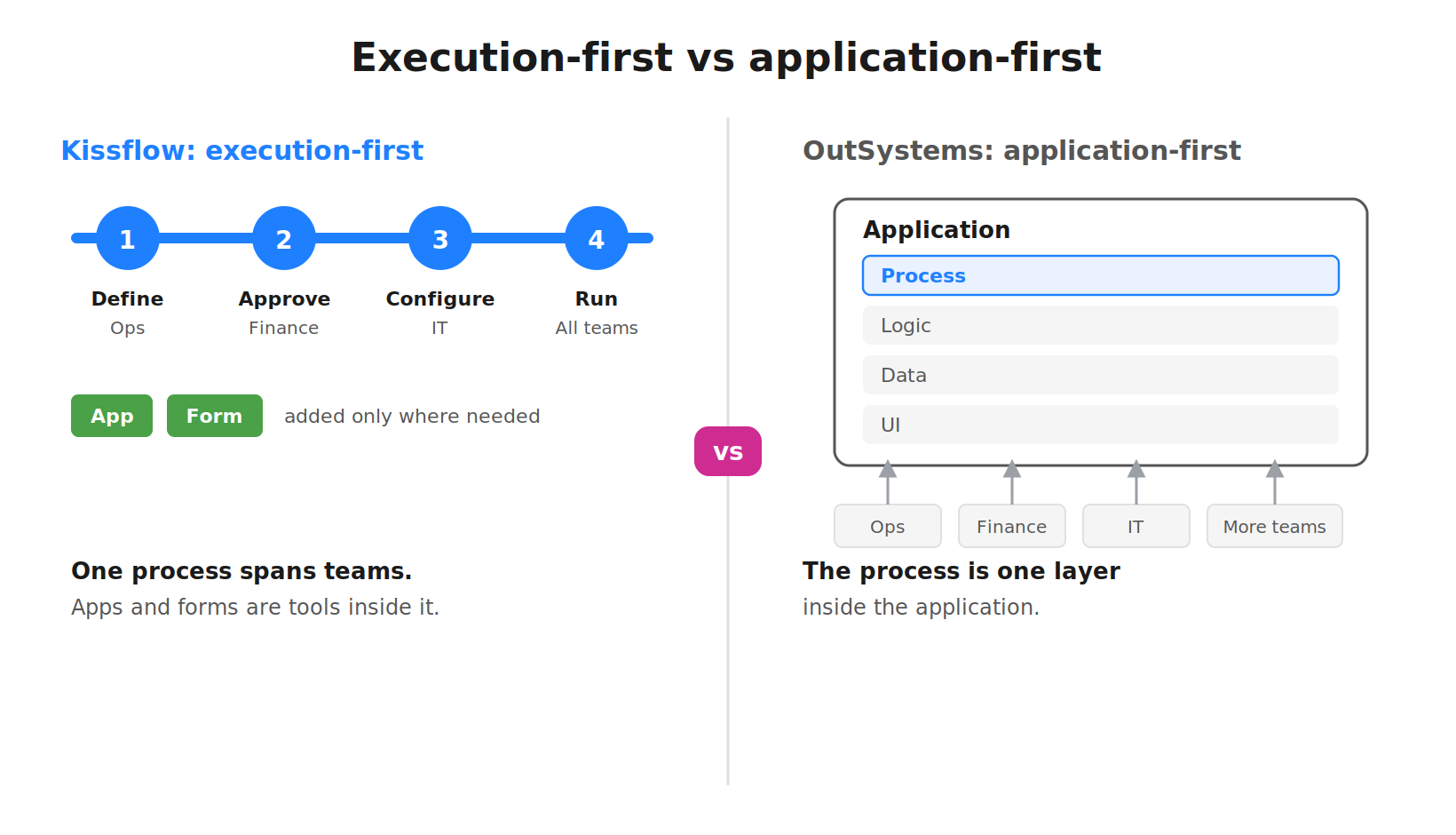
Kissflow runs one process across teams, with apps and forms as tools. OutSystems holds the process as one layer inside an application.
|
Dimension |
Kissflow |
OutSystems |
|---|---|---|
|
Core model |
Execution-first |
Application-first |
|
Primary builders |
Business teams and IT together |
Professional developers |
|
Change model |
Continuous |
Release-driven |
|
Governance |
Built into execution |
Managed through the lifecycle |
Example: raising an approval limit from 50,000 to 100,000. In Kissflow, you update the rule directly. In OutSystems, a developer modifies the logic, tests it, and redeploys. The same change can take minutes rather than a release cycle.
How the difference shows up
Take a process that crosses many teams, like opening a new retail store. Real estate, legal, finance, construction, IT, and operations all hold a part of it. The two platforms approach it from opposite ends.
|
Approach |
Kissflow (execution-first) |
OutSystems (application-first) |
|---|---|---|
|
Step 1 |
Define the process across teams |
Design an application to manage the process |
|
Step 2 |
Configure steps, approvals, and dependencies |
Implement workflows inside the app |
|
Step 3 |
Build apps or forms only where needed |
Define logic, states, and integrations |
|
Over time |
Execution evolves continuously |
Changes follow release cycles |
A smaller process shows the same split. For vendor onboarding, a Kissflow builder creates a form, configures approvals, adds rules, and publishes. An OutSystems developer builds the UI, defines the data, implements the approval logic, handles states, and deploys.
The takeaway: in Kissflow, apps are one of many tools. In OutSystems, the application is where execution lives.
Kissflow vs OutSystems feature comparison
Kissflow leads where execution, governance, and change speed matter. OutSystems leads where deep application engineering matters, such as native mobile, full UI control, and microservices. The table below maps each capability to how the platform delivers it.
|
Capability |
Kissflow |
OutSystems |
|---|---|---|
|
Workflow design and orchestration |
Visual step-based builder with SLAs, escalations, and conditions |
Built within application logic and flows |
|
Case management |
Native queues, assignment, states, and tracking |
Built using application patterns |
|
Forms and data modeling |
Integrated with workflows, no separate modeling step |
Strong data modeling within the application architecture |
|
Role-based access and permissions |
Configured at the process level: roles, visibility, approvals |
Defined within application roles and logic |
|
Business rules and decision logic |
Configured with conditions, branching, and decision tables |
Implemented through visual logic or code |
|
External portals |
Built in for vendor and customer interaction |
Built as part of the application UI |
|
Integrations: APIs and connectors |
Pre-built connectors plus REST APIs, configuration driven |
Extensive integrations, developer driven |
|
Change management |
Direct updates to workflows and rules, no release cycle |
Requires development, testing, and deployment |
|
Audit trails and compliance |
Automatic across every workflow |
Available, but configured deliberately |
|
AI in execution |
Generates a blueprint a person reviews, validated at build time |
Generates application code, UI, and agents in the lifecycle |
|
UI and UX customization |
Configurable components within the platform structure |
Fully customizable through development |
|
Mobile and offline support |
Progressive web app experience |
Strong native mobile and offline capability |
|
Architecture flexibility |
Extended through integrations |
Strong support for microservices and modular design |
On AI, the two platforms differ by design. Kissflow AI maps a prompt to platform metadata, not code. It produces a structured blueprint covering data, pages, roles, and workflows. A person stays in the lead before anything goes live. The AI Builder has been generally available since May 2026. OutSystems Mentor generates application code, UI, and agents inside the development lifecycle.
Governance built into execution
In Kissflow, governance sits inside execution. Roles, audit logs, and monitoring come with the platform, not with each app build. In OutSystems, governance is real but managed around the application lifecycle. Its depth depends on how each app was built.
|
Control |
Kissflow |
OutSystems |
|---|---|---|
|
Role-based access |
Built in |
Supported |
|
Audit logs |
Native across workflows |
Configured deliberately |
|
Monitoring |
Embedded in the platform |
Through lifecycle tools |
|
Governance model |
Inside execution |
Around the application lifecycle |
Example: an auditor asks for the approval history of a request. In Kissflow, that history is available instantly because every workflow logs it. In OutSystems, the answer depends on how the application was built. Kissflow also carries SOC 1, SOC 2, SOC 3, ISO/IEC 27001, HIPAA, GDPR, and CCPA coverage.
Total cost of ownership
Kissflow prices on users and usage, so cost stays predictable as you add workflows and apps. OutSystems prices on applications and runtimes, so cost tends to rise with the number of apps and objects you run.
|
Factor |
Kissflow |
OutSystems |
|---|---|---|
|
Pricing model |
User and usage based |
Application based |
|
Scaling |
Add workflows and apps without per-app pricing |
Scales with apps and objects |
|
Cost predictability |
High |
Variable |
|
Engineering overhead |
Lower |
Higher |
Example: scaling from a few workflows to dozens. In Kissflow, cost stays predictable regardless of scale. In OutSystems, cost grows with each new application and object. Because OutSystems shares most pricing by quote, model your three-year cost before you commit.
What OutSystems actually costs
OutSystems does not publish full pricing. The Developer Cloud plan starts at 36,300 dollars per year, and most tiers above it are quote-only. Cost is driven by applications, users, and Application Objects, so it rises as your portfolio grows.
|
Cost factor |
Detail |
Source |
|---|---|---|
|
Entry price |
From 36,300 dollars per year |
Capterra, 2026 |
|
What entry covers |
3 runtimes, 100 internal users, one app of about 150 Application Objects |
Superblocks, 2026 |
|
Value metric |
Application Objects: screens, tables, and APIs |
PricingNow, 2026 |
|
Pricing visibility |
Base tier published; higher tiers by quote |
CheckThat.ai, 2026 |
Sources: Capterra, Superblocks, PricingNow, and CheckThat.ai, all 2026. By contrast, Kissflow prices on users and usage, which you can model upfront.
When to choose Kissflow, and when to choose OutSystems
Neither platform wins every case. The right answer follows your goal, your builders, and your tolerance for release cycles.
Choose Kissflow if:
- You run multiple cross-functional processes across teams.
- You need continuous changes without release cycles.
- You want business-led execution under central governance.
- You want predictable cost and lower engineering overhead.
Choose OutSystems if:
- Your main goal is professional developer productivity.
- Advanced native mobile and offline capability is non-negotiable.
- You can accommodate longer development and deployment timelines.
- You already have OutSystems-trained developers in place.
The Gartner Hype Cycle for Enterprise Process Automation, 2025, lists Kissflow as a sample vendor for no-code platforms. Kissflow also appears in the Forrester AppGen and Low-Code Platforms Landscape, Q2 2026.
Proof point: Godrej Consumer Products replaced a developer-first low-code platform with Kissflow. The move put process building in the hands of business teams, with IT keeping governance.
“The beauty of Kissflow is how quick and easy it is to create the apps I need. It is so user-friendly that I made exactly what I needed in 30 minutes.”
Oliver Umehara, IT Manager, SoftBank
How to switch from OutSystems to Kissflow
Moving off OutSystems usually means rebuilding the process on the new platform, not porting code. OutSystems can detach your apps as standard .NET and React code. That detachment is a one-way step at contract end, often behind extra fees (Superblocks, 2026).
OutSystems generates standard .NET and React apps that can run without OutSystems. In practice, the detached code is large and hard to maintain, so most teams rebuild rather than port the code.
A clean rebuild is often faster than untangling tightly coupled detached apps. It is also the moment to move execution into a governed platform. Use this sequence.
- Inventory your OutSystems apps and rank them by business value and change frequency.
- Start with the highest-change processes, where a no-release-cycle model pays off first.
- Rebuild each process in Kissflow as a workflow, adding forms and apps only where needed.
- Move governance into the platform, where roles, audit logs, and approvals come built in.
- Run the old and new versions in parallel, then retire the OutSystems app after validation.
The rebuild also resets your cost model from applications and objects to users and usage. That model is easier to predict as you scale.
Other strong OutSystems alternatives
The nine platforms below cover the other reasons teams move off OutSystems. Each entry lists what it does well, where it falls short, and who it fits.
Mendix
Mendix is a low-code platform for building, deploying, and managing enterprise apps. It serves both visual builders and professional developers who write custom code.
Best for: Large developer teams building complex applications.
Strengths
- Flexible UI with many templates for responsive interfaces.
- Database connectors for internal and external systems.
- AI-assisted modeling helps with logic and configuration.
Limitations
- Adding custom features can get complex.
- Documentation and learning resources can be thin.
- The platform leans toward developers more than business users.
Check out: Kissflow vs Mendix: a detailed comparison.
Microsoft Power Apps
Microsoft Power Apps is a low-code platform inside the Power Platform. It fits organizations already standardized on Microsoft 365 and Azure.
Best for: Microsoft-centric teams that want apps close to Office and Teams.
Strengths
- Native ties to Office 365, Teams, and SharePoint.
- Large connector library for common business systems.
- AI Builder adds form processing and detection features.
Limitations
- Performance lags when connecting many data sources.
- A hard limit of 2,000 line items constrains larger data sets.
- Advanced customization needs technical skills and certified developers.
Appian
Appian is a low-code platform built around process automation and case management. It pairs visual design with strong governance for regulated work.
Best for: Process-heavy enterprise workflows that need tight control.
Strengths
- Built-in governance for security and compliance.
- Generative AI assists app creation.
- Apps run across devices and browsers.
Limitations
- Customization has limits for some use cases.
- Larger projects can grow complex.
- Documentation is light on advanced functions.
Check out: Kissflow vs Appian: a detailed comparison.
Pega
Pega is a low-code platform for complex case management and decisioning at scale. It targets large enterprises with deep process needs.
Best for: Complex, high-volume case management.
Strengths
- Strong case management and decisioning.
- Reusable components speed delivery cycles.
- Handles enterprise-scale processes.
Limitations
- Business users face a steep learning curve.
- Integration setup can be involved.
- Front-end response can feel slow under heavy load.
ServiceNow App Engine
ServiceNow App Engine lets teams build custom apps on the ServiceNow platform. It fits organizations that already run ServiceNow for IT service management.
Best for: Teams standardized on ServiceNow.
Strengths
- Ties directly into existing ServiceNow data and workflows.
- Library of pre-built components for common features.
- Central management for requests, deployments, and developers.
Limitations
- Customization options are narrower than full development.
- Business users face a learning curve.
- Debugging and error handling can be difficult.
Nintex
Nintex is a process automation platform with a drag-and-drop designer. It is popular for workflows that sit close to Microsoft 365 and SharePoint.
Best for: Process automation around Microsoft 365.
Strengths
- Fast form and workflow configuration.
- Wide range of data source integrations.
- Built-in error capture and custom handling.
Limitations
- Database options are limited.
- Advanced use cases can get technical.
- Fewer features for professional developers.
Quixy
Quixy is a no-code platform with ready templates and a drag-and-drop builder. It suits smaller teams digitizing day-to-day processes quickly.
Best for: Fast no-code builds for small and mid-size teams.
Strengths
- Ready-to-use templates for common processes.
- Rule engine for configuring business logic without code.
- Rapid build and deploy cycles.
Limitations
- Integration breadth is limited.
- No option to extend apps with custom code.
- Guidance and in-product suggestions could be stronger.
Creatio
Creatio is a low-code platform built around CRM and process automation. It fits teams that want customer-facing apps tied to a CRM core.
Best for: CRM-led process automation.
Strengths
- Comprehensive CRM across sales, marketing, and service.
- Visual process designer for automation.
- Industry templates and accelerators.
Limitations
- Business users still need a developer mindset.
- Complex workflows take time to configure.
- Technical terminology can confuse non-technical users.
Bonitasoft
Bonitasoft is an open-source business process management platform with low-code tooling. It fits developer teams that want to extend the platform with custom code.
Best for: Open-source BPM with heavy customization.
Strengths
- Open-code connectors and extension points.
- Integrates current and legacy enterprise systems.
- Deploys on-premise or in the cloud.
Limitations
- Documentation is light on complex projects.
- Non-technical users find it hard to use.
- Large, complex apps can hit performance limits.
How to choose an OutSystems alternative
Pick an alternative by matching the platform to your team and your constraints, not to a feature list. Work through these six criteria in order.
- Who will build: decide whether business users build, IT builds, or both.
- IT control: confirm the platform gives IT central governance over data, access, and compliance.
- Total cost: look past the entry price to users, environments, and add-ons over three years.
- Pricing transparency: prefer published pricing you can model without a sales process.
- Portability: check whether you can move or extend the app, or whether you are locked in.
- Time to first app: test how fast a real team ships a working app in a trial.
Score each option against these six points. The platform that fits your team usually beats the one with the longest feature list.
Frequently asked questions
Q: What is the best alternative to OutSystems?
A: There is no single best alternative, because the right choice depends on who builds your apps. Kissflow fits teams that want business users and IT building together. Mendix and Appian fit large developer teams. Power Apps fits Microsoft-centric organizations.
Q: How much does OutSystems cost?
A: OutSystems does not publish full pricing on its own site. Capterra lists Developer Cloud starting around 36,300 dollars per year for one app and 100 internal users (Capterra, 2026). Most other pricing is shared by quote, so confirm cost for your scale.
Q: What is the difference between Kissflow and OutSystems?
A: Kissflow is execution-first: business teams and IT run cross-functional processes together, and apps are one tool inside the process. OutSystems is application-first: developers build applications, and execution lives inside them. The split shapes who builds, how changes ship, and how cost scales.
Q: Is OutSystems low-code or no-code?
A: OutSystems is a low-code platform aimed at professional developers, not a no-code tool for business users. It uses a visual IDE and a full development lifecycle. Business users without development skills generally find it hard to build apps on their own.
Q: Why do teams switch from OutSystems?
A: Teams switch mainly over cost, pricing complexity, and reliance on professional developers. Because OutSystems centers on a developer IDE, non-technical users struggle to build, which keeps delivery inside IT. Moving an app off the platform also means a one-way code detachment, which most teams prefer to avoid.
Q: Can you migrate off OutSystems easily?
A: Migration takes planning. OutSystems can detach your apps as standard .NET and React code. That detachment is a one-way step at contract end, often behind extra fees (Superblocks, 2026). Because the detached code is hard to maintain, teams usually rebuild on the new platform rather than port it.
Choose the right OutSystems alternative for your team
The choice comes down to one question: do you want to build applications, or run execution? OutSystems is built to make developers productive inside applications. Kissflow is built to run cross-functional processes under one governance model, with business teams and IT building together.
If your main need is deep application engineering, native mobile, or full UI control, weigh OutSystems and Mendix first. If your need is governed execution across teams, predictable cost, and change without release cycles, start with Kissflow.
See how Kissflow runs cross-functional processes under one governance model in a 30-minute demo.
-May-19-2025-11-22-41-6975-AM.png)
Related Articles


11 MINUTES READ
Copilot Studio Alternatives: Picks by Use Case for 2026
11 MINUTES READ
Top 7 Pipefy Alternatives in 2026