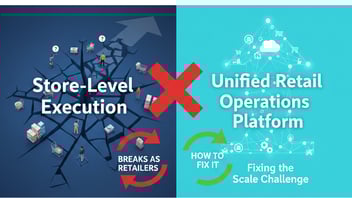
There is a pattern that plays out in growing retail organizations. The first few stores open successfully, largely through the effort of talented people who figure things out as they go. Then the company decides to accelerate expansion. What worked with five stores starts breaking at fifteen. By fifty stores, operations are in constant firefighting mode, and leadership is wondering how things got so out of control.
The fundamental challenge of scaling retail operations is that the approaches which work at small scale do not work at large scale. Individual heroics cannot be replicated across hundreds of managers. Tribal knowledge cannot be transferred to new hires fast enough. Ad hoc problem solving cannot maintain consistency across diverse markets and formats. Sustainable growth requires scalable retail operations built on standardized workflows that maintain quality regardless of how many locations you operate.
Why chaos scales faster than operations
When operations depend on individual judgment and informal coordination, every new location adds complexity exponentially rather than linearly. A new store means new relationships to manage, new variations to accommodate, and new opportunities for things to fall through the cracks. Without standardized systems, each location develops its own ways of doing things, creating inconsistency that becomes harder to manage as the organization grows.
The global retail automation market is projected to reach $44.3 billion by 2029, growing at nearly 10 percent annually. This growth reflects widespread recognition that manual, ad hoc approaches to retail operations cannot support the efficiency and consistency that modern markets demand. Retailers who fail to standardize will find themselves at an increasing disadvantage against competitors who have built scalable operational foundations.
The standardization paradox
Many retailers resist standardization because they believe it will make them less flexible. They worry that rigid processes will prevent them from responding to local market conditions, accommodating unique store requirements, or capitalizing on unexpected opportunities. This concern reflects a misunderstanding of what effective standardization looks like.
Well designed scalable retail operations do not eliminate flexibility. They create a foundation of consistency that enables focused flexibility where it matters. You standardize the coordination layer so that variations in execution are handled systematically rather than chaotically. The result is actually more flexibility, not less, because your operational capacity is not consumed by firefighting predictable problems.
The technology enablement factor
Traditional process standardization often failed because it required extensive documentation, training, and enforcement that could not keep pace with business change. Modern workflow platforms change this equation by embedding processes in systems that guide users through correct execution automatically. When the system routes tasks to the right people, captures required information, and enforces approval sequences, standardization happens through tool usage rather than policy compliance.
According to Morgan Stanley research, automation could reduce the best positioned retailers' unit costs by as much as 20 percent over time, translating into margin expansion of 50 to 100 basis points. These savings come from the efficiency gains of standardized, automated processes that eliminate the waste inherent in manual coordination.
Building the foundation for scalable growth
How to scale retail operations without chaos starts with identifying the processes that must be consistent across all locations. Store opening procedures, inventory management workflows, employee onboarding processes, compliance documentation, vendor coordination protocols. These are the operational building blocks that enable growth when standardized and derail growth when left to individual interpretation.
By 2025, retailers plan to automate 70 percent of their daily routine store tasks, according to company surveys. This shift reflects understanding that human capacity should be reserved for activities that require judgment and creativity, while routine coordination should flow through systems that execute reliably at any scale.
The low-code scalability advantage
Traditional enterprise software often became a barrier to growth because customizing it for new requirements required expensive IT projects with long lead times. Low-code scalability changes this dynamic by putting process design in the hands of business users who understand operational needs. When the operations team can modify workflows directly, the organization can evolve its processes as fast as market conditions demand.
The workflow automation market is projected to grow to $45.49 billion by 2032, driven by organizations recognizing that competitive advantage increasingly depends on operational agility. Retailers who build low-code scalability into their operational foundations will be able to adapt faster than competitors relying on rigid legacy systems.
Creating templates for repeatable success
Scalable retail operations work through templates that encode best practices while allowing configuration for specific needs. A store opening template captures the standard sequence of activities, required approvals, and key milestones while allowing customization for different store formats, markets, or building types. A vendor onboarding template ensures consistent qualification and documentation while accommodating different vendor categories and risk levels.
These templates create organizational learning. When a store opening goes well, the template captures what worked. When problems occur, the template is updated to prevent recurrence. Over time, the templates embody accumulated operational wisdom that benefits every new location.
Measuring what matters for sustainable growth
Standardized workflows create standardized data. When every store opening follows the same process, you can compare performance across locations objectively. Which stores opened on time? Where did delays occur? Which vendors performed well? Which process steps consistently create bottlenecks? This visibility enables continuous improvement that compounds over time.
According to McKinsey research, 76 percent of companies have implemented advanced planning systems to improve operational visibility and reduce manual workarounds. For retail expansion, this means having data driven insights into what works and what does not, enabling better decisions about where to focus improvement efforts.
Building operational excellence into company culture
When standardized workflows become the way work happens, operational excellence becomes cultural rather than aspirational. New hires learn proper processes because that is how the systems work. Regional variations are accommodated within consistent frameworks rather than as exceptions that undermine consistency. Continuous improvement becomes possible because you have baselines to improve from.
Organizations using integrating hyper automation technology with improved operational procedures can reduce operational expenses by 30 percent, according to Gartner projections. These savings come not just from automation efficiency but from eliminating the waste, rework, and firefighting that consume resources in organizations without standardized operations.
How Kissflow enables scalable retail growth
Kissflow's no-code and low-code platform provides the foundation for building scalable retail operations that grow with your business. Operations teams can design standardized workflows for store openings, vendor management, compliance tracking, and every other process that needs to work consistently across locations.
With Kissflow's workflow capabilities, retailers achieve low-code scalability that puts process control in the hands of business users. Templates encode best practices while allowing configuration for local needs. Dashboards provide visibility across all operations, enabling data driven decisions about where to focus improvement efforts. And because the platform handles the coordination layer, your team's capacity is freed for the strategic work that drives competitive advantage.
The result is growth that does not require proportional increases in operational complexity. Each new store adds revenue without adding chaos. Expansion plans execute predictably. And your organization builds operational excellence that compounds with every location added.
Kissflow's no-code platform enables enterprises to scale workflows rapidly without code. This ensures agility during growth phases.
Scaling retail without structure leads to operational chaos. A scalable retail operations platform brings order through standardized workflows.
Frequently Asked Question
1) Why does retail chaos increase as companies scale?
Because early success often depends on individual effort and informal coordination. As store counts grow, these approaches cannot be replicated consistently, causing complexity to grow faster than operations.
2) What breaks first when retail operations scale?
Store openings, vendor coordination, compliance tracking, inventory processes, and employee onboarding are usually the first to fail when workflows are not standardized.
3) What are scalable retail operations?
Scalable retail operations use standardized workflows, automated coordination, and consistent data to ensure processes work reliably regardless of how many locations a retailer operates.
4) Does standardization reduce flexibility in retail?
No. Effective standardization focuses on the coordination layer, allowing execution flexibility while preventing chaos. This actually increases agility by reducing firefighting.
5) How does workflow automation help retail scale efficiently?
Workflow automation routes tasks, enforces approvals, captures documentation, and tracks dependencies automatically—reducing manual coordination and ensuring consistency at scale.
6) Why is low-code important for scaling retail operations?
Low-code platforms allow business teams to update workflows quickly as requirements change, avoiding slow and costly IT development cycles that hinder growth.
7) What processes should be standardized first in retail expansion?
Store opening workflows, vendor onboarding and coordination, compliance documentation, inventory readiness, and employee onboarding should be standardized early.
8) How do templates support scalable retail growth?
Templates encode best practices into repeatable workflows while allowing configuration for store formats, locations, and local requirements—balancing consistency and flexibility.
9) What metrics improve when retail operations are standardized?
On-time store openings, lower operational costs, fewer compliance gaps, improved vendor performance, faster issue resolution, and better cross-location visibility.
10) How does Kissflow enable retailers to scale without chaos?
Kissflow enables retailers to build standardized, configurable workflows using low-code tools, providing visibility, automation, and continuous improvement across all locations.
Related Topics: