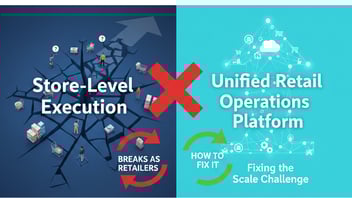
There's a pattern that plays out across the enterprise retail landscape. Operations that worked perfectly well for 50 stores suddenly collapse under the weight of 500. The inventory system that once hummed along now creates weekly fire drills. Regional managers spend more time troubleshooting process failures than actually managing performance. And IT? They're buried under a mountain of urgent requests while simultaneously being blamed for not delivering innovation fast enough.
This isn't a failure of people. It's a failure of systems that were never designed to scale. Managing retail store operations at scale requires fundamentally different approaches than what worked when your footprint was smaller.
According to Gartner, retail IT spending is projected to reach $211.2 billion in 2024, growing at 6.3 percent annually. Yet despite this massive investment, most enterprise retailers still struggle with the same fundamental problem: legacy architectures and fragmented workflows that buckle under increased operational complexity.
The question isn't whether your current systems will eventually break. It's whether you'll fix them proactively or wait until the cost of inaction becomes unbearable.
Where retail operations actually break down
Most conversations about retail IT bottlenecks focus on technology. But the real failure points are almost always process-related. Technology simply exposes and amplifies underlying operational dysfunction.
The hidden cost of workflow fragmentation
Enterprise retailers don't run on a single system. They run on dozens of disconnected tools, spreadsheets, regional workarounds, and decades of accumulated tribal knowledge. A single store opening might require coordination across 15 different systems, none of which communicate with each other automatically.
IDC research reveals that 80 percent of organizations still rely on legacy systems that restrict agility and hinder digital transformation efforts. In retail specifically, this translates to store managers filling out the same information in multiple systems, inventory discrepancies that take days to reconcile, and compliance documentation scattered across shared drives no one can navigate.
This retail workflow fragmentation doesn't just create inefficiency. It creates risk. When processes depend on specific individuals knowing exactly which Excel file contains which data, you've built organizational fragility into your operating model. This is precisely why retail store operations at scale demand standardized, system-driven approaches rather than tribal knowledge.
Why "keep the lights on" spending crowds out innovation
Here's a number that should alarm every retail CIO: organizations spend between 60 to 80 percent of their IT budgets simply maintaining existing systems. By 2025, Gartner projects that companies will spend 40 percent of their IT budgets on maintaining technical debt alone.
This "keep the lights on" spending leaves almost nothing for retail process modernization. The IT team that should be building competitive advantages is instead patching together aging infrastructure and managing vendor relationships for software that stopped receiving meaningful updates years ago.
McKinsey's research on retail tech transformation confirms this reality. Most retailers remain stuck in the "emerging" phase on both architecture and operating model, lacking the tools, processes, and capabilities to fully resolve next-generation retail challenges.
The scaling wall that stops growth
Retail operations scalability isn't a linear challenge. Systems that work at one scale often fail catastrophically at the next. A regional inventory management process that functions well across 100 stores might completely collapse when applied to 400 stores with different product mixes, vendor relationships, and local regulations.
According to McKinsey, 70 percent of transformation initiatives fail due to resistance to change and lack of engagement. But the deeper truth is that many retail transformations fail because they're attempting to scale processes that were never designed for scale in the first place.
The evidence is stark. IDC found that 63 percent of organizations see limited data access as a primary challenge, while companies working with vendors that support legacy integration saw 58 percent gains in operational efficiency.
The real source of retail IT bottlenecks
When retail store operations at scale begin failing, the instinct is to blame technology. But technology is rarely the root cause. The real problems are structural.
Process debt accumulates faster than technical debt
Every workaround creates process debt. Every time a store manager develops a local solution to bypass a broken corporate system, that workaround becomes embedded in operations. Multiply this across hundreds of stores over years, and you end up with an organization running on thousands of undocumented micro-processes that no central system even knows about.
Deloitte's intelligent automation research found that 41 percent of organizations do not have an enterprise-wide intelligent automation strategy. Without strategic process governance, retail operations governance becomes impossible. You can't standardize what you can't see, and you can't see processes that exist only in the habits of individual store teams.
The governance gap between corporate and field operations
Retail enterprise operations automation requires consistent execution across every location. But most retailers have a fundamental disconnect between corporate-designed processes and field-level reality. Corporate creates policies assuming ideal conditions. Field teams adapt those policies to actual conditions. The result is operational drift that accelerates over time.
Research shows that only 38 percent of organizations have mature process definitions, standards, and management. In retail specifically, this governance gap creates compliance risks, inconsistent customer experiences, and operational inefficiencies that compound across the store network.
Why traditional IT can't solve operational problems
IT departments are structured to manage technology, not to redesign business processes. When store operations break, IT receives tickets to fix symptoms rather than mandates to address root causes. They patch the inventory system rather than redesigning the inventory process. They add another integration rather than questioning why so many systems need to communicate in the first place.
According to Gartner, 90 percent of business IT budgets go to maintaining current software. This leaves IT teams with neither the capacity nor the organizational mandate to address the operational architecture problems that actually drive most retail inefficiencies.
How leading retailers scale operations without rebuilding IT infrastructure
The retailers winning at scale aren't rebuilding their entire technology stack. They're finding ways to standardize and automate processes on top of existing systems, closing the gap between corporate design and field execution without requiring massive IT investments. Enterprise retail operations automations built on no-code platforms allow these organizations to move faster than traditional development cycles permit.
The shift from monolithic transformation to incremental modernization
McKinsey's research on retail tech transformation highlights a critical insight: while some companies attempt to leapfrog to an entirely new tech stack, more retailers are taking incremental steps. New business logic can be built out iteratively as modular components that effectively replace legacy functionality without requiring full system replacement.
This approach prioritizes platform upgrades according to value at stake. McKinsey estimates that 20 to 50 percent of platforms may drive up to 80 percent of value. Smart retailers focus transformation efforts there first, leaving functional legacy systems untouched until the economics justify replacement.
Process standardization as a scalability multiplier
Before automating anything, leading retailers standardize. They identify the 20 percent of processes that create 80 percent of operational friction and design consistent execution standards that work across every store type and region.
Fujitsu research identifies the key drivers for digital transformation in retail: improved competitiveness at 70 percent, reduced costs and increased efficiencies at 69 percent, and stronger customer relationships at 69 percent. But these benefits only materialize when transformation rests on a foundation of standardized processes.
Standardization doesn't mean rigidity. It means defining clear parameters within which local adaptation can occur. Store opening procedures should be consistent. How a specific store manager handles a unique local vendor relationship can remain flexible.
Empowering business users to close the process gap
The traditional model, where IT builds everything and business users request changes through ticket,s cannot scale. Gartner predicts that by 2024, 80 percent of technology products and services will be built by those who are not technology professionals.
This shift isn't about removing IT from the equation. It's about creating a division of labor where IT maintains governance, security, and core infrastructure while business users address operational process improvements directly. Forrester research confirms organizations consistently report order-of-magnitude improvements in development velocity when business users can create and modify operational applications.
The most successful enterprise retail operations automation initiatives put workflow tools in the hands of operations teams while maintaining centralized oversight of data, security, and cross-functional integration.
What enterprise-grade retail process modernization actually looks like
Abstract strategies mean nothing without concrete implementation. Here's how retailers actually modernize store operations at scale.
Unified task management across the store network
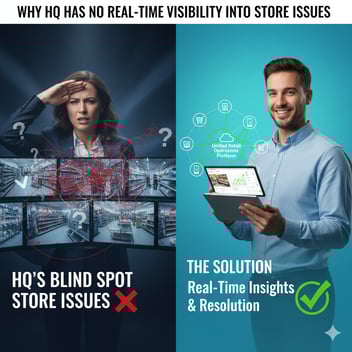
Leading retailers replace fragmented communication channels with unified task management platforms. Instead of regional managers sending emails that may or may not be read, tasks flow through systems that track completion, flag exceptions, and provide real-time visibility into execution across every store.
IDC's 2024 Retail Insights Consumer Sentiment Survey found that 77.4 percent of shoppers actively shop in stores and online. This omnichannel reality requires operational coordination that email and spreadsheets simply cannot provide. Unified task management ensures that store teams execute consistently regardless of which channel drives customer traffic.
Automated compliance and audit workflows
Regulatory compliance in retail isn't optional, but it consumes enormous operational resources when managed manually. Leading retailers automate compliance workflows so that documentation requirements, safety inspections, and regulatory audits generate automatically from normal operational activity.
Deloitte's research shows that 71 percent of retailers report gaining competitive edge through stronger cost control. Automated compliance workflows contribute directly to this advantage by reducing the administrative burden on store teams and ensuring consistent documentation without manual effort.
Real-time exception management and escalation
Operational problems don't wait for scheduled check-ins. The retailer that discovers a critical inventory discrepancy within hours rather than days gains a meaningful competitive advantage. This requires workflow systems that automatically monitor for exceptions and escalate them to the appropriate decision-makers, without requiring anyone to identify problems manually.
McKinsey research indicates that retailers can automate 52 percent of all retail tasks using existing technology. The key is identifying which tasks benefit most from automation and which require human judgment, then designing workflows that route work appropriately.
The business case for workflow-driven retail transformation
Enterprise retail operations don't transform because new technology becomes available. They transform because the economics become compelling. When you're managing retail store operations at scale, the cost of operational inconsistency compounds exponentially.
Quantifying the cost of operational inconsistency
Every time a store process executes differently than corporate intended, there's a cost. It might be inventory shrinkage from inconsistent receiving procedures. It might be lost sales from stockouts that proper replenishment workflows would have prevented. It might be compliance fines from documentation gaps.
Most retailers don't quantify these costs because they're dispersed across the organization. But the numbers are substantial. Companies leveraging cloud services report an average scalability improvement of 30 percent, while those implementing middleware solutions typically achieve a 25 percent reduction in operational costs.
The compounding return on process standardization
Process improvements compound. A single workflow optimization might save 15 minutes per store per day. Across 500 stores operating 365 days per year, that's over 45,000 hours recovered annually. More importantly, standardized processes create the foundation for further automation that generates additional returns year over year.
Forrester research indicates that the average company avoided hiring two IT developers using low-code tools, reaping about $4.4 million in increased business value over three years from applications designed. In retail, where operational scale amplifies every efficiency gain, these returns can be even more significant.
Building organizational capability for continuous improvement
The most valuable outcome of workflow-driven transformation isn't any single process improvement. It's building organizational capability to improve continuously. When business users can modify workflows without IT dependency, the organization develops muscle memory for rapid adaptation. Enterprise retail operations automations become self-sustaining when the people closest to operational challenges can address them directly.
Gartner predicts that 70 percent of new applications developed by organizations will use low-code or no-code technologies by 2025. Retailers who build this capability now position themselves to adapt faster than competitors who remain dependent on traditional IT development cycles.
How Kissflow helps enterprise retailers modernize operations
Kissflow's low-code platform enables enterprise retailers to standardize, automate, and scale store operations without the complexity and timeline of traditional IT projects. For organizations struggling to manage retail store operations at scale, Kissflow provides a path forward that doesn't require rebuilding existing infrastructure. Operations teams can build workflows that connect existing systems, enforce consistent execution across regions, and provide real-time visibility into operational performance.
Rather than replacing legacy infrastructure, Kissflow sits on top of existing systems, orchestrating work across the technology landscape you already have. This means faster time to value, lower implementation risk, and the flexibility to evolve processes as business requirements change. With enterprise-grade governance and security, IT maintains control while business users gain the ability to address operational challenges directly.
Kissflow empowers retail teams to build and modify workflows without writing code. Its enterprise no-code platform enables faster process changes without IT bottlenecks.
To prevent store operations from breaking as retail networks scale, enterprises need systems that adapt faster than manual processes. An enterprise retail operations automation platform helps standardize execution with full visibility.
Related Articles:
1- The Enterprise Retail Compliance Crisis: Why Multi-Location Retailers Can't Keep Up With Audits
2- 67% of retailers still manage inventory in Excel. Here's what that's really costing you
3- Enterprise Retail Expansion Is Broken - Here’s How Leading CIOs Are Fixing It Without Rebuilding Their Tech Stack
4- Why Enterprise Retail Back-Office Operations Collapse Under Multi-Location Complexity
Take the first step toward scalable retail operations—request a Kissflow demo today.
Related Articles