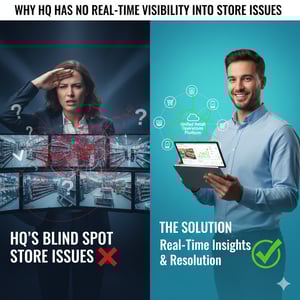
Your executive dashboard shows green across the board. Sales are up. Inventory levels look healthy. Customer satisfaction scores meet targets.
Meanwhile, at Store 47, the HVAC system has been broken for a week. Customers are walking out due to the heat. Staff morale has cratered. The situation has cost you thousands in lost sales. But you will not know any of this until the monthly report lands, by which time the damage is done.
This is the reality for most retail executives. They have plenty of data but almost no real-time visibility into what actually happens on the shop floor.
The illusion of data
Modern retail generates enormous amounts of information. Point-of-sale systems track every transaction. Inventory management software monitors stock levels. Customer feedback platforms collect reviews and ratings. Workforce management systems log schedules and attendance.
Yet with all this data, most headquarters teams remain surprisingly blind to operational reality. The National Retail Federation consistently finds that retailers with connected systems, real-time retail visibility, and data-driven decision-making outperform peers in both profitability and customer loyalty. But achieving that connectivity proves elusive for most.
The problem is not data scarcity. It is data latency. By the time information reaches decision-makers, it is already history. And in retail, history offers cold comfort when problems are happening right now.
The reporting gap
Consider how information typically flows from stores to headquarters.
A store manager notices a problem on Monday. They mention it to the district manager during a scheduled call on Wednesday. The district manager includes it in their weekly report on Friday. Regional leadership reviews reports the following Monday. By the time the issue reaches someone with authority to act, two weeks have passed.
For urgent issues, this timeline compresses through phone calls and escalations. But urgent issues represent a fraction of operational problems. The chronic issues that slowly erode performance rarely feel urgent enough to warrant escalation. They accumulate quietly until they become crises.
Research shows that when retail chains rely on store managers to supply performance data, the information can be inconsistent and unreliable. Incomplete data submissions, delays, and human error make tracking trends virtually impossible. Reporting disparities obscure insights about underperforming locations, and decision-making stalls because leaders spend time cleaning or validating data instead of taking strategic action.
What stores know that HQ does not
Walk into any retail store and spend an hour observing. You will witness dozens of small issues that never appear in reports:
A display fixture that fell last week and was never properly repaired. A pricing discrepancy between the shelf tag and the register. A receiving door that sticks, adding 20 minutes to every delivery. Employee workarounds that technically violate policy but keep things running. Customer complaints that never get formally documented.
These details matter. Individually, each represents a minor inefficiency. Collectively, they determine whether a store thrives or struggles.
But headquarters has no mechanism to capture this reality. Store issue tracking systems, when they exist, typically handle only formal problems that require capital expenditure or outside services. The everyday operational friction that defines store experience remains invisible.
The cost of delayed information
Late information is not just inconvenient. It is expensive.
When retailers lack real-time retail visibility, problems compound before anyone can intervene. A merchandising error that could be fixed in an hour on Day 1 becomes a week-long project by Day 7 as inventory accumulates, displays need rebuilding, and staff need retraining.
Gartner notes that merchandising is moving from retrospective analysis toward real-time decision-making. Retail organizations are transitioning from traditional Business Intelligence to AI-driven analytics that continuously optimize stock levels, assortments, and product bundling for specific store locations. Those that succeed gain competitive advantage. Those that remain stuck in batch reporting fall behind.
The pattern extends beyond merchandising. Labor scheduling, promotional execution, maintenance response, customer service recovery: every operational domain suffers when visibility is delayed.
Why technology alone has not solved this
Retailers have invested billions in technology over the past two decades. Enterprise resource planning systems, business intelligence platforms, customer relationship management tools, workforce management applications. Yet real-time visibility remains elusive.
The problem stems from how these systems were designed. Most enterprise retail technology focuses on transactions and outcomes. It captures what happened: sales completed, inventory moved, hours worked. It struggles to capture what is happening: emerging problems, operational friction, employee workarounds.
Additionally, many retailers still rely on periodic manual checks or point-of-sale data to infer operational status. This can lead to stockouts that go unnoticed for hours or days, phantom inventory where systems show product in stock but shelves are actually empty, and decisions based on outdated or inaccurate information.
The technology exists to provide real-time insight. But deploying it requires rethinking how stores and headquarters communicate, not just upgrading existing systems.
Building genuine visibility
Creating real-time retail visibility requires addressing multiple gaps simultaneously.
Observation systems. How do you capture what is happening on the store floor? Options include mobile reporting apps, IoT sensors, camera-based AI, and digital checklists. The right mix depends on what you need to see and how much friction stores can tolerate.
Communication channels. How does information flow from observation to decision-makers? Traditional hierarchies create bottlenecks. Modern approaches route information directly to those who can act on it.
Decision frameworks. Who has authority to act on what information? Real-time data overwhelms organizations that require every decision to climb the hierarchy.
Feedback loops. How do actions taken flow back to stores? Visibility must be bidirectional. Stores need to know that headquarters received their input and what happened next.
Research consistently shows that retailers with connected systems perform better. But connection requires more than technology. It requires new operating models that match the speed of available information.
How Kissflow helps
Kissflow enables retail organizations to build the store issue tracking and communication workflows that create real-time visibility without complex IT projects. Store managers report issues via mobile in seconds. Information routes automatically to the right people. Status updates flow back to stores. Dashboards show executives what is happening across the entire network right now.
With Kissflow's no-code platform, you design the workflows that match your operations rather than forcing your operations to match rigid software. Whether you need maintenance tracking, compliance reporting, operational checklists, or custom processes unique to your business, Kissflow provides the foundation for genuine real-time retail visibility.
Kissflow's no-code platform enables teams to build real-time dashboards using no-code tools. This gives leadership immediate visibility into retail operations.
Retail leaders struggle when decisions rely on delayed data. A real-time retail operations visibility platform delivers instant insights across stores.
Related Articles: