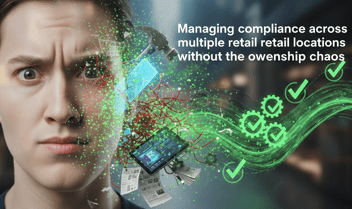
Every new store location represents new compliance exposure. Different states have different labor laws. Different municipalities have different permit requirements. Different regions have different data privacy regulations. For retailers focused on the urgency of expansion, these compliance challenges during retail expansion often fade into the background until something goes wrong.
The problem with expansion compliance risk is that it accumulates silently. One store with an incomplete I-9 file seems manageable. Ten stores with inconsistent food safety documentation starts to feel concerning. Fifty stores with varying levels of compliance across multiple regulatory domains becomes a material liability that could threaten the business.
Why compliance gaps multiply during rapid growth
When retailers operate a handful of locations, compliance often relies on experienced managers who know the requirements and handle them appropriately. As the store count grows, this institutional knowledge gets stretched thin. New store managers may not have the same depth of understanding. Regional oversight becomes harder to maintain. The processes that worked for five stores fail at fifty.
Research shows that 85 percent of companies say compliance has become more complex in the past three years. For expanding retailers, this complexity multiplies across every new jurisdiction entered. Each state, each city, each regulatory body adds layers to what is already a challenging compliance landscape.
The scalable compliance challenge
Building scalable compliance means creating systems that maintain consistency regardless of how many locations you operate. This is fundamentally different from the compliance approaches that work for small operations. Instead of relying on individual judgment and experience, scalable compliance requires documented processes, automated tracking, and systematic auditing.
Most retailers discover their compliance gaps reactively. An audit reveals incomplete documentation. A lawsuit exposes inconsistent practices. A regulatory fine highlights systematic failures. By the time these issues surface, they have often been accumulating across the organization for months or years.
The documentation dilemma
Compliance is not just about doing the right things. It is about proving you did the right things. This requires documentation that captures what was done, when it was done, and who did it. For expanding retailers, maintaining consistent documentation standards across dozens or hundreds of locations is a significant operational challenge.
According to compliance research, only half of organizations perform ongoing risk management and monitor compliance consistently, while just 33 percent address risks associated with new technologies and processes. For retailers adding new locations, this documentation gap creates exposure that grows with each expansion.
The true cost of expansion compliance risk
Non-compliance is expensive, and the costs go far beyond regulatory fines. The global average cost of a data breach reached $4.88 million in 2024, a ten percent increase over the previous year. Retailers handling payment card data face PCI DSS requirements with fines ranging from $5,000 to $100,000 per month for non-compliance. State privacy laws like CCPA can impose penalties of up to $7,500 per violation.
Companies with significant compliance issues end up losing more than 50 percent more from data breaches than companies with fewer compliance problems. Non-compliance with data privacy regulations costs organizations 2.71 times more in the long run. These are not abstract statistics. They represent real financial exposure that expands with every new location opened.
Beyond financial penalties
The costs of compliance failures extend beyond fines and penalties. Regulatory investigations consume management attention. Legal defense drains resources. Remediation efforts disrupt operations. And reputational damage can affect customer trust and investor confidence in ways that persist long after the immediate crisis passes.
According to McKinsey research, only 18 percent of consumers trust retail companies with their data, significantly lower than healthcare and financial services. In an environment where consumer trust is already fragile, compliance failures can accelerate the erosion of customer relationships that are essential for sustainable growth.
Building compliance into expansion processes
The compliance challenges during retail expansion cannot be solved by hiring more compliance staff or conducting more audits. These approaches do not scale. What scales is building compliance requirements directly into operational workflows so that the right things happen automatically as a byproduct of normal operations.
This means creating systematic processes where new store openings cannot proceed without required compliance steps being completed. Where documentation is captured as part of task completion rather than as a separate administrative burden. Where compliance status is visible in real time rather than discovered through periodic audits.
Compliance by design
Scalable compliance works best when it is designed into processes from the beginning rather than bolted on afterward. When a store opening workflow includes automatic permit verification, required certification uploads, and mandatory sign offs before proceeding to next phases, compliance becomes part of execution rather than a parallel track that teams might neglect under pressure.
Organizations using security automation extensively report $1.9 million lower data breach costs on average. The same principle applies to operational compliance. Systems that automate compliance checks, capture required documentation, and flag gaps before they become violations fundamentally change the risk profile of expansion.
Creating audit ready operations
When compliance is built into workflows, organizations become audit ready by default. Every completed task creates a record. Every approval captures who authorized what and when. Every document upload is timestamped and attributed. This audit trail exists not as a separate compliance exercise but as a natural output of doing business.
For growing retailers, this capability becomes increasingly valuable. Instead of scrambling to compile documentation when auditors arrive, you can produce complete records instantly. Instead of wondering whether a particular location followed required procedures, you can verify compliance systematically across the entire organization.
How Kissflow enables scalable compliance for retail expansion
Kissflow's no-code and low-code platform allows retailers to build expansion compliance risk management directly into their operational processes. Compliance teams can design workflows that embed required checks, documentation, and approvals without creating separate compliance procedures that add burden and get bypassed under pressure.
With Kissflow's workflow capabilities, retailers create standardized expansion templates that enforce compliance requirements automatically. Tasks cannot advance without required documentation. Approvals route to appropriate parties with full audit trails. Dashboards show compliance status across all locations in real time. And because business users can configure workflows directly, compliance processes can evolve as regulations change without requiring development resources.
The result is scalable compliance that grows with your organization, protecting the business from expansion compliance risk while enabling the speed of execution that competitive markets demand.
Kissflow's no-code platform enables compliance workflows to scale with expansion—without custom builds. Business teams stay in control.
Rapid retail expansion amplifies compliance risks across regions. A retail expansion compliance platform embeds governance into growth.
Frequently Asked Questions
1) Why does retail expansion increase compliance risk?
Each new store adds exposure to local labor laws, permits, health and safety rules, and data privacy regulations. As locations grow, oversight weakens and inconsistencies multiply, creating hidden risk.
2) What are common compliance gaps during retail expansion?
Incomplete employee documentation, missing permits, inconsistent food safety records, unverified certifications, outdated privacy disclosures, and undocumented approvals across locations.
3) Why do compliance issues often go unnoticed until audits or fines?
Because compliance gaps accumulate gradually. Individual issues seem manageable, but across dozens of locations they become systemic and surface only during audits, lawsuits, or regulatory investigations.
4) Why don’t traditional compliance audits scale with growth?
Audits are reactive and periodic. They detect problems after violations occur rather than preventing them, and they require manual effort that increases linearly with store count.
5) What is scalable compliance in retail operations?
Scalable compliance replaces individual judgment with documented processes, automated checks, standardized approvals, and consistent documentation that works regardless of store count or geography.
6) How can compliance be embedded into store opening workflows?
By making permits, certifications, policy acknowledgements, and documentation mandatory steps that must be completed before workflows can advance to the next phase.
7) How does workflow automation reduce expansion compliance risk?
Automation enforces required steps, captures audit trails automatically, flags gaps in real time, and ensures compliance happens as part of execution—not as an afterthought.
8) What does “audit-ready operations” mean for retailers?
It means every task, approval, and document is automatically recorded, timestamped, and attributable—so compliance evidence is always available without last-minute scrambling.
9) What are the non-financial risks of compliance failure?
Operational disruption, leadership distraction, remediation costs, strained vendor relationships, reputational damage, and loss of customer and investor trust.
10) How does Kissflow support compliance during retail expansion?
Kissflow enables retailers to design workflows that enforce compliance checks, capture documentation, route approvals, and provide real-time visibility—creating scalable, audit-ready expansion processes.
Related Topics: